The big idea: Your Capstone is a 15 to 20 minute story of how your team got from people’s needs to a tested prototype, and your summer plan is the commitment that keeps that prototype moving into BUAD 497.
In 60 seconds
- The Capstone is a 15 to 20 minute team story from people’s needs to a tested prototype.
- Show the prototype, the testing and what changed, in more formats than slides.
- A summer plan with a meeting rhythm, measurable goals and named stakeholders carries the project into BUAD 497.
Do this: budget your Capstone to 15 to 20 minutes, rehearse it to the clock, and email your team a summer plan before Class 14 ends.
How the Capstone presentation works

How the Capstone presentation works
Your Capstone is the story of how you got to a tested prototype.
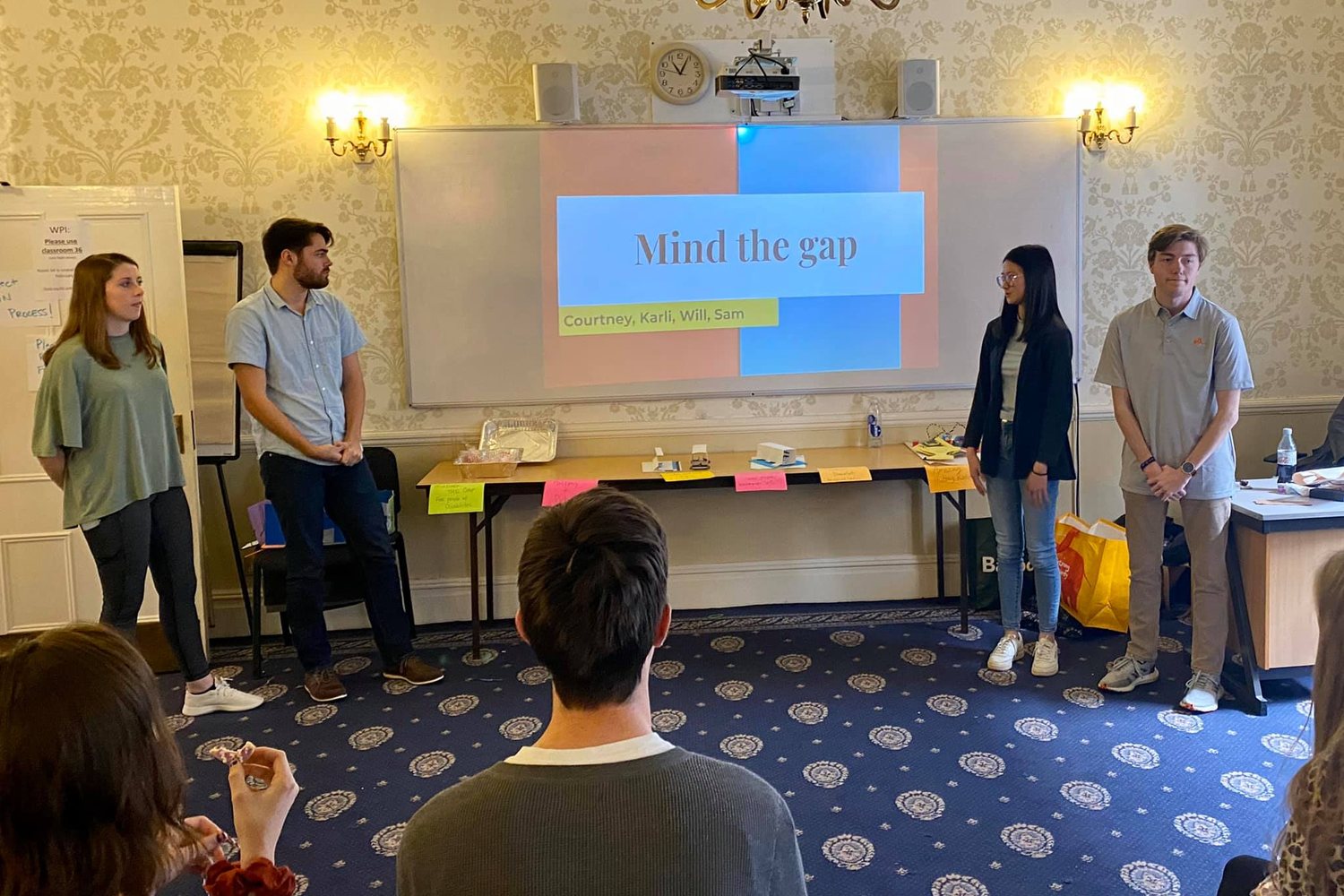
In Class 14 your prototype team presents its Capstone: a 15 to 20 minute story of how you got from people’s needs to a tested prototype, and why we should believe in it. It is also the first draft of the story you will tell all through senior year.
Where the Capstone fits
Your Capstone tells the story of the whole curve.
Text version of this diagram
- Inspiration: the curve opens wide (diverge) as you learn from people, then narrows (converge) on what you learned.
- Ideation: it opens again (diverge) into many ideas, then narrows (converge) toward a few prototypes.
- Implementation: it keeps narrowing as you iterate, run a live prototype and pilot.
- This page sits in Implementation. Your Capstone tells the story of the whole curve.
The time box
Twenty minutes, tops. Rehearse with a timer.
Text version of this diagram
15 to 20 minutes, in class, as a team. Rehearse with a timer. Going long means cutting your strongest evidence on the fly.
Be creative
Some slides are fine. Make us believers.
The outline does not have to run in order or in formal sections. Open with a video and follow with a few slides, build a mural and talk through it, act out the experience, even write a song.
The whole semester on one slide
Every step you took is part of the story.
Text version of this diagram
- Inspiration (diverge, then converge): frame your design challenge; research with people, experts, immersion, analogous inspiration, extremes and mainstreams, and interview techniques; create a plan; field research.
- Ideation (diverge, then converge): synthesis (download your learnings, find themes and insights, craft HMW questions); brainstorming (brainstorming rules, top ideas); prototyping (storyboard, rapid prototyping, test and get feedback, integrate feedback and iterate).
- Implementation (keeps narrowing): keep iterating, live prototyping, pilot.
Use the full map to pick the moments your Capstone tells. You do not need all of them. You need the ones that explain your prototype.
The Capstone outline
Ten parts, each drawn from work you already did.
What to cover in each part, and where it comes from
| Part | What to cover | Draw on |
|---|---|---|
| Working title and team | A clear, engaging project name and every team member. | Your prototype team |
| Genesis | How did you get here? What prompted this prototype idea? | Part A interviews, Part B brainstorm |
| Ideal customer | Who is it for? Be specific about the person and the moment. | Part A, need finding, jobs to be done |
| What makes it unique | How it differs from what people use or do today. | Secondary research, Part A |
| Desirable, feasible, viable | Evidence for each lens, and sustainable too if it fits. | Part D lens notes |
| Your prototype | Briefly introduce it. Show it if you can. | Part C |
| Research, findings, testing and iterations | A short overview: who you heard from, what you learned, how each version changed. | Parts A to D |
| Spreading the word | How will people find out about your idea? | Findable pillar, feedback interviews |
| The experience | Take us inside it: what will the user think, feel and see? | Empathy map, Part D observations |
| Early business case | First ideas on value, cost and who pays. Optional to perfect, useful to start. | Viable lens, expert interviews |
Questions your audience will ask
Sell us on why we should invest.
The original Capstone brief frames the presentation as a pitch. Each part of your outline answers one of these questions.
GenesisQ1
“How did you get here?”
ChallengeQ2
“How does this idea address our design challenge?”
CustomerQ3
“Who is your ideal customer?”
UniqueQ4
“What makes it unique?”
LensesQ5
“How is it desirable, feasible and viable?”
SpreadQ6
“How will people find out about it?”
More: what makes an audience believe
Take us into the experience: help us understand what the customer will think, feel and see. Bring energy and excitement around your idea. Video, strong visuals, music or acting it out all work; some slides are fine. A business case is a bonus, not a requirement.
Evidence
Show the evidence you have. Plan for the evidence you need.
Text version of this diagram
- What you have so far. The syllabus also asks you to share the relevant, credible evidence you have so far
- What you still need, and how you plan to find the additional evidence the senior project will need.
Your summer plan answers the second half.

Story craft lives elsewhere
Need story arcs and hooks? Two pages cover them.
For story arcs, opening hooks and pitching under time pressure, use Storytelling and the Final Presentation (IB 407) and Pitching Your Prototype (BUAD 497).
This page covers what the BUAD 317 Capstone asks for and what comes next.
This or that
Capstone Slide Face Off
In each round, pick the Capstone move that makes the class believe in your tested prototype in 15 to 20 minutes.
Try it: Capstone and Summer Planner
Tool · BUAD 317
Capstone and Summer Planner
Budget your 15 to 20 minute Capstone, pick how you will show each part, then commit to a summer plan.
- 1Time it
- 2Plan summer
- 3Share
Your Capstone
All checks
Put it to work: Deliverable #4 and your summer plan
Deliverable #4, the Capstone presentation, is a team grade presented in Class 14. Your summer project plan goes with it. Use Class 13 and the week after to build both.
Gather your evidence
Pull together the best of Parts A to D: two or three exact quotes, the number of people you heard from, photos of each prototype version and the change each round of feedback produced.
Your deliverable: an evidence folder your whole team can reach.
Budget the time
Give every part of the outline its minutes, so the total lands between 15 and 20. Protect time for research, testing and iterations, and for the user’s experience.
Your deliverable: a run of show from the Capstone and Summer Planner above.
Choose how you will show each part
Mix formats. Demo the prototype live, act out the experience, play a short video, or build a mural. Use slides where they help, not everywhere.
Your deliverable: slides or a poster built on the ten-part template, plus any video, prop or script.
Rehearse to the clock
Run it at least twice with a timer, once in front of another team. Ask them to retell your story in one sentence. If they cannot, simplify.
Your deliverable: a tight 15 to 20 minute talk with clear handoffs between speakers.
Present your Capstone
Tell one user’s story, show the prototype, say what worked and what did not, and say what evidence you still need.
Your deliverable: D#4, presented in Class 14.
Commit to the summer plan
Before the team scatters, agree on meeting rhythm, summer and fall prototype goals and the stakeholders you will speak with. Email it to everyone.
Your deliverable: your HCD project plan, the baseline for your fall update in BUAD 497.
Complete your team evaluation
On your own, rate each teammate on the five criteria and estimate your hours.
Your deliverable: D#5, confidential and individual.
Example: a hospital discharge teamA made-up 18-minute run of show
Project. “Home Ready”: a bedside teach-back conversation and a one-page going-home card for family caregivers taking an older parent home.
- Genesis, 2 minutes, told as a story. A daughter from the Part A interviews left the hospital with a thick folder and no idea what mattered that night.
- Customer and uniqueness, 2.5 minutes. First-time family caregivers. It teaches at the bedside instead of adding more paper.
- Lenses, 2 minutes. Most caregivers in feedback interviews asked for it (desirable). Nurses can run it in about ten minutes (feasible). Fewer follow-up calls (viable). One shared file each unit reprints (sustainable).
- Prototype, 3 minutes, live demo. Two teammates run the teach-back with the card.
- Research and iterations, 4 minutes. Street interviews, feedback interviews and three versions of the card, each change tied to a quote.
- The experience, 2 minutes, role play. The night before discharge: what the daughter thinks, feels and sees.
- Spreading the word and business case, 2 minutes. Nurses introduce it at admission. Early cost and savings ideas.
Summer plan. Video call every other Sunday. Test version four with five more caregivers and two discharge nurses. Speak with a nurse manager, a patient education specialist and a pharmacist.
Do this, not thatWhat separates a strong Capstone
Do this
- Open with one real person’s moment.
- Show the prototype itself.
- Say what did not work and what you changed.
- Back each lens with evidence.
- Finish inside 20 minutes.
- Leave with a summer plan everyone agreed to.
Not that
- Opening with your topic and team logo for three minutes.
- A screenshot of the prototype on slide twelve.
- Presenting only the successes.
- “People liked it” as your desirability proof.
- Reading dense slides word for word.
- “We’ll figure out summer later.”
Before you presentA final check for D#4 and your summer plan
- [ ] Our talk runs 15 to 20 minutes in rehearsal.
- [ ] Every part of the outline appears somewhere, in whatever order works.
- [ ] The class will see, hold or watch the prototype, not just a picture of it.
- [ ] We share who we heard from, what we learned and how the prototype changed.
- [ ] We name evidence for desirable, feasible and viable, and sustainable if it fits.
- [ ] We take the audience into one user’s experience: think, feel, see.
- [ ] We say what evidence we still need and how we will get it.
- [ ] Our summer plan names a meeting rhythm, measurable goals and stakeholders by role.
- [ ] No participant names or identifying photos appear without permission.
Go deeper
Methods and resources
Related topics
BUAD 317 is taught by Lane Morris, PhD and Jules Morris, PhD.
Unlock this topic
Do the work, earn the stop
Finish each step on this page to unlock the button that adds this topic to your research trail.
Back to all BUAD 317 topics · Next: The Summer Plan and BUAD 497
In-class team activity · 25 min
Twenty Minutes and a Summer
By the end: A timed run of show for your Capstone, one rehearsed experience moment tested on another team, and a summer plan your whole prototype team agrees to. Your instructor will give you the password in class.
Part of BUAD 317, taught by Lane Morris, PhD and Jules Morris, PhD, in the Smith GLS human-centered leadership program, toward the Human Centered Consulting Certificate.
Frequently asked questions
How long is the BUAD 317 Capstone presentation?
The Capstone presentation, Deliverable #4, runs 15 to 20 minutes and is given by your prototype team in Class 14. Rehearse with a timer at least twice. If a run goes long, cut the parts that explain your process before you cut the prototype demo, the testing story or the user's experience.
What should a capstone prototype presentation include?
Cover your working title and team, how you got to the idea, your ideal customer, what makes it unique, how it is desirable, feasible and viable (sustainable too if it fits), the prototype, your research, testing and iterations, how people will hear about it, the user's experience and early business case ideas. The order and format are up to you.
Can our Capstone use something other than slides?
Yes. The brief encourages creativity: open with a video, build a mural and talk through it, act out the user's experience or even perform a song. Some slides are fine. The goal is to make the audience believe in the idea, so show the prototype itself and take them inside the experience.
What goes in the summer project plan?
Your prototype team agrees on how you will work together (summer meeting goals and fall meetings besides class), a timeline for developing the prototype with summer and fall goals, and which key stakeholders you will speak with for more input. When fall semester starts, your team updates the class on how far the project has come.
How does BUAD 317 connect to the BUAD 497 technical report?
Your prototype team stays together for senior year. The 317 work feeds the 497 technical report: secondary research becomes the literature review, street interviews become the research approach, interpretation and brainstorming become the ideation section, and the prototype and feedback interviews become the testing and iteration sections. The ten-part slide template also becomes your EUReCA poster.