The big idea
Creative alliances run on bonds. Strengthen how people feel together, and what they do and achieve together follows.
In 60 seconds
- Creative alliances are the working space between you and me. Their strength is the top factor in reaching meaningful outcomes and change.
- Five bonds power them: Core Conditions (empathy, positive regard, congruence), Creative Climate, Positive Mindsets & Emotions, Character and Collaborative Partnerships.
- Bonds fuel co-creation (Understand, Dream, Experiment, Flourish), carried by communication, toward Excellence and six goals.
Do this: take the Bonds Check, pick the bond that needs you most, then run one real challenge through the Co-Creation Planner.
How creative alliances work

Operationalizing Human Centered Leadership I & II
Creative Alliances, put to work.
Part I: the bonds, how we feel together. Part II: the tasks, tools and goals, what we do and achieve together.Michael Lane Morris, PhD
Where we left off
The Decisive Advantage introduced the model. Now we put it to work.
Text version of this diagram
- In The Decisive Advantage we defined human-centered leadership, made the business case and introduced creative alliances: the working space between you and me, whose strength is the top factor in meaningful outcomes and change.
- Part I goes deep on the bonds, how we feel together: Core Conditions at the heart, with Creative Climate, Positive Mindsets and Emotions, Character and Collaborative Partnerships.
- Part II follows the bonds into Tasks and Tools, Change and Transitions, Communication and Goals.
Questions leaders bring us
What does this system answer?
Why do good people disengage, and how do we win them back?
Bonds
How do I build trust fast, and repair it when it breaks?
Core Conditions and alliance ruptures
How do we get better ideas from the people closest to the problem?
Co-creation
How do we lead through nonstop change without burning people out?
Change, transitions and Flourish
Why does what we say land differently than we meant?
Communication
How will we know it’s working?
Goals and Excellence

Every person is a walking story
Every person is a walking story and a walking experience.
This intersection, between your story and mine, is where flourishing happens.
A giftPeople’s stories and experiences are a gift. Treat them that way.
UnleashedHere, creativity and peak performance can be unleashed to shape our stories for the better.
Creative alliances are bona-adaptive transactions
Alliances help people bounce.
Alliances confront the change-resistance cycle.
Resilience: bounce back
- Restore equilibrium
- Return to the status quo
- Constructively relieve distress
Anti-fragility: bounce forward
- Use disequilibrium to be creative
- Discover new opportunities and solutions
- Move the system toward the goals and Excellence
The change-resistance cycle
Change without alliances becomes a loop.
Text version of this diagram
- Constant change: nonstop transformations.
- Stress and negative emotions: people feel the strain.
- Less willing to change: reduced willingness to try new behaviors and adapt, so the next change lands even harder, and the loop repeats.
- Creative alliances break the loop by keeping people connected, heard and part of the solution, relieving distress so people bounce back, and forward.

Creative alliances unleash creative capacity
The people with the challenge have the ideas.
In a flourishing system, we believe the things that matter can be created, changed and improved.
Challenges need solutionsAnd they have them.
Start with the peopleThose living the challenge hold ideas and answers.
Creative alliances are NOT…
Alliances are not a free pass.
These factors did not matter:
Entitlement programsFor people unwilling to align with the organization’s goalsFor people unwilling to be accountableFor people unwilling to adaptQuick fixesEasy answers to adaptive challenges
Alliances are also not a fix for organizations that are broken; the myth of dysfunction says otherwise.

Alliance ruptures
Repair the relationship early.
An alliance rupture is a dip in the strength or quality of the relationship. Big gaps between how leaders and employees see things can signal, or cause, a rupture.
The first 60 secondsStart building the alliance at the first touchpoint.
No surprisePeople leave bad managers.
RepairRuptures are normal. Repairing them is how alliances get stronger.
Bonds defined
How Lane’s bonds map to the new model.
| Lane’s bond competency | In the Creative Alliances System |
|---|---|
| Connection: empathy and compassion, positive regard, congruence | Core Conditions |
| Chemistry: positive resonance; Climate: psychological safety | Creative Climate |
| Positive Mindsets: the catalysts | Positive Mindsets & Emotions |
| Character: inspiring trust in times of imperfection | Character |
| Cohesion: common plus unity in purpose and plan | Collaborative Partnerships |
| Capacity Development: meaning and purpose, growth, well-being | Flourish, in Tasks & Tools |
| Communication: casual learning conversations | Communication, the bridge across the model |
Part I · Bonds
Bond: Core Conditions
Core Conditions sit at the heart of every bond.
Empathy and compassion, unconditional positive regard, congruence and creative leadership self-efficacy. The glue and the accelerant.
Connection
the energy that exists between people when they feel seen, heard, and valued; when they can give and receive without judgment; and when they derive sustenance and strength from the relationship.
Brené BrownThe Gifts of Imperfection (2010)
Connections are person-centered attachments
How we attach shapes how we show up.
| Attachment | What it drives |
|---|---|
| Security | Confidence |
| Anxiousness | Insecurity |
| Ambivalence | Fearfulness |
| Avoidance | Dismissiveness |
Congruence: authenticity and genuineness
Being real.
Fully here, right now, without a mask, facade or false front.
The inner person matches the outer person
Unconditional positive regard
Accept people as they are, not when they are.
Mattering and belonging: people feel they count, and that they belong here.
- Genuine, non-possessive caringLiking people and wanting good for them, not harm.
- Free of prejudice and judgmentRespect for dignity and worth.
- Contribution over fitThe focus is what someone adds, not whether they fit.
- Belief in changePeople can learn, grow, improve and change.
Read more: How to Make Employees Feel Connected at Work (opens in a new tab)
Empathy and compassion: the most important leadership skill
Being understood is the most basic human need.
Experiences of empathy and compassion rest on a common humanity: recognizing humanity in another is acknowledging them as equal to the self.
Empathy
- Imaginative participation: crawling into the psychological space of others
- Understanding another person’s thoughts, feelings and experiences from their point of view, rather than your own
Compassion
- Empathy in action
- Learning to comprehend the “human half” of challenges and problems in order to act
- The most effective human agency known
Empathy: cornerstone of human-centered leadership
Awareness of other people’s perspectives builds stronger solutions together.
Bone-deep.
Empathy is uniquely human.
What makes people tick?Empathy helps us learn what is going on in their minds, and the story of why: the purpose a person has for doing something.
Self and other, unitedEmpathy turns what we observe in another person into a response within ourselves, a process that at least temporarily unites two separate people.
A word study
Empathy means feeling into.
Einfühlung
German
“Feeling into”: ein = in, fühlung = feeling.
En-pathos
Greek
In feeling, or in suffering.
Splagchnizomai
Koine Greek
To be moved in the inward parts; the bowels yearned. Compassion felt in the gut.
The empathy deficit
We should talk more about our empathy deficit—the ability to put ourselves in someone else’s shoes; to see the world through the eyes of those who are different from us.
Barack ObamaCommencement address, Northwestern University, 2006
Many definitions of empathy and compassion
Every definition ends in action.
- More than an emotion: a felt and enacted desire to alleviate suffering.
- Central to human well-being, for those who provide it and those who receive it.
- Noticing and responding to the individual experiences of another.
- The ability to experience and relate to the thoughts, emotions and experiences of others, in order to act.
- The capacity to understand others’ behavior, experience their feelings, and express that understanding by acting on their behalf.
- Built through a willingness to take time to discover the deep-down thoughts and reactions that make another person tick.
- Purposely setting out to comprehend another person’s cognitive and affective state in order to respond.
Empathy: four components (Janice Morse)
Head, heart, hands and honor.
Cognitive
Head: noticing with the intention of comprehending
The ability to intellectually understand another person’s perspective.
- Deliberate perspective-taking
- See the world through their eyes
- Consider the forces acting on them
Affective
Heart: feeling with the intention of acting
The ability to subjectively perceive another person’s feelings.
- Emotional mirroring and resonance
- An other-oriented emotional response
Behavioral
Hands: responding with the intention of changing
The ability to communicate empathic understanding and concern.
- Empathizing is a verb
- Listen for the “song beneath the words”
Ethical
Honor code: acting with character
An innate ability or empathic disposition.
- The bedrock of human morality
- Relieve suffering for their sake, not your gain
Empathy lets us project ourselves into another’s shoes and experience the world from their perspective, without losing ourselves (agency) or our pathways to our goals, in order to act on the challenges they experience. Compassion is empathy in action.
Janice M. Morse and colleagues (1992), nursing scholarship on the multidimensional nature of empathy; head, heart, hands and honor-code framing by Michael Lane Morris.
Meanwhile, on the farm
Empathy starts with asking.
Text version of this diagram
- Panel 1: the Highland coo boss tells the Nubian goat, I know exactly how you feel.
- Panel 2: arms crossed, she says, you haven’t asked how I feel.
- Panel 3: he sits down across from her: fair, tell me what it’s like.
Watch: empathy at Cleveland Clinic
What would you see if you could stand in someone else’s shoes?
Cleveland Clinic’s short film imagines the thoughts and feelings of the patients, families and staff walking its halls. Watch it, then talk about what you would see in your own workplace.
Empathy runs through leadership theory
Empathy is the common thread.
Text version of this diagram
- Servant leadership, Robert Greenleaf (1970).
- Transformational leadership, Bernard Bass (1985).
- On Becoming a Leader, Warren Bennis (1989).
- Emotional intelligence, Daniel Goleman (1995).
- Authentic leadership, Walumbwa, Avolio, Gardner, Wernsing and Peterson (2008).
- Compassionate leadership, Shuck, Alagaraja and Immekus (2019).
- Ken Blanchard’s people-centered leadership belongs on this list too.

Fostering emotional resonance
Empathy is a skill, not an innate talent.
EssentialEmpathy and compassion are core mechanisms of human-centered leadership.
Cultivate itUnless we cultivate them, we tend to stay at the same level all our lives.
Built inWe have a natural predisposition toward empathy, care and compassion.
TeachableThey are not fixed traits. They can be taught and learned.
Demonstrating empathy and compassion
Employees expect it. Leaders struggle with it.
31% of leaders feel very confident knowing when to show empathy versus compassion.
60%+ of leaders say showing empathy and compassion adds stress to their role.
Harvard Business Impact (2025). Leadership fitness: the path to developing human-centered leaders who drive employee fulfillment. Survey of 3,400+ employees in 11 countries. Nearly a third (32%) say their manager fails to meet expectations for both.
Design-led companies win
Empathy-led design outperforms the market.
211%
Over 10 years, design-led companies, built on empathy for the people they serve, outperformed the S&P 500 by 211%.
32 pts faster revenue growth for top-quartile design performers over five years
56 pts higher total returns to shareholders over the same period
Design Management Institute, 2015 Design Value Index; McKinsey & Company (2018), The business value of design.
HCL’s empathy- and compassion-driven profit chain
People first, then profit.
Text version of this diagram
- People first leads to a culture of empathy and compassion, the secret sauce.
- People feel valued, that they matter and belong, which strengthens intrinsic motivation.
- Deeper meaning, impact, growth and fulfillment drive engagement and discretionary effort.
- That shows up in customer service, customer satisfaction and loyalty, and sustainable profits.
Empathy pays off
Empathic leaders get more from people.
Text version of this diagram
- Employees with highly empathic senior leaders: 61% often or always innovative, vs. 13% with less empathic leaders (Catalyst, 2021).
- Engaged: 76% vs. 32% (Catalyst, 2021).
- Call their workplace toxic: 14% at empathetic organizations vs. 45% at unempathetic ones (Businessolver, 2025).
Empathy and compassion: the business case
Mutual empathy pays, if it’s real.
52%
of U.S. workers believe their company’s empathy efforts are dishonest, up from 46% in 2021.
- 88% say mutual empathy increases efficiency
- 87% say it increases creativity
- 86% say empathetic leadership boosts morale
Congruence matters: empathy only pays when people believe it.
EY US Consulting (2023, March 30). New EY US Consulting study, 1,012 U.S. workers. The grid shows 52 of 100.
What empathetic leaders do
Openness tops the list.
Text version of this diagram
- Top qualities of an empathetic senior leader: open and transparent (41%), fair (37%), follows through on actions (37%), encourages others to share opinions (36%), and trusted to handle difficult conversations (34%).
- 89% say empathetic leadership creates better leaders, 88% say it inspires positive change, and 87% say it builds trust between employees and leaders.
Creative leadership self-efficacy
From being the source of creative answers to enabling others to create answers together.
The central shift, and the backbone of human-centered leadership.
Creative leadership self-efficacy
Leadership is not simply what a leader accomplishes through people, but what people become capable of accomplishing because of that leader.
Michael Lane Morris and Jules MorrisCreative Leadership Self-Efficacy
The integrated proposition
Belief becomes process becomes outcome.
- BeliefI’m creative, and I can enable creative action in others.
- ProcessInspire, mobilize and co-create.
- OutcomeTackle tough challenges and do things that matter.
From self-efficacy to creative leadership agency
Three beliefs, each bigger than the last.
Text version of this diagram
- Self-efficacy (Albert Bandura): belief in my capability to organize and carry out the actions needed to reach an outcome.
- Creative self-efficacy (Tierney and Farmer, 2002): belief in my ability to produce creative outcomes and solve problems creatively.
- Creative leadership self-efficacy (proposed): belief in my ability to enable creativity in others and mobilize collective creative action.
- Individual capability, then individual creative agency, then confidence to cultivate collective creative agency.
The process of inspiring and mobilizing people to co-creatively tackle tough challenges and do things that matter.
Creative leadership self-efficacy, defined
A leader’s belief in their capacity to inspire and mobilize creativity, within themselves and others,
to understand complex human challenges, imagine new possibilities, experiment with solutions, and bring about meaningful, positive change.
Four defining characteristics
What the belief entails.
- RelationalCreative outcomes emerge through human interaction. It’s a team sport, not solely individual ability.
- GenerativeThe leader grows creative confidence and capability in other people.
- AdaptiveThe leader enables improvisation, experimentation, learning and constructive responses to uncertainty.
- PurposefulCreativity advances human experiences, capabilities and well-being, not novelty alone.
How creative leaders think
Six beliefs that switch it on.
People are capable Creative potential is distributed, not reserved for a few experts.
Curiosity before certainty Listen deeply, question assumptions and explore multiple perspectives.
With people, not to people Solutions improve when those affected help shape them.
Safe-to-learn experimentation Uncertainty, feedback and setbacks are chances to learn.
Agency grows through practice Leaders can strengthen others’ confidence and creative capability.
Meaning matters Creative action should advance contribution, growth, well-being and flourishing.
Six ways it enables human-centered leadership
Confidence that turns into capability.
- Discover people’s needsLead with empathy and insight.
- Reframe the possibleChallenge assumptions; imagine better futures.
- Unlock collective creativityMobilize diverse perspectives and shared agency.
- Make it safe to contributeTrust, candor and room for interpersonal risk.
- Turn ideas into learningPrototype, test, adapt and act amid uncertainty.
- Advance human flourishingConfidence, purpose, contribution and well-being.
Measuring it: six dimensions
A proposed 60-item scale.
Each is the confidence to do it. Ten items per dimension.
- Empathic discoveryUnderstand human experiences and uncover underlying needs.
- Creative reframingQuestion assumptions and redefine problems as creative opportunities.
- Collaborative creativityMobilize diverse people in shared ideation and co-creation.
- Psychological safetyCreate trust, candor, inclusion and constructive risk taking.
- Experimentation and adaptationPrototype, learn from feedback and adjust course.
- Human flourishingDevelop agency, meaningful contribution and well-being.
Foundations: Bandura (1997, 2006); Tierney & Farmer (2002); Edmondson (1999); human-centered design. The CLSE framework and scale are proposed and not yet validated.
Part I · Bonds
Bond: Creative Climate
Climate is the holding environment.
Trust, psychological safety, rapport and transparency, boosted by freedom, resources, recognition, playfulness and humor. Fuels Engagement and Experience.
Creative climate
What shapes the atmosphere.
Perceptions, policies, procedures, practices, benefits and rewards all send climate signals.
The interpersonal climate
- Trust
- Psychological safety
- Rapport
- Transparency
Boosters raise it
- Freedom and autonomy
- Challenging work
- Resources
- Supportive bosses and peers
- Recognition
- Playfulness and humor
Barriers drain it
- Time pressure
- Evaluation systems
- Status quo thinking
- Politics
Read more: What Kills Creativity at Work? (opens in a new tab)
Psychological safety
A shared belief that the team is safe for interpersonal risk taking.
Amy Edmondson (1999). In Lane’s words: you can share thoughts, feelings, opinions and ideas freely, speak up and speak out, without fear of punishment, humiliation, shame or embarrassment.
Psychological safety: the evidence
Safety drives learning and performance.
Text version of this diagram
- A meta-analysis of the research finds psychological safety correlates with learning behavior at 0.62, engagement at 0.45 and task performance at 0.43. In this research, 0.5 or more counts as a large effect.
- Yet only 43% of employees report a positive team climate (McKinsey, 2021). Consultative, supportive leadership predicts psychological safety.
The four stages of psychological safety
Each stage earns more respect and more permission.
Text version of this diagram
- Timothy R. Clark’s model climbs from exclusion to innovation as respect and permission grow.
- Stage 1, inclusion safety: I belong. Stage 2, learner safety: I can learn and grow.
- Stage 3, contributor safety: I can make a difference. Stage 4, challenger safety: I can challenge the status quo, which opens the door to innovation.
Questions to ask your team
Safety or danger?
Psychological safety
- Are we comfortable admitting mistakes?
- Do we learn from failures?
- Are all ideas openly shared?
- Are we seeing better innovation and decisions?
Psychological danger
- Fear of mistakes
- Blaming others
- Sharing only views you know will be embraced
- The common-knowledge effect: only what everyone already knows gets discussed
Chemistry: resonating relationship dynamics
Be easy to find, ask and approach.
Positive resonance: reverberating, echoing, in sync
What do people need most from leaders?
Followers want hope first.
Text version of this diagram
- Asked to describe a leader who has a positive influence on their daily life, people around the world named hope most often: 56% of mentions.
- Trust followed at 33%, then compassion at 7% and stability at 4%.
Part I · Bonds
Bond: Positive Mindsets & Emotions
Positive mindsets are the catalysts.
Hope, optimism, gratitude and joy; growth, abundance, resilience and reframing. Fuels Efficacy and Expansion.
Positive mindsets are…
Mindsets can be learned.
- Not personalities or identitiesThey are not who you are.
- Habits of thinking and feelingVital attitudes, opinions, beliefs and perspectives that drive action.
- Fluid, not fixedThey shift with practice and context.
- LearnableThey can be developed, by you and by the people you lead.
Two ways to think about people
What you believe about people shows up in how you lead.
Theory X: people…
- Hate to work
- Must be closely monitored, forced, threatened or punished to meet goals
- Avoid responsibility
- Are motivated mainly by fear and money
- Have little ambition and just want to feel safe
Theory Y: people…
- Like to work
- Work toward goals that matter to them
- Seek responsibility and growth
- Can be creative, clever, innovative problem solvers
- Appreciate recognition and a wide variety of rewards
Douglas McGregor, The Human Side of Enterprise (1960).
Two mindsets
Business-centered vs. human-centered leadership.
| Business-centered leadership | Human-centered leadership | |
|---|---|---|
| Mindsets and attitudes | Confident, knowledgeable, decisive | Humble, empathetic, a listener; a growth and contribution mindset |
| Context | Structured, organized, stable, with clear goals and targets | Sees people, culture and growth as enduring and critical for success |
| Relationships | A means to an end; transactional | Essential to growth, innovation, well-being and doing good; transformational |
| Focus | Goals, rewards, incentives, alignment, hitting the numbers | Inspiration, skills, empowerment, connections, culture |
| Mistakes | Worries about errors, mistakes and failures | Creates a sense of safety for new ideas |
Mindsets matter
What we believe about ability shapes what we do next.
Entity theory: fixed
- You can’t really change how intelligent you are
- You’re born with a certain amount of empathy
- Setbacks lead to dead-end actions: revenge, retaliation, getting even, lost confidence
Incremental theory: growth
- You can change your basic abilities
- People can grow how much empathy they feel
- The developing leader looks inside, reframes and realigns, and uses the trigger to do something better
Carol Dweck, Mindset: The New Psychology of Success (2006); Dweck & Leggett (1988).
Building on mindsets
The mindsets of the Creative Alliances System.
Fueled by positive emotions: hope, optimism, gratitude and joy.
Growth
Over fixed.
Abundance
Over scarcity.
Resilience
And anti-fragility.
Ambigility
Embracing ambiguity and change.
Improvisation
Work with what shows up.
Reframing
See the problem a new way.
Generative
Create new possibilities.
Reflective
Step onto the balcony.
Part I · Bonds
Bond: Character
Character inspires trust in times of imperfection.
Honesty (tell the truth), integrity (do the right thing), humility and ethical judgment. Fuels Effectiveness.

The crucible moment
Leadership is an imperfect art and science.
People, including you, make mistakes. A leader’s crucible moment is how they function in those imperfect moments.
DNA or lip service?Are the leader’s espoused values and virtues part of who they are?
EngravedCharacter is the chiseled markings, stamp and engravings of who we are.
Character: values and virtues
Values are the why. Virtues are the how.
Values: inward
- Internal beliefs and personal principles that guide behavior and choices
- The why behind our actions
- Give direction and motivation
- Help us tell right from wrong and what truly matters
Virtues: outward
- The behaviors and qualities we strive to embody
- How we act in line with our values
- Character traits that promote well-being
- Actions that benefit self, others and society
Crucible of leadership: the trifecta
Three things earn trust.
Text version of this diagram
- When employees strongly agree their leaders do three things, 95% fully trust their leaders:
- 1. Communicate clearly.
- 2. Inspire confidence in the future.
- 3. Lead and support change.
Part I · Bonds
Bond: Collaborative Partnerships
Cohesion: common plus unity.
Common unity in purpose and plan: realistic expectations, shared responsibility, mutual feedback and mutual respect. Fuels Efficiency.
Collaborative partnerships
What turns a group into a partnership.
Realistic expectations Agreed up front.
Shared responsibility We own it together.
Mutual feedback It flows both ways.
Results orientation Focused on what we achieve.
Goal and task agreement Clear on what and who.
Reliable, healthy boundaries Predictable and respectful.
Mutual respect and autonomy Trusted to do the work.
Try it: the Bonds Check
Which bond needs you this week?
Below this deck, rate yourself on each bond. You’ll see your strongest and weakest bond and one practice to try.
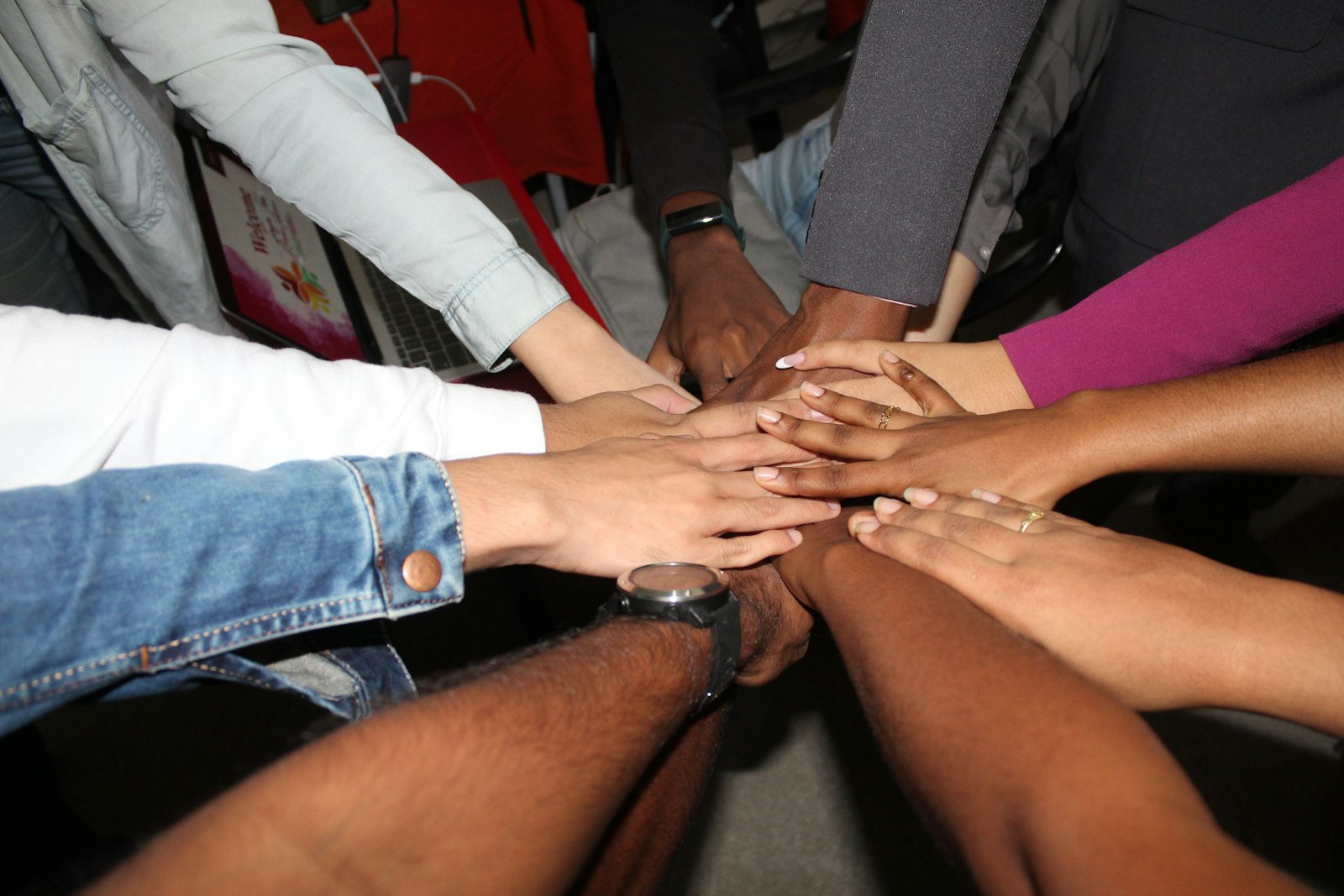
Part II
Tasks, tools and goals: what we do and achieve together.
Co-creation, change and transitions, communication and the goals.
The Creative Alliances System
Part II moves from bonds to tasks and goals.
How this topic fits the Creative Alliances System
- Part I is the bonds. Core Conditions at the heart, with Creative Climate, Positive Mindsets & Emotions, Character and Collaborative Partnerships.
- Lane’s earlier bond names map in. Connection is Core Conditions; Chemistry and Climate are Creative Climate; Cohesion is Collaborative Partnerships; Lane’s former Capacity Development bond now lives in Tasks & Tools as Flourish.
- Part II is tasks, tools and goals. Co-Creation through Understand, Dream, Experiment and Flourish, inside Change and Transitions, carried by Communication to the goals.
- Where other sessions sit. Performance Communication and High Performance Teams build Collaborative Partnerships; Leadership Fork in the Road builds Positive Mindsets and Character; Work/Life Harmony builds Flourish.
Text version of this diagram
- Tasks and Tools are behavior, what we do together: Co-Creation at the center, moving through Understand, Dream, Experiment and Flourish.
- Change and Transitions ring the tasks. Change is the event that happens; transitions are the human response to it.
- Communication carries trust, ideas and feedback between bonds, tasks and goals.
- Goals are what we come to know and achieve: Excellence at the core, with Engagement, Efficiency, Experience, Expansion, Efficacy and Effectiveness.
Part II · Tasks & Tools
Co-creation
Creating together as equal partners, not top-down or alone.
Drawing on shared knowledge, diverse perspectives and mutual input from beginning to end.
Human-centered design methods
Co-creation has tools.
- UnderstandInsight gathering, empathy interviews, journey and concept mapping, systems thinking, gap analysis.
- DreamReframing, analogous inspiration, divergent creative thinking, brainstorming and brainwriting.
- ExperimentPrototyping, creative problem solving, adapting and iterating, feedback loops.
- FlourishLearning, growth and development; health and well-being.
Part II · Tasks & Tools
Understand
Listen to what people are experiencing.
Including what the change asks them to leave behind. Insight gathering, empathy interviews, mapping, systems thinking and gap analysis.
Part II · Tasks & Tools
Dream
Make meaning together and imagine the better future worth creating.
Reframing, analogous inspiration, divergent creative thinking, brainstorming and brainwriting.
Dream: go wide, then choose
Diverge first. Converge second.
Diverge: go wide
- Reframe the problem
- Look for analogous inspiration
- Brainstorm and brainwrite
- Wild ideas welcome
Converge: choose
- Cluster and connect ideas
- Pick what is desirable, feasible and viable
- Turn it into a How might we
- Decide what to try first
Part II · Tasks & Tools
Experiment
Try, learn and improve our way into the change.
Prototyping, creative problem solving, adapting and iterating, feedback loops.

Experiment: the tools
Make it real enough to react to.
PrototypeMake ideas real enough to react to.
Creative problem solvingWork the problem together.
Adapt and iterateFail early, fast and small.
Feedback loopsLearn from the people it serves.
Part II · Tasks & Tools
Flourish
Embed what works so people and the organization are better for it.
Learning, growth and development; health and well-being. It starts with meaning and purpose.
Flourishing: the cultural operating system of a creative alliance
Not a buzzword. A science-backed idea.
A state in which all aspects of a person’s life are good (not perfect), but meaningfully supported. At work it includes happiness, and goes beyond it to purpose, resilience, energy, belonging, continuous learning and strong relationships.
Feel wellIt reflects not just how people feel…
Function well…but how they function, grow and contribute over time, in every domain of life.
Flourishing: a cultural operating system
What, how and why we do things here.
Flourishing is deeply interconnected
Flourishing as a cultural operating system
Flourishing functions like a cultural operating system. It’s not a standalone initiative or a one-off intervention.
Amy BlanksonForbes, April 30, 2025
Blankson, A. (2025). Flourishing as a cultural operating system: the new language of success. Forbes.
Flourishing: the ROI
CEOs already see the return.
Text version of this diagram
- 82% of CEOs report a positive return on investment from employee well-being programs.
- 58% of CEOs say employee well-being is critical to their company’s financial success.
- Across about one million employee surveys at 1,782 U.S. public firms, higher workplace well-being goes with higher profitability and firm value.
The Global Flourishing Study
Young adults are struggling.
202,898
people in 22 countries
The largest study of human flourishing to date, nationally representative.
Flourishing waits until 50. It stays flat from ages 18 to 49 and climbs only after 50. In the U.S., young people are not doing well.
Money isn’t everything. Richer nations score higher on financial security; middle-income nations score higher on meaning, purpose and relationships.
Relationships and community matter. Being married and regularly attending religious services are both linked to higher flourishing.
VanderWeele, T. J., et al. (2025). The Global Flourishing Study. Nature Mental Health, 3(6), 636–653; Harvard T.H. Chan School of Public Health summary.
Positive practices of a flourishing culture
29 practices, seven families.
Dignity and respect
- Respect
- Dignity
- Trust
- Integrity
- Confidence in others
- Appreciation
- Gratitude
Support
- Help others facing difficulty
- Care for struggling colleagues
- Emotional support
Empathy and compassion
- Strong relationships
- Kindness
- Honor others’ talents
Inspiration
- Share enthusiasm
- Inspire each other
- Name the good in others
Caring
- Take an interest
- Colleagues are friends
- Genuinely care
- Feel responsible for others
Meaning
- Elevated by our work
- Renewed and re-energized
- Motivated
- Meaning in our work
- See the larger picture
Forgiveness
- Don’t blame
- Correct errors without blame
- Forgive mistakes
Adapted from Cameron, K., Mora, C., Leutscher, T., & Calarco, M. (2011). Effects of positive practices on organizational effectiveness. Journal of Applied Behavioral Science, 47(3), 266–308.
Gallup Exceptional Workplace Award, 2025
People are their greatest asset.
The 70 organizations Gallup recognized in 2025 for exceptional workplace cultures share that core belief.
Gallup (2025). Announcing the 2025 Gallup Exceptional Workplace Award winners.
A word about “fully functional”
Flourishing people are fully functional.
After Carl Rogers’ fully functioning person.
- Super-abundanceOverflowing; more than enough.
- Striving for their bestSeeking their full potential.
- Fully awareOf thoughts, feelings, desires and goals.
- OpenFully engaged and open to new experiences and feedback.
- FreeInner freedom to embrace creativity, excitement and challenge.
- Not bound by the pastUses the past as a present resource.
Transformational cultural experiences
Learning in three loops.
Text version of this diagram
- Single-loop learning (what; adaptive): make adjustments to correct a mistake. Focus on doing things right.
- Double-loop learning (how; generative): invent new ways of looking at the world and work. Focus on doing the right things.
- Triple-loop learning (why; emancipatory): explore our values and ask why we do what we do.
Flourish
Two parts, one purpose.
Rooted in meaning and purpose: why the work matters
Flourish starts with meaning and purpose
Meaning is the primary human motivation.
Viktor Frankl’s logotherapy: finding meaning and purpose, not pleasure or power, drives us.
Do the efforts in the roles that matter to me count for something significant?
Meaning
Am I recognized and valued for what I do?
Meaning
Are the things I’m doing taking me in a direction I care about?
Purpose
Viktor E. Frankl, Man’s Search for Meaning (1946/1959).
Purpose: a reason for being
Ikigai sits where four questions meet.
Text version of this diagram
- Four circles: what you love, what you’re good at, what the world needs and what you can be paid for.
- Passion sits between love and skill; profession between skill and pay; vocation between pay and need; mission between need and love.
- Ikigai, a Japanese idea of a reason for being, sits at the center of all four.
The role of meaningfulness
Meaning comes in three prepositions.
Meaningfulness is the quality of having great value, significance or importance. We discover it in three forms.
Meaning
- inThe work itself: is what I do significant?
- ofWhy the work matters to others: who does it serve?
- atThe people and place: do I belong and matter here?
work.
Lane Morris; on meaningfulness in work and at work, see Pratt and Ashforth (2003).
Flourish: learning, growth and development
Am I becoming more?
- Am I learning?Or bored, stagnant, hitting a glass ceiling?
- Am I growing?Becoming a bigger, better person in all areas of my life.
- Am I expanding?Adding to my portfolio of knowledge, skills and abilities.
- Am I getting new chances?To change in ways that matter and benefit me too.
- Am I at my peak?Operating at the highest level of my ability, with results that matter.
Flow
Where challenges and skills meet.
Text version of this diagram
- Flow sits where high challenge meets high skill: focused and happy.
- High challenge with low skill brings anxiety and worry; low challenge with high skill brings control, relaxation or boredom; low challenge and low skill bring apathy.

Peak and pit moments
Mine the mountaintop, and the pit.
Peak experiences are storied moments when you performed at your best: full ability, self-awareness, absorption, effortless effort and a sense of enough.
PeakFlourishing, flow, extreme, maximized, your A-game.
PitThe low moments teach too. What drained you, and why?
Try itMap one peak and one pit from the last year. What conditions made the difference?
Flourish: health and well-being
Is this pace sustainable?
Am I feeling good about myself physically, mentally, relationally, emotionally and economically?
How confident am I that the pace I’m asked to work and change is sustainable over time?
Do I have endurance and stamina, or do I feel exhausted, fatigued and burned out?
The wellness wheel
Energy, valence and vigor.
- Energy
- The ability to do work.
- Vigor
- Liveliness versus lifelessness; determination and exuberant strength.
- Valence
- How good, or bad, something feels.
The Global Flourishing Study wellness wheel
Six domains of human flourishing.
Text version of this diagram
- The Global Flourishing Study measures six domains: happiness and life satisfaction; mental and physical health; meaning and purpose; character and virtue; close social relationships; and financial and material stability.
Part II · Tasks & Tools
Change and transitions
Change is the event. Transition is the human response.
The ring around co-creation. Leaders manage the change; people live the transition.
Leading people through transitions
Every transition starts with an ending.
Text version of this diagram
- William Bridges’ transition model shows three overlapping phases over time.
- Endings: people name what they are losing and let go. This is where Understand starts.
- The neutral zone: the uncertain in-between, when the old way is gone and the new one isn’t settled. It is also the most creative time: Dream and Experiment here.
- New beginnings: people take on the new identity, energy and purpose. Flourish embeds it.
- The phases overlap; people move through them at different speeds.
Meanwhile, on the farm
Start with what’s ending.
Text version of this diagram
- Panel 1: the Highland coo boss points to an easel: big news, new system Monday!
- Panel 2: the KuneKune pig and the Sebastopol goose worry: what happens to the old way, and us?
- Panel 3: he sits with them at a table: let’s start with what’s ending.
Communication, the bridge
Communication runs through the whole model.
Text version of this diagram
- Communication is a facilitation dimension that runs through the whole model, carrying trust, ideas and feedback between bonds, tasks and goals.
- In Lane’s earlier model, communication was a bond in its own right, facilitated through casual learning conversations.
The challenges of human communication
All behavior communicates.
These factors did not matter:
Words are precise toolsIntent always equals impactPeople say exactly what they meanListening is easyWe hear without filters
Words are imprecise, so accuracy depends on verification. People speak in codes, attention is easily distracted, and biases distort what we say and hear. It is impossible not to communicate.
“One cannot not communicate”: Watzlawick, Beavin & Jackson, Pragmatics of Human Communication (1967).
Unlock understanding: observe, listen and ask
What makes this person tick?
What’s going on in this person’s head?
What challenges are they facing that need solutions?
How can I build their confidence?
How can I connect with them in a more meaningful way?
What does their behavior signal they need: control, connection or competence?
Say what? Communication barriers to HCL
Mixed messages stall people.
- Think outside the box, but don’t fail
- We’re a learning organization, but failure is not an option
- People are our most valuable asset, but let’s cut the training budget
- Take calculated risks, but remember, safety first
- We value transparent communication, but circle back to me privately
- Give 110%, but invest in your wellness
The 5 I’s of empathy
Five ways communication builds understanding.
Immersion
Experiential adventures
- Observe everything
- Live in the community as they live in it
- Experience it from their point of view
- Be vulnerable
Investigation
Fly on the wall
- Become attentive
- Put on new glasses
- Avoid snap judgments
Imagination
Projecting into their space
- What’s it like to be them?
- Get on the balcony and reflect
- The platinum rule, not the golden rule
Imitation
Meeting them at their level
- Reflect back gestures and expressions
- Mirror and try it yourself
- Mirror neurons at work
Inquiry
Casual learning conversations
- Get people to share
- Casual plus conversation is less threatening
- Purposeful, two-way
You met casual learning conversations in the Bootcamp
Now use them to lead.
The HCD Bootcamp covered empathy, the continuum of compassion, curiosity, the conversation arc and the basics of a casual learning conversation. Here we go deeper on listening, techniques and the stories people tell.
Listen with your eyes: EMPATHY
Hear the whole person.
Text version of this diagram
- E, eye contact: where they look, especially on the hard parts.
- M, muscles of facial expression: do they match the words?
- P, posture: leaning in or pulling away.
- A, affect: the overall emotion, such as flat, animated, anxious or relieved.
- T, tone of voice: pace, volume and pitch.
- H, hearing the whole person: the context and feelings behind the answer.
- Y, your response: stay curious and notice your own judgment.
Listening: three clusters of skills
Few people are good listeners. It can be learned.
Attending
“I’m here, I’m interested, I’m fully engaged.”
- Posture, eye contact, leaning in
- Relaxed alertness
- Psychological presence
Following
Engages people
- Door openers: “I noticed… let’s discuss”
- Minimal encouragers: “Okay, go on…”
- Infrequent, open questions
- Attentive silence
Reflecting
Structures meaning and gives feedback
- Paraphrase and summarize
- Reflect feelings
- “You feel… because… and you want…”
- Describe expectations; offer course corrections
Listening takes up more of our waking hours than any other activity, yet most of us were trained to be poor listeners.
The empathy map
What does this person think, feel, see, hear, say and do?
Text version of this diagram
- Think and feel (top): what really matters to them; their major worries and aspirations.
- Hear (left): what friends, bosses and influencers say.
- See (right): their environment, their world, what others offer them.
- Say and do (bottom): their attitude in public, appearance and behavior toward others.
- Pains: fears, frustrations and obstacles.
- Gains: wants and needs, measures of success and opportunities.
Sour grapes and sweet grapes
What shuts a conversation down, and what opens it up.
Sour grapes
Pre-judge, send solutions, ignore concerns
- Mindreading: assuming you know without checking
- Kitchen-sinking: one issue becomes an avalanche
- Topping: my problem is bigger than yours
- Advising: “If I were you…”
- Devaluing: “You shouldn’t feel that way”
- False reassurance: “Don’t worry, it’ll be OK”
Sweet grapes
Open the door to understanding
- Validation: convey understanding and legitimacy
- Check-ups: make sure intentions equal impact
- Leveling: use I-language to state thoughts and feelings
- Congruence: content and emotion match
- Editing: check you’re understood as intended
Messages: content and emotion
Every message carries words and temperature.
Content is the literal words (direct or indirect). Emotion is the temperature of the message (honest or dishonest).
| Honesty | Dishonesty | |
|---|---|---|
| Directness | Candid, leveling: accurate information shared without fear | Covert: inaccurate information to mislead (“What’s wrong?” “Nothing!”) |
| Indirectness | Catch-22: accurate information shared in fear | Counterfeiting: acting naïve to learn more |
Why focus on touchpoints?
Touchpoints become defining moments.
Experiences are a series of touchpoints: holistic, personal and situational. Touchpoints are interactions that create value, or don’t. They can be tracked, measured and, most importantly, impacted.
- LiftingElevation, delight, fulfillment
- LearningDiscovery and insight
- LaudableCelebration and pride
- LoyaltySharing meaningful connections
- LiberationUnleashing freedom
Need-finding questions
Ask for the story behind the story.
You smiled when I said that. Can I learn why?
Tracing behaviors
If you had this to do all over again…?
Second chances
If I were a genie and could grant your wish, what would you ask for?
Superhero
When didn’t it work?
Exceptions to the rule
How would you explain this to your kids?
Valued others
How will this look 50 years from now?
Crystal ball
Friendly communication reminders
Small habits that make people feel they matter.
- Listen, truly listen. With your ears, eyes and heart.
- Don’t interrupt. Don’t rush to advice or change the subject. Allow people their moment.
- Be fully present. No email, watch or phone when someone drops in.
- Use people’s names. And remember the names of the people they love.
- Be affirming. Catch people doing the right things, and make your praise specific.
- Encourage the quiet ones. An attentive nod can boost someone’s confidence.
- Tune in to nonverbals. When people talk about feelings and attitudes, tone and body language carry most of the message (Mehrabian).
- Smile. And show genuine curiosity about people’s lives.
Part II · Goals
Goals: what we achieve
Excellence: the standard every outcome turns around.
Goals are cognition and outcomes, what we come to know and achieve. Each goal takes the color of the bond that fuels it.
Goals of Creative Alliances
A people-first community aims for Excellence.
Text version of this diagram
- Excellence sits at the center: performance quality and standards.
- Effectiveness: better, with real impact. Expansion: bigger. Efficiency: cheaper operations. Efficacy: faster, easier and results-oriented.
- Experience: community, not just culture. Engagement: head, heart and hands.
- Lane’s list also names Empowerment, which unleashes capacity and potential, and Enrichment: learning and growth, actualization, meaning and fulfillment, calling and purpose.
How will we know it’s working?
Put a measure on every goal.
| Goal | Fueled by | Signals to watch |
|---|---|---|
| Engagement | Creative Climate | Engagement survey scores, discretionary effort, ideas offered |
| Experience | Creative Climate | Employee and customer experience scores, net promoter scores |
| Efficiency | Collaborative Partnerships | Cycle time, rework, cost per outcome, meetings that end in decisions |
| Efficacy | Positive Mindsets & Emotions | Commitments delivered on time; the team’s confidence that it can |
| Expansion | Positive Mindsets & Emotions | New customers, relationships and markets; referrals and repeat business |
| Effectiveness | Character | Progress on the outcomes that matter most; trust in leaders |
Excellence sits at the core: every turn of the wheel raises the bar. Pick one or two signals per goal and track them over time.
Try it: the Co-Creation Planner
Take one tough challenge around the wheel.
Below this deck, take a challenge through Understand, Dream, Experiment and Flourish, and pick the goals it should move.
How it all connects
Bonds fuel tasks. Tasks deliver goals.
Text version of this diagram
- Bonds (how we feel together) fuel co-creation (what we do together), which delivers the goals (what we achieve).
- Each goal takes the color of the bond that fuels it: Creative Climate fuels Engagement and Experience; Positive Mindsets and Emotions fuel Efficacy and Expansion; Character fuels Effectiveness; Collaborative Partnerships fuel Efficiency.
- Communication carries it all, and Change and Transitions ring the work.
Satya Nadella, Microsoft CEO
Together, we must embrace our shared humanity, and aspire to create a society that is filled with respect, empathy, and opportunity for all.
Satya NadellaEmail to Microsoft employees, August 2017
Try it: Bonds Check
Self-check · Creative Alliances System
Bonds Check
Rate how often each statement is true of you as a leader. See your strongest and weakest bonds, and get one thing to practice this week.
- 1Rate
- 2See
- 3Practice
Core Conditionsthe heart of every bond
I show empathy and compassion, especially when people are struggling.
I treat people with positive regard, even when I disagree with them.
People get the same, genuine me in every room.
I believe I can bring out creativity in the people I lead.
Creative Climatefuels Engagement and Experience
People on my team speak up, ask questions and challenge ideas without fear.
I share what I know openly and explain the why behind decisions.
People have the freedom, time and resources to try new ideas.
Positive Mindsets & Emotionsfuels Efficacy and Expansion
I treat setbacks as chances to learn, not as proof of failure.
I bring hope, optimism and gratitude into hard moments.
I reframe problems instead of taking them as given.
Characterfuels Effectiveness
I tell the truth, even when it is uncomfortable.
I do the right thing when no one is watching.
I admit mistakes and give others the credit.
Collaborative Partnershipsfuels Efficiency
We agree on goals, roles and tasks before the work starts.
Feedback flows both ways between me and the people I lead.
I keep realistic expectations and healthy, reliable boundaries.
Your bonds
Your result builds as you rate.
This is a reflection exercise, not a validated assessment. Your answers stay in this browser tab. Nothing is sent or saved.
Try it: Co-Creation Planner
Planning tool · Creative Alliances System
Co-Creation Planner
Take one tough challenge through Understand, Dream, Experiment and Flourish, choose the goals it should move, and leave with a plan you can copy or print.
- 1Frame
- 2Co-create
- 3Plan
Which goals should this move? (pick one to three)
Your co-creation plan
Your plan builds here as you answer.
Your answers stay in this browser tab. Nothing is sent or saved.
Go deeper
Back to all Executive Education topics · Related: The Decisive Advantage
Part of Executive Education from the Human Centered Lab: workshops Jules Morris, PhD and Lane Morris, PhD lead for working professionals.
Frequently asked questions
What are creative alliances?
Creative alliances are the working relationships at the intersection of leader and employee: interpersonal, two-way partnerships built at every touchpoint. Lane Morris argues that alliance strength is the top factor in reaching meaningful outcomes and change.
What are the bonds in the Creative Alliances System?
Bonds are how we feel together. Core Conditions (empathy and compassion, unconditional positive regard, congruence and creative leadership self-efficacy) sit at the heart, surrounded by Creative Climate, Positive Mindsets & Emotions, Character and Collaborative Partnerships.
What is the difference between empathy and compassion?
Empathy is deep understanding: seeing a situation from another person’s point of view. Compassion is empathy in action: doing something to relieve what the other person is facing.
What do people need most from leaders?
Gallup’s 2025 research found that hope is named most often (56%), followed by trust (33%), compassion (7%) and stability (4%).
What is the difference between change and transition?
Change is the event that happens. Transition is the human response to it. William Bridges described three phases of transition: endings, the neutral zone and new beginnings.