The big idea: The Value Proposition Canvas asks one question about your prototype: does it relieve the pains and create the gains your research actually found, starting with the ones that matter most?
In 60 seconds
- The Value Proposition Canvas asks one question: does your prototype relieve the pains and create the gains your research found?
- Fill the customer profile first, from your research: jobs, pains and gains, ranked and labeled with evidence. Then build the value map.
- Every pain reliever and gain creator should point at a specific pain or gain. Fit on paper still needs proof from testing.
Do this: build one canvas per segment, close or explain the gaps, and write the value proposition for your report’s Context section.
How the Value Proposition Canvas works
How the Value Proposition Canvas works
Does your prototype answer what matters most?
The Value Proposition Canvas zooms in on two blocks of the Business Model Canvas: one customer segment and the value proposition you offer it.
Two halves
The circle is the customer. The square is your offer.
Customer profile (the circle)
- Customer jobs. What people are trying to get done: tasks to finish, problems to solve, and how they want to feel or be seen.
- Pains. What annoys them, blocks them or worries them before, during or after the job: obstacles, risks, bad outcomes.
- Gains. The outcomes and benefits they want, from must-haves to nice surprises.
Value map (the square)
- Products and services. What you actually offer: the program, process, tool or service.
- Pain relievers. How it removes or reduces specific pains.
- Gain creators. How it produces specific gains.
How the two halves fit together
It has two halves. The circle on the right describes the customer. The square on the left describes what you offer. Fit is when the square answers what matters most in the circle.
The Value Proposition Canvas is by Strategyzer AG, the makers of the Business Model Canvas. The descriptions here are written in our own words for this course.
How to use the canvas
Customer first. Solution second.
- 1Profile from researchFill the circle from your interviews, observations and data. One canvas per segment.
- 2Rank what mattersMark each job, pain and gain high, medium or low, and note the evidence behind it.
- 3Build the value mapDescribe your prototype, then write relievers and creators that point at specific pains and gains.
- 4Check fitDo the high pains and gains have answers? Which features answer nothing?
The rule for each step
- Profile from research. Rule: customer first, solution second.
- Rank what matters. Watch: high items resting on guesses.
- Build the value map. Rule: every reliever names the pain it relieves.
- Check fit. Then: test it with real people.
You already have the raw material
If a pain is not in your data, it is an assumption, and the canvas should say so.
Your Inspiration interviews and observations are full of jobs, pains and gains. Pull exact phrases from your notes.

Jobs to be done, again
The job is the progress, not your product.
The customer jobs side connects to the jobs to be done thinking some of you met in marketing courses. The job is the progress a person is trying to make, not your product.
Jobs, pains and gains: an example
Write the customer’s job, not your feature.
Common mistake
- Job: “Use our permit portal.”
- Pain: “No checklist exists.”
- Gain: “A modern website.”
Food truck owner’s view
- Job: Get legally open before the summer season.
- Pain: Forms get rejected for small errors, so the wait starts over.
- Gain: Knows the date they can open.
Jobs, pains and gains: a city’s permit process for new food truck owners
| Part | Example | Common mistake |
|---|---|---|
| Job | Get legally open before the summer season. | “Use our permit portal.” That is your product, not their job. |
| Pain | Forms get rejected for small errors, so the wait starts over. | “No checklist exists.” That is the absence of your solution, not a pain. |
| Gain | Knows the date they can open. | “A modern website.” That is a feature, not an outcome. |
| Pain reliever | Staff pre-check forms before they are filed. | “Great customer service.” Too vague to point at any pain. |
| Gain creator | The status tracker shows an expected approval date. | A branded tote bag that answers no gain on the profile. |
This example is invented for practice.
Three kinds of fit
Paper fit is only the first one.
Fit on paper
Your research shows people care about these jobs, pains and gains, and your value map answers the important ones.
Proof: interview and observation evidence.
Fit in testing
Real people react to your prototype the way your canvas predicts. They use it, prefer it or ask for it.
Proof: live prototyping and pilot results.
Fit in the business model
The value proposition can be delivered and paid for over time, which is where the Business Model Canvas comes back in.
Proof: costs, funding and partners that hold up.
For your capstone, aim for strong paper fit by December and evidence from testing by spring.
Where the idea of fit comes from
Strategyzer describes a similar progression from problem-solution fit to product-market fit to business model fit.
This or that
Circle or Square?
Pick the card that keeps the customer first and points every reliever at a real pain or gain.
Try it: Value Fit Checker
Tool · BUAD 497
Value Fit Checker
Link what you offer to the pains and gains your research found, and see where the fit breaks.
- 1Profile
- 2Link
- 3Share
Value fit
All checks
Canvas structure: the Value Proposition Canvas by Strategyzer AG. Tool and example are original for this course.
Put it to work: the Context section and your value proposition
The Value Proposition Canvas is part of the Implementation phase that kicks off in December. In your HCD Technical Report it shapes the Context section, which the checklist labels “Value Proposition Canvas”: customer or user profile, jobs to be done, pains and gains, and pain relievers and gain creators. It also feeds the Unique Value Proposition in your Executive Summary and the desirability evidence for your EUReCA poster.
Pick the segment
Choose the user group your prototype serves most directly. Make a second canvas if payers or other users need something different.
Your deliverable: one named segment per canvas.
Profile from your data
Pull jobs, pains and gains from your interview and observation notes. Rank each one and label its evidence.
Your deliverable: the Customer/User Profile, Jobs to Be Done, and Pains and Gains parts of your report’s Context section.
Map your prototype
Describe the product or service, then write relievers and creators linked to specific pains and gains.
Your deliverable: the Pain Relievers and Gain Creators part of the Context section.
Close or explain the gaps
Run the Value Fit Checker. For each high gap, add an answer, plan a test or explain why it is out of scope.
Your deliverable: a gap list for your Weekly Consulting Brief and next round of testing.
Write the value proposition
Turn the strongest fit into one or two sentences: for whom, which job, which pain or gain, and why it is different.
Your deliverable: the Unique Value Proposition in your Executive Summary and on your EUReCA poster.
Before you submitCheck your canvas
- [ ] Each canvas covers one named segment.
- [ ] Jobs, pains and gains come from your research, in participants’ words where possible.
- [ ] High-importance items are backed by evidence, or marked as assumptions to test.
- [ ] Every pain reliever and gain creator links to a specific pain or gain.
- [ ] Every high pain and gain has an answer or a stated reason it is left out.
- [ ] The canvas credits Strategyzer AG.
Go deeper
Unlock this topic
Do the work, earn the sticky note
Finish each step on this page to unlock the button that adds this topic to your consulting engagement.
Back to all BUAD 497 topics · Next: Live Prototyping and Iteration
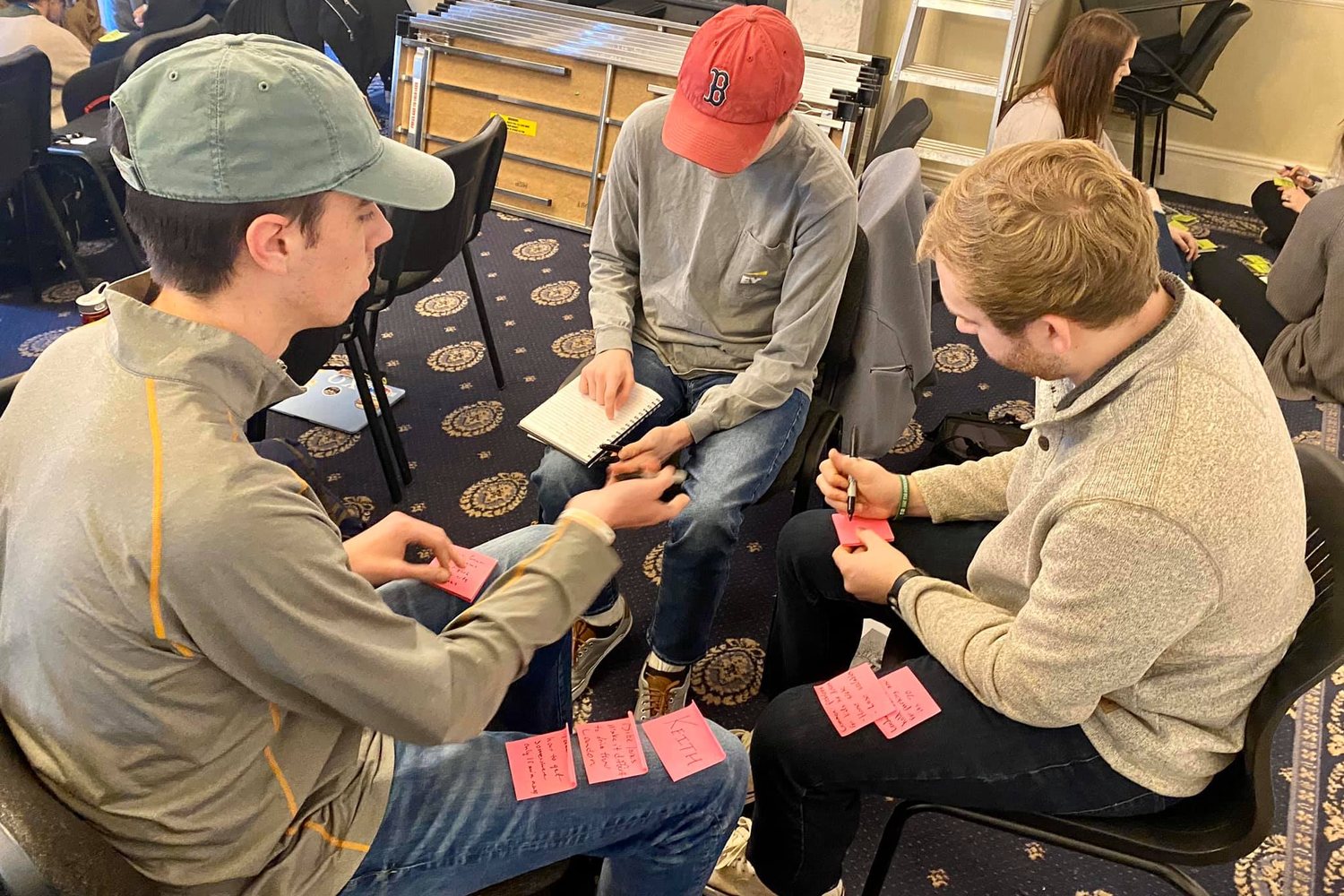
In-class team activity · 25 min
Pain Auction
By the end: A Value Proposition Canvas for one segment of your client project with ranked, evidence-backed pains and gains, linked relievers and creators, and a clear list of gaps to test. Your instructor will give you the password in class.
Part of the Smith GLS human-centered leadership sequence: IB 407, BUAD 317 and BUAD 497, toward the Human Centered Consulting Certificate.
Frequently asked questions
What is the Value Proposition Canvas?
The Value Proposition Canvas, by Strategyzer AG, zooms in on two blocks of the Business Model Canvas: one customer segment and the value proposition offered to it. The circle describes the customer through jobs, pains and gains. The square describes your offer through products and services, pain relievers and gain creators. Fit is when the square answers what matters most in the circle.
What are customer jobs, pains and gains?
Customer jobs are what people are trying to get done, including tasks, problems and how they want to feel or be seen. Pains are what annoys, blocks or worries them before, during or after the job. Gains are the outcomes and benefits they want, from must-haves to nice surprises. Fill all three from interviews and observation, in participants' own words where possible.
How do you fill out a Value Proposition Canvas?
Start with the customer, not the solution. Fill the customer profile from your interviews, observations and data, using one canvas per segment. Rank each job, pain and gain high, medium or low and note its evidence. Then describe your prototype, write pain relievers and gain creators that each point at a specific pain or gain, and check whether the high items have answers.
What are common Value Proposition Canvas mistakes?
Common mistakes include starting with the square and inventing pains to match, listing features as gains, trying to relieve every pain, calling a guess "research" and stopping at paper fit without testing. For example, "use our permit portal" is your product, not the customer's job, and "a modern website" is a feature, not an outcome.
What are the three kinds of value proposition fit?
There are three kinds of fit: fit on paper, fit in testing and fit in the business model. Paper fit means research shows people care about the jobs, pains and gains your value map answers. Testing fit means real people react to your prototype as the canvas predicts. Business model fit means the value can be delivered and paid for over time.