The big idea: An insight is not data, an observation or a wish: it is a human truth that explains why people act as they do, and finding one is what turns a pile of interview notes into a question worth designing for.
In 60 seconds
- Synthesis moves notes from learnings to themes to insights to How Might We questions to ideas.
- An insight is not data, an observation or a wish. It explains why people act the way they do.
- Write it in three sentences: the situation, the dilemma and the ideal end state.
Do this: practice turning your interview notes into named themes, then write two or more three-sentence insights.
How synthesis works
Our design challenge
How might we delight London tourists?
Solid interviews
You talked to real people. Now make sense of it.
Today we turn stories into insights.
Activity
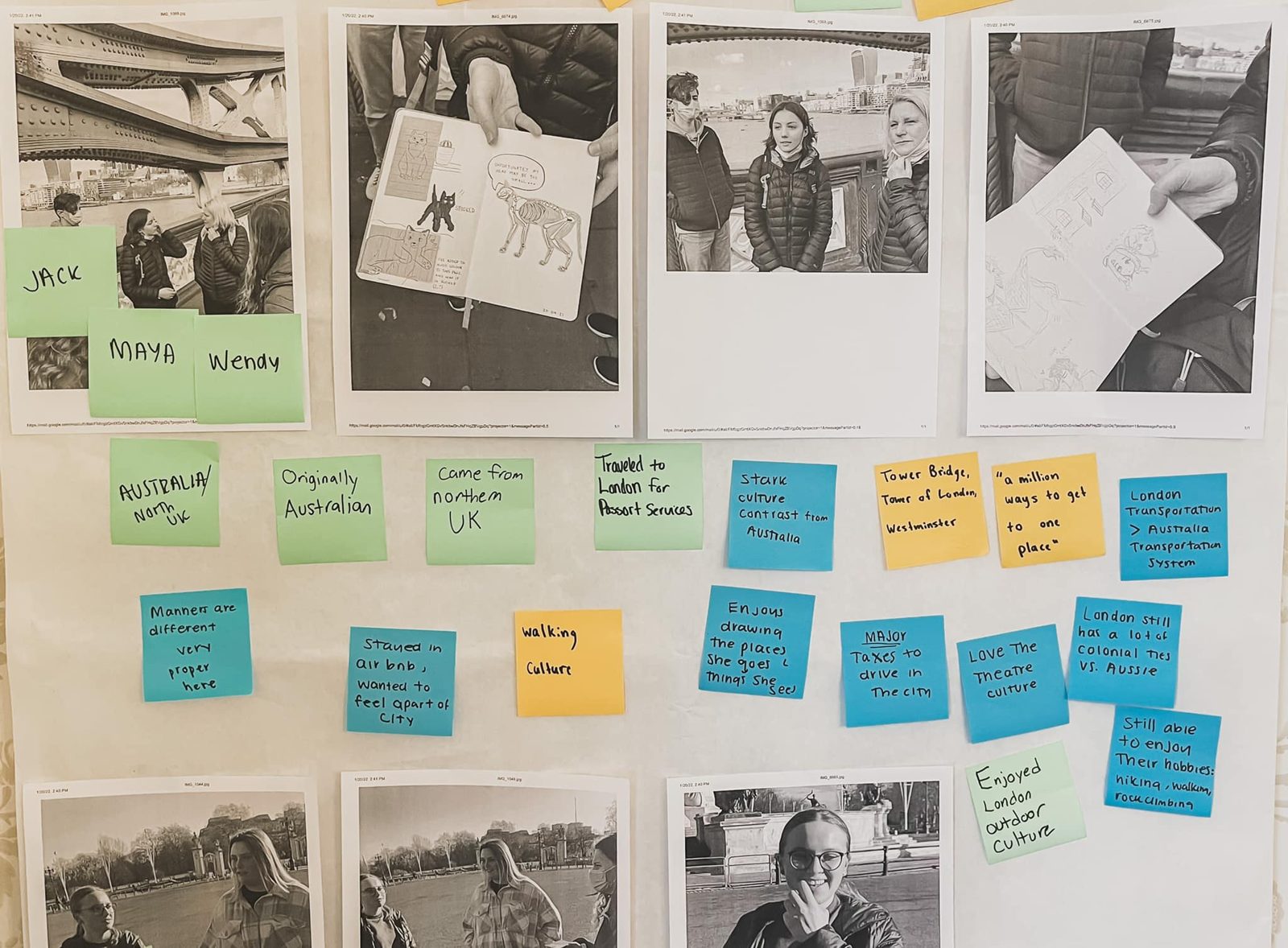
Download your learnings.
- 1Grab suppliesSticky notes and a marker.
- 2Name itWrite the name of the person you talked to on a sticky note at the top of the board.
- 3One per noteJot down memorable information, quotes and observations, each on its own note.
- 4ShareDiscuss your main takeaways from each interview with your team.
- 5BuildBuild on each other’s observations.
- 6Tell the storyPrepare each interviewee’s story to share with the class. You have 20 minutes.
Empathy map
Sort what you heard into one picture.
Text version of this diagram
- Think and feel
- Hear
- See
- Say and do
- Pains
- Gains
- Goals
The empathy map
Look hardest where the squares disagree.
Put the person in the middle. Sort your stickies around them. Gaps show you what you still do not know.
Says
Direct quotes. What they told you out loud.
Thinks
What they seem to believe or worry about but may not say.
Does
What you watched them do, including workarounds.
Feels
The emotions you noticed: in their face, voice or choices.
Pains, gains and tensions
| Square | What goes there |
|---|---|
| Says | Direct quotes. What they told you out loud. |
| Does | What you watched them do, including workarounds. |
| Thinks | What they seem to believe or worry about but may not say. |
| Feels | The emotions you noticed: in their face, voice or choices. |
| Pains | Fears, frustrations and obstacles. |
| Gains | What they want, how they measure success, and the openings you see. |
Look hardest where the squares disagree. A visitor who says “we’re relaxed” but checks the time every five minutes is showing you a tension, and tensions lead to insights. The version in your slides also asks what the person sees and hears around them.
Empathy map example
One person, one map.
Example from class: someone shopping for a new TV. Their sticky notes cover what they said, did, thought and felt along the way. Try one for each person you interviewed.
London Day 5
Ideation
The HCD process
Today we move into Ideation.
Text version of this diagram
- Inspiration: open wide to learn from people, then narrow to what you learned.
- Ideation: open wide again into many ideas, then narrow to a few prototypes.
- Implementation: keep narrowing as you iterate, run a live prototype and pilot.
- Today: Ideation.
London Day 5
Synthesis
Synthesis
Synthesis means making sense.
Synthesis is making sense out of what we see and hear to uncover opportunities for design.
Steps of synthesis
Four steps, in order.
- 1Download your learningsShare what you saw and heard. One idea per note.
- 2Listen for and capture insightsHear the meaning under the story.
- 3Find themesCluster the notes and name what you see.
- 4Craft HMW questionsTurn insights into questions to brainstorm.
Unpacking stories
Unpack every story.
Ask these of each story your team shares.
- What stood out to me or us?
- Why is it interesting, given the design challenge?
- What does it reveal about this person: what they care about and believe?
- Why is this highlight important? What does it mean?
- Where else have I seen something like this? Why?
- How does this help me see the design challenge in a new way?
Download your learnings
One note, one idea.
- In your teams you will have a few minutes to download your learnings.
- Each team gets sticky notes and markers.
- Share and collaborate on what you learned.
- Capture insights, memorable quotes and takeaways on sticky notes. One per note.
- Be ready to share with the larger group: each team has 5 minutes.
PriyaFirst trip to London · Loves museums · On a budget
“I spent an hour just figuring out the Tube map.”
“Everything costs more than I planned.”
“I want to find the places locals actually go.”
From learnings to ideas
Your notes will evolve.
Text version of this diagram
- Learning: “It took me an hour to figure out the Tube.”
- Theme: getting around is stressful.
- Insight: tourists want to roam freely, but transit feels like a test.
- How might we make getting around London feel like part of the adventure?
- Idea: a “first ride” Tube buddy.
Find themes
Patterns emerge as you share.
- Remind yourself of the design challenge: HMW delight London tourists?
- Set up your sticky-note boards from all of your interviews.
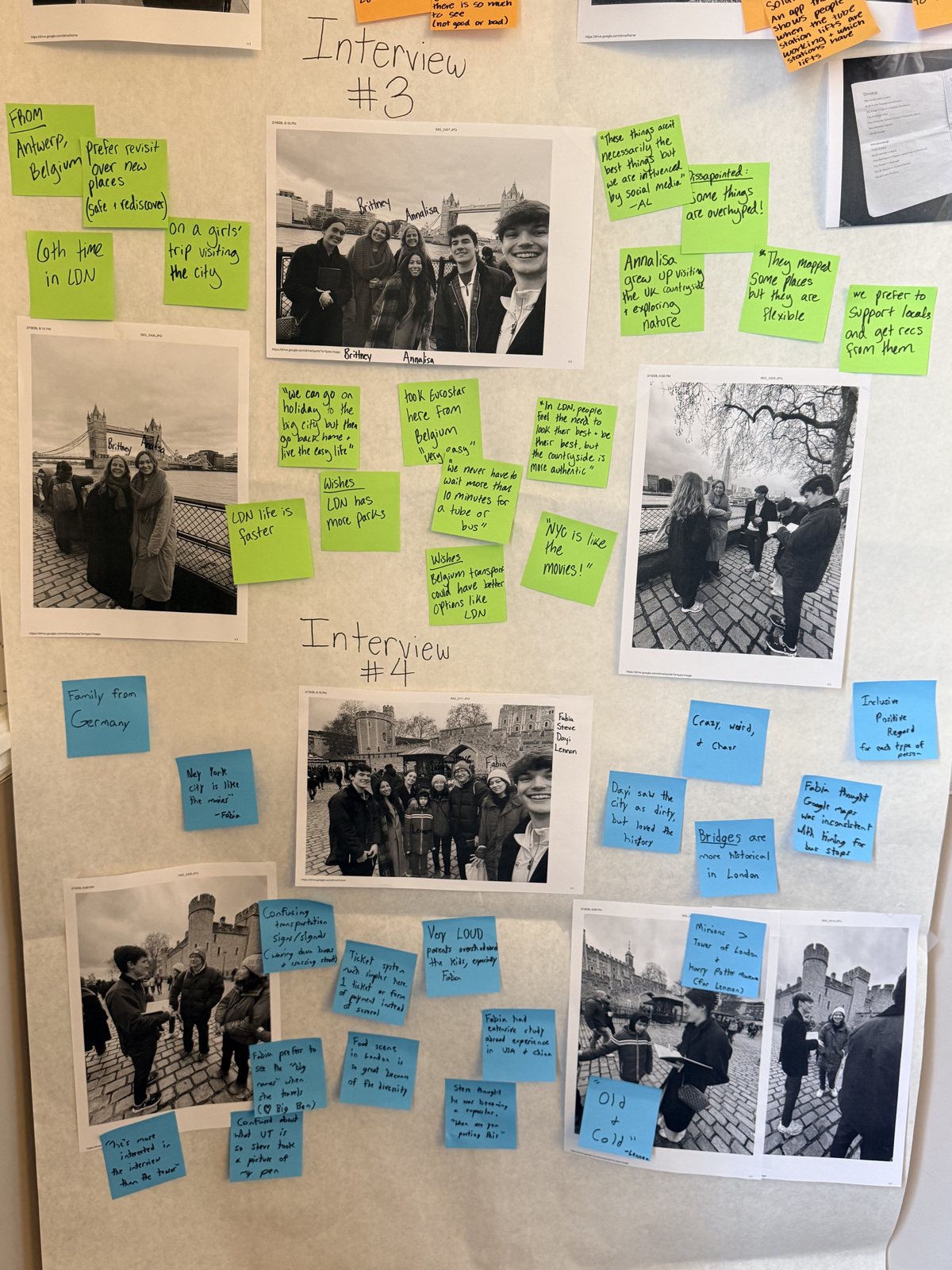
- Move the most compelling, common and inspiring quotes, stories or ideas to a new board and sort them into categories.
- Look for patterns between categories and possible tensions. Notice what’s missing.
- Arrange and rearrange the notes. Discuss and talk through what’s emerging until everyone agrees the clusters are meaningful.
- Identify themes that are useful in the design process.
Sorting and sharing with themes
Sort the notes. See the bigger picture.
After each group shares with the larger group and we create themes, sort the notes under the themes.
Some notes won’t make it from the first board to the second, such as names and personal details.
It’s common to capture things that don’t end up being “important.” That is all part of the process.
Sorting lets you see the bigger picture by pulling the findings of many interviews into one place.
THEME
Getting around
Visitors want to feel confident getting around on day one.
INSIGHT
“I spent an hour just figuring out the Tube map.”
QUOTE
What is insight?
Not data. A new way of seeing.
An insight is NOT
Data. A plain observation (the “what” without the “why”). A person’s wish or a statement of need.
An insight IS
A fundamental human truth that reveals the inner nature of things. A new way of viewing the world that challenges the status quo. A discovery about the motivations that drive behavior.
The five principles of an insight
One London visitor, five principles.
- 1ContextThey plan every hour of the trip on their phones.
- 2DilemmaThe plan falls apart by lunch.
- 3WhyQueues and Tube changes take longer than expected.
- 4MotivationThey do not want to waste a trip they saved for.
- 5Envision the idealThe day feels well spent, whatever they saw.
What each principle asks
| Principle | Ask | Example |
|---|---|---|
| Context | What do they do, think and feel, and what are they trying to achieve? | They plan every hour of the trip on their phones. |
| Dilemma | What blocks them? Where is the tension or discomfort? | The plan falls apart by lunch. |
| Why | What explains the behavior? What unmet need drives it? | Queues and Tube changes take longer than expected. |
| Motivation | What do they want to change, and what need is unfulfilled? | They do not want to waste a trip they saved for. |
| Envision the ideal | What does the good experience look like to them? | The day feels well spent, whatever they saw. |
Then write it as three sentences in the builder below. Your insight also becomes the “because” in a need statement.
Example: insight statement
Three sentences that tell the truth.
First sentence
Describe the current situation and the person’s behavior.
Second sentence
Describe the dilemma: why this is a frustration in their life.
Third sentence
Describe their desired end-state and ideal situation.
Example
Taking pictures of the city instantly reminds me of special moments. But I find that my London pictures stay hidden on my devices, because I never have time to print them. I wish there were a way to enjoy my London memories every day without having to actively play them on my computer or phone.
Knowing when you have an insight
A real insight does something.
Connects
With people’s emotions and elicits “You understand me.”
Challenges
Existing conventions and the status quo.
Solves a real problem
That results in satisfying people.
Inspires action
Gives a clear customer to aim for.
Clear
On what to do next, and how to deliver new value.
Brings new keenness
To the team and helps informed decisions.
Create insight statements
From themes to insights.
- 1Gather themesPut the themes from Find Themes on a wall or board.
- 2RephraseRephrase each theme as a short statement. You are not looking for a solution, just turning the theme into an insight.
- 3NarrowLook back at your design challenge. Discard the ones that don’t relate. You want three to five insights.
- 4RefineMake sure each one conveys a new perspective or possibility. Check it with someone outside your team.
Activity
Create insight statements.
Use the worksheet: write your design challenge, then each theme with the insights that came from it.
Crafting HMW questions
What makes a good How Might We?
- Based on insights from your interviews and observations.
- Human-centered: we always solve problems for people.
- Not focused on organizational constraints, technology, money or product specs.
- Reveal needs that should be met.
- Suggest a solution is possible, and can be answered in many ways.
- Don’t name a solution. They give you a frame for innovative thinking.
- Broad enough for many solutions, narrow enough to act on.
- It takes practice!
Craft “How might we” questions, continued
Not too broad. Not too narrow.
- 1Generate moreExplore related questions by asking “Why?” (to broaden) and “What’s stopping you?” (to narrow).
- 2Pick 1 to 3Choose the HMWs at the right level: broad enough for lots of ideas, narrow enough to focus.
Example
Insight: healthy food is hard to get in some neighborhoods. HMW make it easy to get healthy food in low-income neighborhoods?
Activity
Create How Might We questions.
On the worksheet, write each insight and the HMW question it inspires. Aim for three to five strong HMWs.
London Day 5
Brainstorming
Myth or fact
Insight or Not? Myth vs Fact
Call each statement about synthesis and insights a myth or a fact before your team hits the sticky-note wall.
Try it: Insight Statement Builder
Tool · IB 407
Insight Statement Builder
Write an insight in three sentences, test it against the five principles, and get the How Might We it leads to.
- 1Write
- 2Check
- 3Share
Your insight statement
The How Might We it implies
All checks
Go broader: ask “why does that matter to them?” Go narrower: ask “what is stopping them?”
Put it to work: insights for Interpret/Define
Insights are the heart of Interpret/Define. Strong synthesis finds several deep insights from non-obvious sources and reframes the challenge around a user. Picking one obvious problem leaves the best insights on the table.
From interviews to insights in five steps
Download every interview
One sheet per person, one fact per sticky, read aloud. About 20 minutes.
Map your most surprising person
Build an empathy map for the person who surprised you most. Circle where says and does disagree.
Cluster and name themes
Move the strongest stickies to a new board, group them and name each group.
Write three to five insights
One per strong theme, in three sentences. Run each through the Insight Statement Builder.
Pick the strongest and ask HMW
Choose one to three insights that pass the gut check. Turn each into How Might We questions.
A worked exampleFrom stickies to an HMW at a small accounting firm
For example, a team studying a small accounting firm’s clients at tax time posts these learnings:
- A bakery owner brings a shoebox of receipts in April.
- “I know I should sort these monthly. I just never get to it.”
- She apologizes three times in a 30-minute meeting.
Theme: shame about the shoebox.
Insight: (1) Small business owners save every receipt all year because they want to do things right. (2) But sorting them feels like a test they already failed, so they put it off and arrive embarrassed, which keeps them from asking the questions that could save them money. (3) They want to walk into the meeting feeling on top of their business, not judged.
HMW: How might we help small business owners feel on top of their books all year, not just in April?
Do this, not thatHabits that turn notes into insights
Do this
- Write facts first. Interpret after the download.
- Put one learning on each sticky.
- Look for tension: where what people say and do disagree.
- Back every insight with a quote or observation.
- Keep going until the insight surprises you.
Not that
- Stickies that say “anxious” or “confused” with no fact behind them.
- Calling a statistic or an observation an insight.
- Writing a wish (“they want an app”) as your insight.
- Insights anyone could guess before fieldwork.
- Jumping from one interview to ideas.
Quick self-checkCheck your synthesis
- [ ] Every interview has its own sheet of learnings, one per sticky.
- [ ] We built at least one empathy map with pains and gains.
- [ ] Every theme cluster has a name.
- [ ] Each insight has three sentences: situation, dilemma, ideal.
- [ ] Each insight has a why and a feeling, and is backed by field evidence.
- [ ] None of our insights is data, an observation or a wish.
- [ ] Our strongest insights became How Might We questions.
Go deeper
Back to all IB 407 topics · Next: Define: How Might We Questions
Part of the Smith GLS human-centered leadership sequence: IB 407, BUAD 317, BUAD 497 and BUAD 417, toward the Human Centered Consulting Certificate.
Frequently asked questions
What is an insight in human-centered design?
An insight is a human truth that explains why people act the way they do. It offers a new way of seeing, makes you question how things are done now, and names what drives people, including what they feel but do not say. An insight is what turns a pile of interview notes into a question worth designing for.
What is the difference between an insight, an observation and data?
Data says how many, such as "most visitors use their phones," but not why. An observation says what happened, such as "the Tube is confusing," with no reason behind it. A wish, like "they want a better app," is often a solution in disguise. An insight goes further: it explains the motivation behind behavior and names a real problem to design for.
How do you write an insight statement?
Write an insight as three sentences. First, the situation: what the person does now and what they are trying to achieve. Second, the dilemma: what gets in the way, why it happens and how it makes them feel. Third, the ideal: the good experience they want, in their terms, described as an end state rather than a product.
What are the steps of synthesis after design research interviews?
Synthesis has three steps adapted from IDEO's Field Guide to Human-Centered Design: download your learnings, find themes and insights, and craft How Might We questions. Notes move through five forms: learnings, themes, insights, How Might We questions and ideas. Download one fact per sticky, cluster and name themes, then write insights and turn the strongest into HMW questions.
How do you use an empathy map to find insights?
Put one person in the middle and sort their learnings into four squares: says, does, thinks and feels, plus pains and gains. Gaps show what you still do not know. Look hardest where the squares disagree. A visitor who says "we're relaxed" but checks the time every five minutes is showing a tension, and tensions lead to insights.