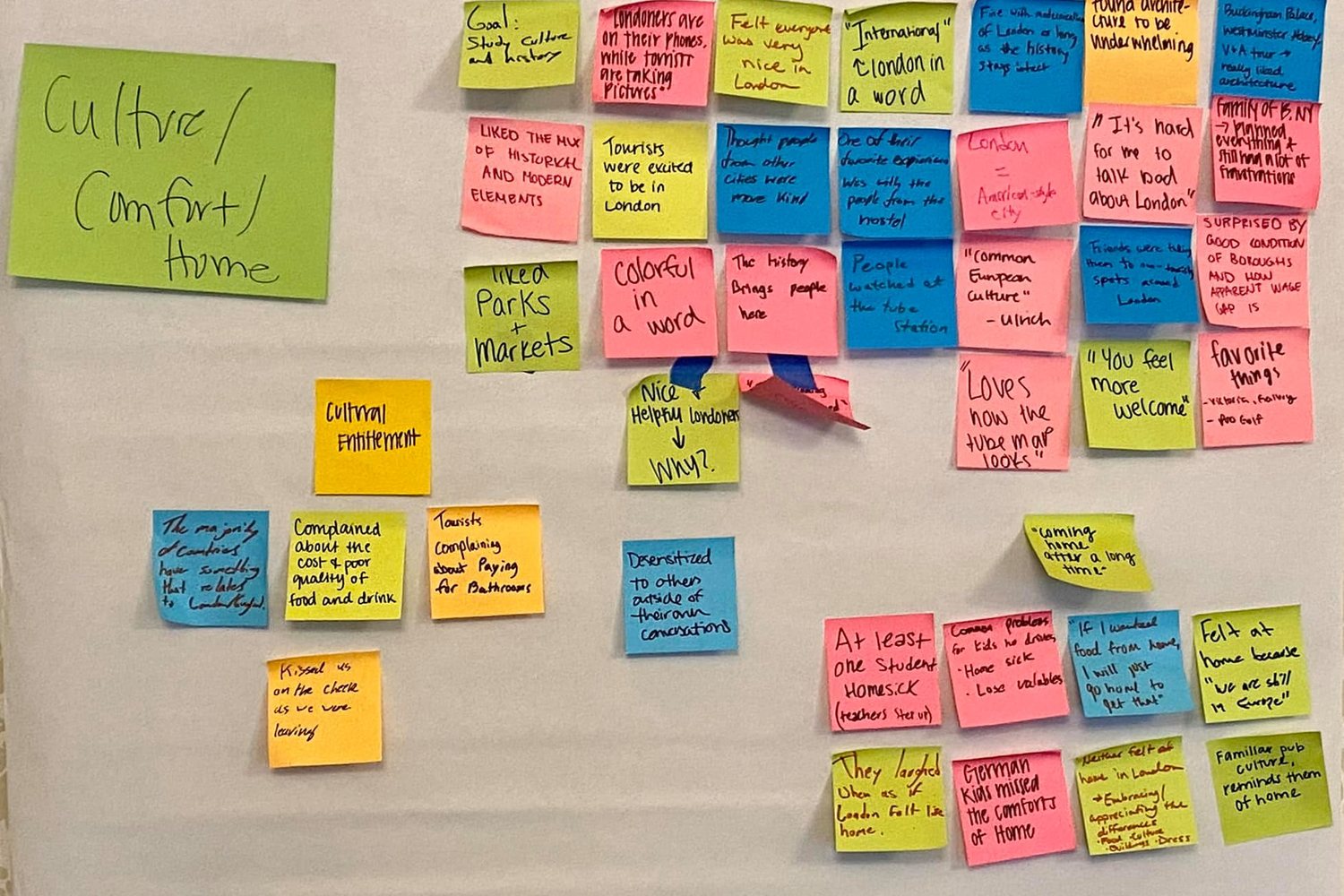
The big idea: Quotes are evidence, not answers: your job is to find the pattern across people, explain why it exists, and turn it into a question worth designing for.
In 60 seconds
- Quotes are evidence, not answers: your job is to find the pattern across people.
- An insight explains why a pattern exists. It is not a quote and not a solution.
- Back every theme with quotes from more than one stakeholder type, then turn it into a How Might We question.
Do this: build your Deliverable #3 insight board with three to five evidence-backed insights and HMW questions.
How analysis and synthesis work
Analysis takes your interviews apart. Synthesis puts them back together as meaning your team can design from. The class example sums it up: if your log is only quotes, you are not done yet.
Evidence
Exact words and what you saw. One quote or observation per sticky note.
Looks like: “We don’t know who to call.” (Business)
Sense-making
Short notes on what stood out: repeats, emotions, contradictions.
Looks like: mentions time and respect again and again.
Theme
A pattern that shows up across several people, named as a short sentence.
Looks like: connection happens by chance, not by design.
Insight
Your interpretation of why the pattern exists and what it means for people.
Looks like: people are willing, but no one can see where to start.
How might we
A question that turns the insight into a design opportunity.
Looks like: HMW make the first step easy to find?
One interview, three layers
This comes from the class example: an interview with a downtown Knoxville jewelry entrepreneur about working with universities.
What we heard
Evidence, in their words: “I don’t need free labor. I need thoughtful collaboration.”
Rule: exact words in quotation marks, with who said it (by role).
What we noticed
Sense-making notes: she speaks warmly about students but cautiously about institutions, and brings up time and respect several times.
Rule: these are notes, not insights yet.
What this means
Insight: she is emotionally open to helping students but feels structurally disconnected from the university.
Rule: an interpretation, not a quote. It explains how she experiences the situation.
Analysis: take it apart
- Read and memo. Go through every interview and jot first thoughts in the margin.
- Describe. Capture context, actions and interactions, not just opinions.
- Classify. Code each note with a short label, then group notes that belong together.
Synthesis: put it back together
- Name themes as sentences. “Connection happens by chance,” not “Connection.”
- Interpret. Ask why the pattern exists. That is where insights live.
- Find the tensions. “People want connection, but the systems feel impersonal.”
- Turn to opportunity. Write How Might We questions from your strongest insights.
Needs are verbs, not nouns
A noun need is a solution in disguise: a ladder, an app, a portal. A verb need opens up options: reach, learn, know, connect. Ask “why does this need exist?” until you hit a verb. That is how you uncover the needs people do not say out loud.
An insight passes three tests
It is not a quote. It is not a solution. It explains something about people that was not obvious when you started.
Code and cluster your sticky notesA step-by-step method for your team board
- One idea per note. A quote, an observation or an ah-ha. Add the interview code (B3, S2) so you can trace it back.
- Read everything aloud first. Each interviewer shares their notes before anyone starts grouping.
- Cluster silently. Move notes that feel related next to each other. Talk after the first pass.
- Name each cluster as a sentence. If you cannot write a sentence, the cluster is still a pile.
- Count voices. How many people, and how many stakeholder types, sit in each cluster? One loud story is not a theme.
- Keep the outliers. Contradictions and odd notes are often the “nuggets of gold” worth chasing.
- Write the insight under each theme. Why is this happening? What does it mean for the people involved?
What a full synthesis looks likeThe structure of the class synthesis example
The class synthesis on connecting Haslam with the Knoxville business community is a good model. It moves in this order:
- Design challenge. The question you started with.
- Core insight. One sentence that sums up what you learned. In the example: the challenge is not a lack of willingness, it is a lack of intentional connection design.
- Top insights with evidence. Each theme, a short explanation and three to five supporting quotes labeled by role (Student, Business, Alumni).
- Jobs to be done. What each stakeholder group is trying to get done, in their voice: “Help me meet people who open doors.”
- Key tensions. Pairs that pull against each other: willingness vs transactional systems.
- Design opportunity. What a good answer must be: human, clear, visible, valuable to both sides, scalable.
- How Might We questions. One per theme, each with its key insight and what you heard.
Interpret wiselyHabits from the class slides on analysis and interpretation
Keep analyzing as you go
Is your question still answerable and worth answering? Are your methods catching the data you want? Do interim analysis, and avoid acting too early.
Stay close to the data
Connect every interpretation to specific evidence. State what is missing and avoid claims the data cannot support.
Do not sell it
Avoid being “evangelical.” Let the findings speak for themselves instead of pitching your favorite idea.
Use critical friends
Ask someone outside your team to poke holes. If you are not comfortable offering an interpretation, do not offer it.
Show findings visually where it helps: a matrix of themes by stakeholder, a concept map of causes and effects, or a simple chart.
Numbers and mixed methodsWhen you also have survey or count data
Descriptive statistics summarize numbers: the mean (average), median (middle), mode (most frequent) and standard deviation (spread). Count what counts, and be careful not to over-interpret.
- Triangulation: collect interviews and numbers at the same time, then compare. You can count how often a code appears.
- Explanatory: numbers first, then interviews with the outliers to understand them.
- Exploratory: interviews first to find themes, then a survey to measure how common they are.
Using AI in analysisWhere it helps and where it gets you in trouble
- Helps: suggesting possible clusters, spotting repeated words, rewording a clunky HMW.
- Your job: check every AI theme against real quotes. If you cannot point to three notes from different people, drop it.
- Never: let AI invent or “clean up” quotes, or paste names and private details into a public AI tool. The course AI policy rules out fabricated data and confidential data in public tools.
Try it: Insight Builder
Tool · BUAD 317
Insight Builder
Climb from quotes to a theme, an insight and a How Might We question.
- 1Add quotes
- 2Climb
- 3Share
Your How Might We
All four rungs
Put it to work: your Deliverable #3 insight board
Analysis and synthesis are graded in Deliverable #3, Stakeholder Interviews: sticky-note insights prepared before class, a short reflection for each interview, early patterns and themes, and a share-out that focuses on what the data is telling you, not just what people said. Your themes and How Might We questions then feed Deliverable #4, brainstorming in class.
Get from interviews to a board in six steps
One quote per sticky note
Each teammate turns their interviews into notes: one quote, observation or ah-ha per note, with the interview code.
Your deliverable: a stack of labeled sticky notes for every interview, done before class.
Reflect on each interview
Right after each interview, answer three questions: what surprised us, what we learned, why it matters for the project.
Your deliverable: a short reflection for each interview in your log.
Cluster as a team
Meet before class. Read notes aloud, cluster silently, then talk. Keep the contradictions.
Your deliverable: clusters with a sentence header and a count of voices and stakeholder types.
Write the insights
Under each strong theme, write what it means and why. Run each one through the Insight Builder.
Your deliverable: three to five insights, each backed by quotes from more than one stakeholder type.
Turn insights into How Might We
Write one HMW per top insight. Check that none of them has a solution baked in.
Your deliverable: a short list of HMW questions to bring to Deliverable #4 brainstorming.
Present what the data says
Walk the class through your board: themes, aha moments, contradictions and nuggets of gold.
Your deliverable: a share-out your whole team agreed on before class began.
Is it an insight?Sort your notes with this quick test
| Type | Example: a small manufacturer’s onboarding | Why |
|---|---|---|
| Quote | “Nobody shows the new folks where the real checklist is.” | Their exact words. Evidence. |
| Observation | Supervisors keep handwritten checklists taped in toolboxes. | What you saw. Evidence. |
| Theme | The real training happens off the books. | A pattern across several people. |
| Insight | New hires learn from whoever stands next to them, so quality depends on luck rather than the official program. | Your interpretation, with the why. |
| Solution (not yet) | Build an onboarding app. | A noun. Save it for brainstorming. |
Do this, not thatHabits that make your board convincing
Do this
- Keep one idea per sticky note, with the interview code.
- Name themes as sentences.
- Back every insight with quotes from more than one stakeholder type.
- Show contradictions and say what they teach you.
- Write HMWs that leave room for many answers.
Not that
- Presenting a wall of quotes with no interpretation.
- One-word themes like “Communication” or “Time.”
- Building a theme on one dramatic story.
- Insights that are really solutions (“They need an app”).
- Letting AI write or tidy up quotes.
Before you submitCheck these before your Deliverable #3 share-out
- [ ] Every interview is on sticky notes, one quote or insight per note, labeled with a code.
- [ ] Each interview has a short reflection: surprise, learning, why it matters.
- [ ] Each theme is a sentence and has quotes from more than one stakeholder type.
- [ ] Each insight is an interpretation, not a quote and not a solution.
- [ ] We named at least one contradiction or nugget of gold.
- [ ] Our HMW questions grow from our insights and have no solution baked in.
- [ ] The whole team agrees on the top takeaways before class.
Go deeper
Back to all BUAD 317 topics · Next: Is Our Research Good? The Big Tent Criteria
In-class team activity · 30 min
Beat the Bot Synthesis
By the end: One evidence-backed theme, a sharp insight and a How Might We question from your own interview notes, tested against an AI version and a rival team. Your instructor will give you the password in class.
Part of the Smith GLS human-centered leadership sequence: IB 407, BUAD 317 and BUAD 497, toward the Human Centered Consulting Certificate.
Frequently asked questions
What is the difference between analysis and synthesis in qualitative research?
Analysis takes your interviews apart, and synthesis puts them back together as meaning your team can design from. In analysis you read, memo, describe and code each note with a short label. In synthesis you name themes as sentences, ask why each pattern exists, find the tensions and turn your strongest insights into How Might We questions.
How do you turn interview notes into insights?
Move through five layers: evidence, sense-making, theme, insight and How Might We. Put one quote or observation on each sticky note with its interview code, cluster related notes silently, then name each cluster as a sentence. Under each strong theme, write why the pattern exists and what it means for the people involved.
What is the difference between a quote, a theme and an insight?
A quote is evidence: a person's exact words. A theme is a pattern that shows up across several people, named as a short sentence. An insight is your interpretation of why that pattern exists and what it means. A good insight is not a quote, is not a solution and explains something that was not obvious at the start.
What are common mistakes when synthesizing interview data?
Common mistakes include presenting a wall of quotes with no interpretation, naming themes with one word like "Communication," and building a theme on one dramatic story. Other traps are writing insights that are really solutions, such as "They need an app," and letting AI write or tidy up quotes. Back every insight with quotes from more than one stakeholder type.
How should students use AI when analyzing interview data?
AI can help suggest possible clusters, spot repeated words or reword a clunky How Might We question. Students must check every AI theme against real quotes, and if they cannot point to three notes from different people, they should drop it. AI should never invent or clean up quotes, and names or private details never go into a public AI tool.