The big idea: The challenge is given, so your job is to research it well: ask AI questions about a specific person, moment and feeling, demand real sources, and check every claim before it shapes your fieldwork.
In 60 seconds
- The design challenge is given, so your job is to research it well before fieldwork.
- Generic questions get generic AI answers. Name a person, a moment and a feeling or need, then ask the next good question.
- AI is a research assistant, not a source: demand named, dated, reputable sources and check every claim yourself.
Do this: coach your research question from surface to insightful, run the prompt in Copilot, check every claim at its source and write three insight starters for fieldwork.
How secondary research with AI works

London Day 2
Inspiration

Warm-up
How many uses can you find for a paper clip?
Two minutes. Go for quantity. Wild ideas welcome.
NASA creativity test
We are born divergent thinkers.
Text version of this diagram
- George Land built a creativity test for NASA to select innovative engineers and scientists.
- He gave it to 1,600 children. At age 5, 98 percent scored at the “creative genius” level.
- Age 10: 30 percent. Age 15: 12 percent. Adults: 2 percent.
- Kids connect unrelated things easily. That divergent thinking is critical to creativity.
We often work the wrong problems
People spend a lifetime on the same old problems.
John Gottman found that about 70 percent of the problems in marriages are perpetual: they never get resolved. Teams and organizations do this too.
Adaptive vs. technical challenges
The single biggest failure of leadership is to treat adaptive challenges like technical challenges.
Ronald Heifetz
Four types of problems
Know what kind of problem you are facing.
Text version of this diagram
- Gravity: impossible to overcome.
- Anchor: stuck on one solution; the fix became the problem.
- Technical: a subject matter expert can solve it.
- Adaptive: thorny, wicked problems that require us to change beliefs, values and behaviors.
Technical vs. adaptive challenges
Different problems need different work.
| Technical challenges | Adaptive challenges |
|---|---|
| Easy to identify | Difficult to identify, easy to deny |
| Quick, cut-and-dried solutions | Require changes in values, beliefs, roles, relationships and approaches |
| An authority or expert can solve it | The people with the problem do the work of solving it |
| Change in one place, inside one boundary | Change across many places and boundaries |
| People welcome the fix | People resist acknowledging the challenge |
| Can be put in place quickly, even by edict | Need experiments and new discoveries; take time; can’t be ordered |
The HCD process
Today we start Inspiration.
Text version of this diagram
- Inspiration: open wide to learn from people, then narrow to what you learned.
- Ideation: open wide again into many ideas, then narrow to a few prototypes.
- Implementation: keep narrowing as you iterate, run a live prototype and pilot.
- Today: Inspiration.
Inspiration
Understand people: what they say, do, think and feel.
You’ll observe and ask about people’s hopes, needs, feelings and desires. All of it inspires ideas that improve lives.
Text version of this diagram
- In the Inspiration phase you explore different ways to understand people.
- You observe and ask about their hopes, needs, feelings and desires.
- All of it will inspire ideas that improve lives.
Where do I start?
Empathy and curiosity.
What is empathy?
Four abilities, from Wiseman (1996).
Listen
The ability to listen intently to another person.
Take their frame
To take on their frame of reference.
Don’t judge
To understand and not judge.
Reflect it back
To communicate that understanding back to the person.
Video
Empathy vs. sympathy.
A short animation of Brené Brown explaining the difference between feeling with someone and feeling for them. Which character are you, most days?
Continuum of empathy
From apathy to compassion.
Text version of this diagram
- Apathy: I don’t know or care.
- Pity: I acknowledge it and feel sorry.
- Sympathy: I care and feel for you.
- Empathy: I understand and feel with you.
- Compassion: I want to relieve it. Empathy in action.
Multi-dimensional: four components
Empathy works on four levels.
Empathy lets us step into another person’s shoes without losing ourselves, our agency or our path to our own goals.
Cognitive
The ability to understand another person’s perspective.
Affective
The ability to feel another person’s feelings.
Behavioral
The ability to communicate empathic understanding and concern.
Ethical
An inner motive or disposition to be empathic.
Human-centered leadership’s 5 I’s of empathy
Five ways to build empathy.
Immersion
Live it. Spend time in their world.
Investigate
Ask, observe and dig.
Imagination
Picture life from their side.
Imitate
Try what they do.
Inquiry
Stay curious. Ask the next question.

Case study
Airbnb: empathy as strategy.
Bring your notes from the Airbnb case. When the founders flew to New York and stayed with their hosts, what did they see that the numbers could not show?
London Day 2
Frame your design challenge.

Our design challenge
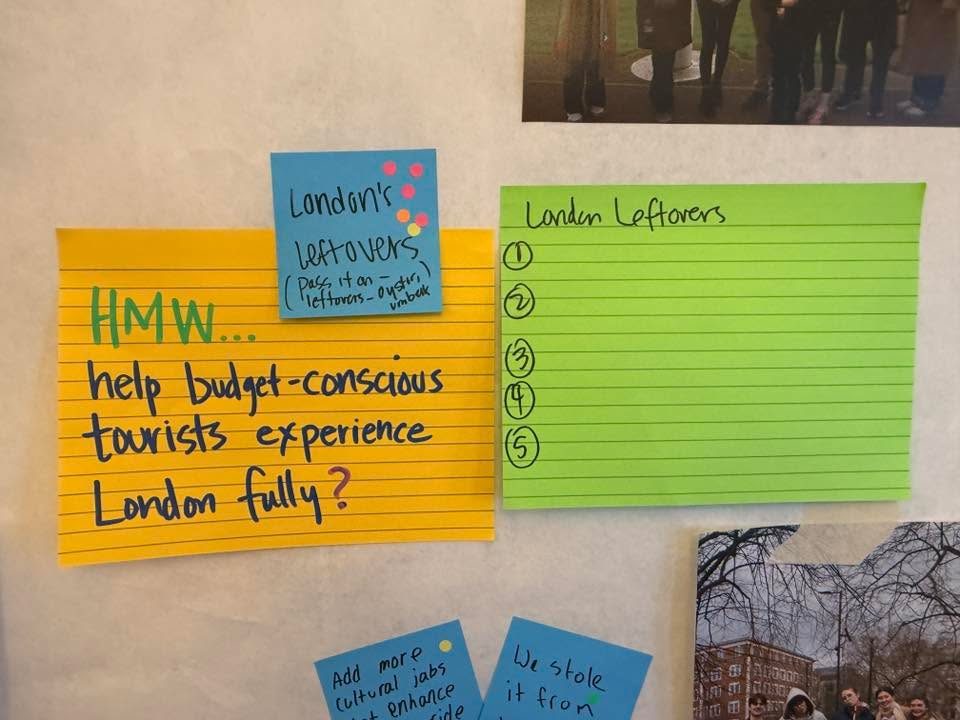
How might we delight tourists in London?
Tweaking the question
The right challenge arrives at a good solution.
Think across experiences, spaces, activities, services and products.
- What is the job, opportunity or problem you are trying to solve?
- Take a stab at writing the HMW design question.
- What is the ultimate impact you are trying to have?
- What are some possible solutions? Does your question allow a variety?
- What are the context and constraints you face?
- Does the original question need adjusting? Try it again!
Generic or insightful?
Ask about everyone and you learn nothing.
Generic research
- Asks about everyone. “What do tourists like in London?”
- Gets stock phrases back. “Tourists enjoy a variety of attractions.”
- No source, no date. Nothing you can check.
- Leads nowhere. You walk into fieldwork with nothing to ask.
Insightful research
- Names a person and a moment. “Why do families with toddlers feel stressed on the Tube?”
- Digs into feelings and workarounds. What they say, think, do and feel.
- Comes with a named source and a date. You can open it and check.
- Ends in a question for real people. Who to interview and what to ask.
Ask a deeper research question
A person, a moment and a feeling.
A strong research question has three ingredients. Then you push it one level deeper.
A specific person
Families with toddlers, solo first-time visitors, wheelchair users, budget backpackers, international students, older travelers.
Watch out: “tourists” is everyone, so it is no one.
A moment or place
Arriving at Heathrow, the Tube, a rainy afternoon, museum queues, the last day.
Watch out: “in London” is not a moment.
A feeling or need
Lost, rushed, anxious, left out, or trying to get something done.
Watch out: a solution (“an app that…”) is not a need.
Ask the next good question
Push every question one level deeper.
- Why ladder: ask why, then why again.
- Say, think, do, feel: what people say often differs from what they do.
- Workarounds: the tricks people invent reveal unmet needs.
- Extremes and mainstreams: study the edges to learn about everyone.
- Analogous inspiration: where else do people feel this way, such as airports, theme parks or hospitals?
Secondary research
Learn what’s already known.
- 1Explore broadlyLook at the most recent news in the field: the internet, newspapers, magazines, journals.
- 2Find innovationsLook for new ideas in your area: technological, behavioral or cultural.
- 3Look at what existsWhich solutions have worked? Which haven’t? Why?
- 4Ground your interviewsUse the facts and figures to understand the context before you go talk to people.
Partner with AI: eight moves
Don’t accept the first answer. Push it.
Push it
“That is too general. Ask me three questions, then give me a better answer.”
Give it a perspective
“Act as a London tourism researcher” or “Act as a skeptical journalist.”
Set guardrails
“Sources from the last three years only. Point out any bias. No solutions yet.”
Apply a framework
“What do these visitors say, think, do and feel?” or “What job are they trying to get done?”
All eight moves, with prompts to try
| Move | Try a prompt like |
|---|---|
| Push it | “That is too general. Ask me three questions, then give me a better answer.” |
| Give it a perspective | “Act as a London tourism researcher” or “Act as a skeptical journalist.” |
| Ask it to organize | “Put findings in a table: finding, who it affects, moment, source, date, fact or opinion.” |
| Reframe a poor answer | “Rewrite that for one visitor in one moment: a wheelchair user arriving at Heathrow.” |
| Set guardrails | “Sources from the last three years only. Point out any bias. No solutions yet.” |
| Show good examples | Paste one strong, sourced finding and ask for more like it. |
| Give it data, ask for if/then | “Given this finding, what if/then hypotheses could we test in the field?” |
| Apply a framework | “What do these visitors say, think, do and feel?” or “What job are they trying to get done?” |
Partnering with AI for HCD secondary research is a BombDiggity framework by Jules Morris and Lane Morris.
Where to look
Use sources you can open and check.
Treat with caution
- “Top 10” listicles and content farms
- Uncited blogs
- AI-generated pages, or AI itself as “the source”
- Reviews and forums: good for interview ideas, not for facts
- Anything with no date
Reputable sources
- VisitBritain and VisitEngland research
- Office for National Statistics travel and tourism data
- Transport for London data and reports
- Greater London Authority and London & Partners
- UN Tourism (UNWTO)
- Peer-reviewed tourism journals through UT Libraries
- Major news outlets
AI is a research assistant, not a source
AI can invent links and numbers. Open every source.
Run your prompts in Microsoft Copilot with your UT login, or another AI tool. Open every source it names and check the claim yourself, because AI can invent links and numbers. Never paste personal or confidential information into an AI tool. If your team uses AI, note how you used it.

Gripes & dreams
What do we know about being a tourist in London?
Brainstorm as a team: gripes on one color of sticky note, dreams on another. These become hunches to test on the street.
This or that
Generic or Insightful? You Pick
For each round, pick the research move that will actually send your team somewhere useful before fieldwork in London.
Try it: AI Research Coach
Tool · IB 407
AI Research Coach
Turn generic AI answers into real insight about London visitors. The coach checks your thinking and builds prompts. You run them in Copilot.
- 1Ask deeper
- 2Prompt
- 3Check
- 4Note
Your design challenge (given): How might we delight tourists in London? You do not need to reword it. Your job is to research it well.
1Ask your research question
What do you want to learn about delighting tourists in London? Type the question you would research. I will tell you how deep it is and what to add, as you type.
All question checks
2Ask the next good question
3Build my AI prompt
Pick a research step and the moves you want. I will write one strong prompt. Paste it into Microsoft Copilot (sign in with your UT NetID) or another AI tool. Never paste personal or confidential information.
Your prompt
4Check what AI gave you
Paste the AI answer, or just its key claims, and the source it gave you. I check patterns: sources, dates, generic phrases and whether it says anything about a real person. I cannot verify facts. Only the source can.
All source checks
Next step
5Insight starter
Found something strong and sourced? Turn it into a starter line for fieldwork. Secondary research tells you where to look. People in London tell you why.
My research notebook
Working question
Question trail
Watch your questions go deeper.
Notebook
Put it to work: research your London challenge before fieldwork
Secondary research sets up your Empathy phase. A team that knows what is already published walks into fieldwork knowing who to talk to, where to find them and what it still needs to learn. Expect your best questions to come back changed after your first interviews.
Split the four steps
Give each teammate one step: scan the field, recent innovations, analogous solutions, facts and figures.
Coach your question to Insightful
Start with whatever you are curious about. Use the AI Research Coach until your question names a person, a moment and a feeling or need.
Prompt, then check
Run the coach’s prompt in Copilot with your UT login. Paste the answer back into the coach. Open every source and confirm each claim before you use it.
Write insight starters
Turn your strongest sourced findings into “We learned that… because… so in the field we will ask…” lines.
Turn it into your interview plan
Use the if/then hypotheses and the people AI suggested as a starting list. Choose who you will talk to first, where you will find them in London, and set your role rotation.
Examples: generic to insightfulThree research trails that go deeper
| Surface | Specific | Insightful |
|---|---|---|
| What do tourists like in London? | What do families visiting London find hard about the Tube? | Why do families with toddlers feel stressed on the Tube, and what workarounds do they use? |
| Tourism in London | How do solo first-time visitors spend their first day? | What do solo first-time visitors expect will happen when they arrive at Heathrow, and where does reality surprise them? |
| Should we build an app for museums? | What frustrates older travelers in museum queues? | Where else do older travelers feel worn out waiting (airports, hospitals), and what do those places do that works? |
These are practice questions, not findings.
Do this, not thatHabits that keep AI research useful
Do this
- Name a person, a moment and a feeling in every question.
- Ask AI for the source name, link and date of every claim.
- Open the source and find the exact page or table.
- Push back when the answer could describe any city.
- End every research session with a question for a real person.
Not that
- Asking “what do tourists like?” and copying the answer.
- Citing AI as the source.
- Trusting a number you have not seen at its source.
- Researching your favorite solution instead of a need.
- Pasting personal or confidential details into an AI tool.
Before you head into fieldworkA quick checklist
- [ ] Each teammate covered one of the four research steps.
- [ ] Each of us has a research question that names a person, a moment and a feeling or need.
- [ ] Every fact on our wall has a source and a date we checked ourselves.
- [ ] We wrote at least three insight starters.
- [ ] We know who we will interview first and where to find them.
- [ ] We noted how we used AI.
- [ ] Every teammate has an interview role, and we know how we rotate.
Go deeper
Back to all IB 407 topics · Next: Empathy Fieldwork and Observation
Part of the Smith GLS human-centered leadership sequence: IB 407, BUAD 317, BUAD 497, BUAD 417 and BUAD 427, toward the Human Centered Consulting Certificate.
Frequently asked questions
How do you use AI for secondary research without getting generic answers?
Start with a specific question, not a broad one. Name a person, such as families with toddlers, a moment, such as riding the Tube, and a feeling or need. Then ask AI to cite reputable sources with links and dates, separate facts from opinions and flag uncertainty. When an answer could describe any city, push back and ask again for one visitor in one moment.
What are the four steps of secondary research before design interviews?
Secondary research has four steps: scan the field with recent news, reports and journals; find recent innovations, whether technological, behavioral or cultural; study analogous solutions in settings like airports, theme parks and hospitals; and gather facts and figures with their sources and dates. Interviews give you stories, while secondary research gives you the context around them. The steps are adapted from the IDEO.org Field Guide.
What makes a research question insightful instead of generic?
An insightful research question names a specific person, a moment or place, and a feeling or need, and it digs beneath the surface with a why, a workaround or a contradiction. "What do tourists like in London?" is generic. "Why do families with toddlers feel stressed on the Tube, and what workarounds do they use?" sends research and interviews somewhere useful.
Which sources are reputable for research on tourists in London?
Reputable sources include VisitBritain and VisitEngland research, Office for National Statistics travel and tourism data, Transport for London data and reports, the Greater London Authority and London & Partners, UN Tourism, peer-reviewed tourism journals through UT Libraries and major news outlets. Treat listicles, uncited blogs, reviews and AI-generated pages with caution, and never cite an AI tool itself as a source.
How do you check whether an AI answer is trustworthy?
Check five things: does each claim have a named source and date, is the source reputable, is the language specific rather than stock phrases, is it recent, and does it say anything about a specific person's need. Then open the source and find the exact page or number, because AI can invent links and statistics. A pattern check cannot prove a fact is true.