
The big idea: Creativity is not a gift a few people are born with. It is a process you can learn, and generative research is where it starts: what you learn from people feeds every idea that follows.
Creativity and where generative research came from

Creativity and where generative research came from
Research feeds creativity.
Class 1 pairs generative research with a short look at how creative ideas happen, then shows where this kind of research came from. Use these panels when you need the background.
Day 1 debrief · Creative Confidence
Everyone is creative. Many of us stopped believing it.
In Creative Confidence (2013), Tom and David Kelley describe the “creativity scar”: the moment someone told us we weren’t creative, and we believed them. Most of us carry one. Research takes the courage to look and ask anyway.
Debrief questions
- When did you stop calling yourself creative, or did you ever?
- Where does fear of judgment show up when you talk to strangers?
- What would you try in this project if you knew no one would grade the first draft?
Source: Kelley, T., & Kelley, D. (2013). Creative Confidence: Unleashing the Creative Potential Within Us All. Crown Business.
The creative process in five stages, after Wallas
Every creative process starts with preparation.
Text version, and four stages or five?
- 1 Preparation: conduct research and gather information.
- 2 Incubation: take time to process your findings.
- 3 Illumination: allow your preparatory work to inform a new idea.
- 4 Evaluation: test your idea via experimentation, prototyping and iteration.
- 5 Verification: share your results with your audience.
Four stages or five?
Wallas’s 1926 model named four stages: preparation, incubation, illumination and verification. The course slides add evaluation, the testing step human-centered design depends on, and use verification for sharing results.
Skip the research, skip the fuel
No preparation, nothing in the tank.
Skip generative research, and incubation and illumination run on empty.
Text version of this diagram
- A fuel gauge reads empty: preparation (generative research) was skipped.
- Incubation has nothing to process.
- Illumination has no spark: no new idea forms.
What is creativity?
Creative means novel and appropriate.
Three lenses:Amabile: novel + appropriateFour levels: doing to creatingNoller: C = fa(K, I, E)
Text version, and more on Amabile, the four levels and Noller
- The drawing: two overlapping circles, novel (new) and appropriate (useful for the need at hand). Creative sits where they overlap.
- An idea that is new but misses the need is only novel. One that is useful but already done is only appropriate.
Teresa Amabile (Harvard Business School) defines creativity as producing ideas that are both novel and appropriate: new, and useful for the problem at hand. Her work names three ingredients in a person: expertise, creative-thinking skills and intrinsic motivation (doing the work because it matters to you). A new idea that does not fit the need is not creative in this sense. Generative research is how you learn what “appropriate” means for the people you serve.
Levels of creativity. The Class 1 slides show four levels: doing (to get something done), adapting (to make something on my own), making (to make something with my own hands) and creating (to express my creativity). Each level asks for more interest and more domain expertise. The table below shows them in full.
Ruth Noller’s creative formula is often written as C = fa(K, I, E): creativity is a function of knowledge, imagination and evaluation, all shaped by your attitude. Research supplies the knowledge. Your team supplies the imagination. Feedback interviews supply the evaluation. A closed attitude shuts all three down.
Where ideas come from: head, heart, body
Ideas come from the whole person.
Text version of this diagram
- Center to outside: head, heart, body.
- The outer ring: materials, places and spaces.
- An arrow rises from the head to an idea.
- Ideas come from the whole person, embedded in the materials, places and spaces around them.
Four levels of creativity
From doing to creating.
Each step asks for more interest and expertise, shown in one kitchen.
Text version: the full table
| Level | Motivation | Requirements | Example |
|---|---|---|---|
| Doing | To get something done, to be productive | Minimal interest; minimal domain experience | Organizing my herbs and spices |
| Adapting | To make something on my own | Some interest; some domain expertise | Embellishing a ready-made meal |
| Making | To make something with my own hands | Genuine interest; domain experience | Cooking with a recipe |
| Creating | To express my creativity | Passion; domain expertise | Dreaming up a new dish |
Noller’s creative formula, drawn
Attitude shapes knowledge, imagination and evaluation.
Text version of this diagram
- C = fa(K, I, E).
- C: creativity. f: is a function of. a: attitude, which shapes the whole function.
- K: knowledge. I: imagination. E: evaluation.
Three ingredients of creativity
Creativity lives where three things overlap.
Text version, and Amabile’s own words
- Expertise: technical and procedural knowledge in the area.
- Creative thinking skills: how flexibly and imaginatively you approach problems.
- Motivation: inner passion to solve the problem. Amabile found this is the one leaders can influence most quickly.
- Creativity happens where all three overlap.
“Within every individual, creativity is a function of three components: expertise, creative-thinking skills, and motivation. Can managers influence these components? The answer is an emphatic yes, for better or for worse, through workplace practices and conditions.”
- Expertise “is, in a word, knowledge: technical, procedural, and intellectual.”
- Creative-thinking skills “determine how flexibly and imaginatively people approach problems. Do their solutions upend the status quo? Do they persevere through dry spells?”
- Motivation “Not all motivation is created equal. An inner passion to solve the problem at hand leads to solutions far more creative than do external rewards, such as money.” Amabile calls it intrinsic motivation, and the work environment influences it most immediately.
Creativity and innovation: users and ideas
New users plus new ideas make a revolution.
Text version of this diagram
- Horizontal axis: existing idea to new idea. Vertical axis: existing user to new user.
- Incremental: existing user, existing idea.
- Evolutionary: existing user, new idea.
- Revolutionary: new user, new idea.
Where it came from: Lewin, Susman and the research cycle
Plan, act, learn, repeat.
Generative research grows out of action research: real problems, real settings, real people.
Text version, and where it came from
- Lewin (1934) coined “action research”: cycles of planning, acting and fact-finding.
- Susman (1983): diagnose, plan, act, evaluate, specify learning.
- Swann (2002): the design process follows the same pattern.
- Stringer (2004): a spiral of look, think and act.
- Mills: focus, collect, analyze, plan, in a dialectic spiral.
- Coghlan and Brannick (2014): a meta-cycle standing on content, process and premise.
Psychologist Kurt Lewin coined the term action research and described it as cycles of planning, acting and fact-finding that help ordinary people work through problems together. Later models drew the same idea as a loop:
- Susman’s model (adapted from Susman, 1983) runs five phases: diagnosing the problem, planning action, taking action, evaluating the results and specifying what was learned. Then the cycle starts again.
- Cal Swann (2002) showed that the design process follows the same pattern: identify and analyze the problem, design and synthesize possible solutions, test a design, produce it, then implement, evaluate and revise.
- Stringer (2004) drew it as a spiral of look, think and act that repeats as you learn more.
Your syllabus labels sometimes say “generative action research” (GAR). In this course it means the same thing as generative research: discovering needs in repeated passes before you commit to a solution. If you want the full tradition, the optional supplemental books are Coghlan and Shani, Conducting Action Research for Business and Management Students, and Mills, Action Research: A Guide for the Teacher Researcher.
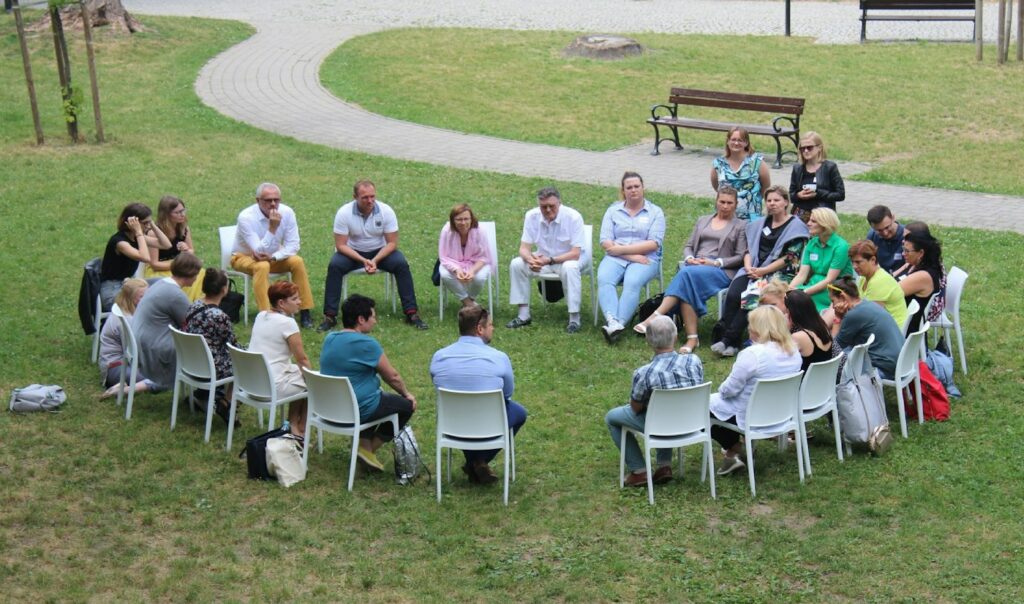
A brief history of action research
Ordinary people, collective discovery.
Kurt Lewin coined “action research” in 1934.
PParticipatoryPeople take part in the inquiry.
DDemocratic impulseEveryone affected has a voice.
CA double contributionTo social science and social change.
More: Kurt Lewin’s idea
Kurt Lewin (1934) coined “action research” as an organizational development tool. It credits the reflective thought, discussion, decision and action of ordinary people who discover things together about their “private troubles.” It runs in cycles of reflection, action and creative problem solving, with a bias toward action, learning and change.
Kurt Lewin’s systems model of action research
Unfreeze, change, refreeze.
Text version of this diagram
- Input, planning: preliminary diagnosis, data gathering, feedback of results, action planning. Stage: unfreezing.
- Transformation, action: learning processes, action planning, action steps. Stage: changing.
- Output, results: changes in behavior, data gathering, measurement. Stage: refreezing.
- Feedback loop A runs from action back to planning. Loop B runs from results back to action. Loop C runs from results back to planning.
Socially and ethically responsive action research
Research done with people, not on them.
- DemocraticEnabling people to participate.
- ParticipatoryBuilding a community of learners.
- EmpoweringProviding freedom from oppressive, debilitating conditions.
- Life-enhancingEnabling expression of full human potential.
Two simple action research cycles
Plan, act, analyze, conclude. Then again.
Text version of this diagram
- Simple cycle: planning, action, analysis, conclusion, then back to planning.
- Mills’s dialectic spiral: identify an area of focus, collect data, analyze and interpret data, develop an action plan.
- Cross-arrows also run from the action plan to collecting data, and from collecting data back to the area of focus.

Practical action research
An emphasis on how to lead.
Practical action research makes four assumptions about leaders.
- Autonomous. Leaders can decide what to study and what to change.
- Committed. To professional development and organizational improvement.
- Reflective. They reflect systematically on their own practices.
- Creative. They design their own research focus and methods to solve problems.
Susman’s cycle and Stringer’s spiral
Five phases, or look, think, act.
Text version of this diagram
- Susman: diagnosing (identifying or defining a problem), action planning (considering alternative courses of action), taking action (selecting a course of action), evaluating (studying the consequences of an action), specifying learning (identifying general findings). Then back to diagnosing.
- Stringer: three overlapping loops, each running look, think, act, spiralling forward.
Goals of action research, and why it counts
Improve lives. Learn the craft.
- Improve lives. Improve, enhance and enrich the lives of people.
- Learn the craft. Lead with creativity and innovation to develop impactful solutions.
- Use visual ways of knowing. Learn and use the visual ways people sense, know, remember and express.
Why it counts:Persuasive and authoritativeRelevantGives leaders access to research findingsSerious research, not a fad
Cal Swann’s iterative design steps (2002)
Research, create, communicate. Loop back.
Text version of this diagram
- Steps: problem, analysis, synthesis, execution, production, evaluation, with arrows looping back between steps.
- Stages: stage 1 research, stage 2 creative, stage 3 communication, with feedback arcs.
- In words: problem identification; analysis of the problem; design and synthesis of possible solutions; execution and testing of a design solution; production of the design; implementation, evaluation and revision of the process.
Progressive problem solving with action research
Each cycle starts higher than the last.
Text version of this diagram
- Cycles 1, 2 and 3 each run: study and plan, take action, collect and analyze evidence, reflect.
- An arrow leads from each reflection to the next cycle’s study and plan. The color deepens each cycle.
The meta-cycle of action research (Coghlan and Brannick, 2014)
A cycle that stands on three legs.
Each step of the cycle is itself a small cycle.
Text version of this diagram
- The tabletop cycle starts at context and purpose, then runs constructing, planning action, taking action, evaluating action.
- The three legs: content, process and premise.
- Each step has its own mini-cycle: experiencing, understanding, judging, taking action.
Planned change through action research
Small cycles climb toward the desired state.
Text version of this diagram
- Start at the current state, beside a context and purpose box.
- Repeated small cycles of construct, plan, act and evaluate climb toward the desired state (complete execution).
- Unexpected events push back into the cycles.
- A dashed path reads: implementation plans for realistic execution.
- General empirical method: be attentive, be intelligent, be reasonable, be responsible.

Co-creation and stories as data
Stories are the data. Storytellers help make sense of them.
- Co-creation can be a mindset, a method or a tool.
- Narrative research: people make meaning by telling stories, so stories are the data.
- Participative narrative inquiry: storytellers also help make sense of their stories.
More: stories as data
Co-creation can be three things. As a mindset, it is the belief that the people you serve are partners. As a method, it is a planned session where people design with you. As a tool, it is a specific kit, such as a card sort or a collage, that helps people express what they know. Sanders and Stappers describe this shift from designing for people to designing with them.
Generative research is narrative research. Narrative research relies on people’s spoken, written or visual accounts of their own experiences. People make meaning of their lives by telling stories, so stories are the data. You listen for the experience story and the epiphany, the moment something changed for the person.
Participative narrative inquiry goes one step further: the people who share stories also help make sense of them, for example by sorting their own stories into themes or reacting to patterns your team found. It keeps interpretation honest because the storytellers can say “that is not what I meant.”
What is narrative research? The power of stories
Stories are the data.
“As humans, the truth about experiences and stories is… that’s all that we are.”
Class 1 supplemental slides
More on narrative research
- It emphasizes the experiences of people as told through their stories.
- It studies (listens to) people’s experiences, embraces the stories of a life and explores the learned significance of those experiences.
- Stories are the data that help us understand people better.
- Narrative inquiry can be both a method and the phenomenon under study.
Co-creation as mindset, method or tool, drawn
Each kind of co-creation adds a different value.
Text version of this diagram
- Levels of value, bottom to top: societal, use and experience, monetary.
- Design development process: pre-design, discover, design and make, market and sell, after sale.
- Co-creation as a mindset: societal row, pre-design to design and make.
- Co-creation as a method: use and experience row, discover to market and sell.
- Co-creation as a collection of tools and techniques: monetary row, design and make to after sale.
Participative narrative inquiry, drawn
Collect, make sense, return.
Text version of this diagram
- Participatory: when people work with their own stories.
- Narrative: to explore values, beliefs, feelings and perspectives.
- Inquiry: somebody always finds out something useful about something.
- PNI sits where all three overlap.
- Storying research cycle: collection, sense-making, return.
Hot take
Hot Takes on Creativity
Pick a side on each creativity claim, argue it with your team, then see what this topic says.
Unlock this topic
Do the work, earn the stop
Finish each step on this page to unlock the button that adds this topic to your research trail.
Back to all BUAD 317 topics · Back: Generative Research: The Research Engine of Human-Centered Design · Next: Framing the Challenge
Part of BUAD 317, taught by Lane Morris, PhD and Jules Morris, PhD, in the Smith GLS human-centered leadership program, toward the Human Centered Consulting Certificate.