Case study · Marketing 465 · Presenting Like Pros
Simon Sinek gave one of the most-watched TED talks ever with no slides, just a marker and three circles drawn on a flip chart. His talk shows how one simple model, repeated and returned to, can carry a whole presentation.

Brand
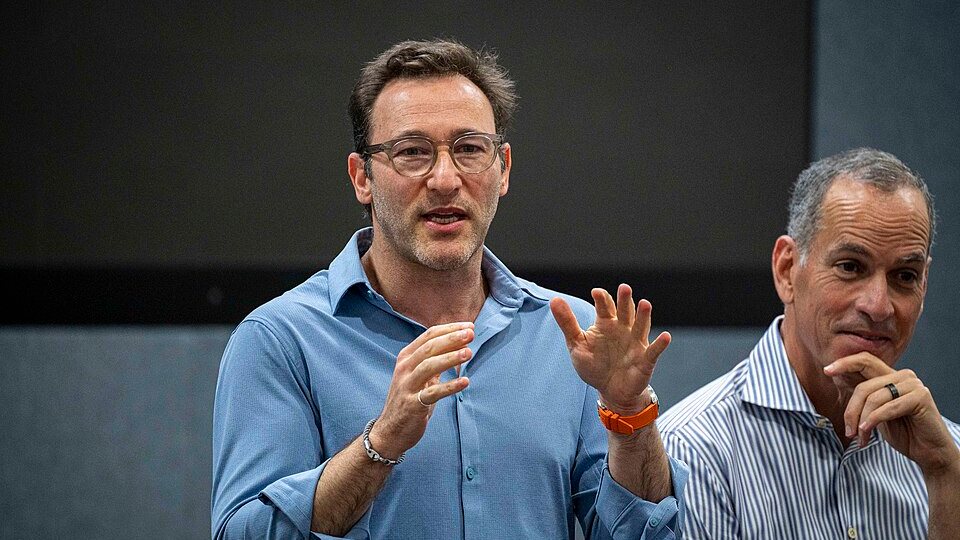
Simon Sinek, author and speaker
Year(s)
2009 to 2026
Channel(s)
Live talk at TEDxPugetSound, TED.com, YouTube, a bestselling book
Goal
Explain why some leaders and brands inspire people while others only inform them
Topic
Presenting Like Pros
71 million+
Plays of the talk on TED.com alone (TED, 2026)
3rd
Most-watched talk on the TED site, as Sinek’s own site reports (simonsinek.com)
18 min
Running time, with a single drawing as the only visual (TED)
171,000
Paperback copies of Start with Why sold in one year, the top-selling leadership book from mid-2016 to mid-2017 (NPD BookScan via Wikipedia)
The situation
In 2009 Simon Sinek was a marketing consultant with a new book, Start with Why. He was invited to speak at TEDxPugetSound, an independently organized TED event in Seattle, not the main TED stage.
His idea was simple. Most organizations explain what they do, then how they do it. The ones people love start by explaining why they exist. He called the model the Golden Circle.
The challenge
Leadership and branding talks are everywhere, and most of them blur together. Sinek had no famous company behind him and no fancy production. He needed an idea that a room could grasp in seconds and remember after they left.
He also needed the idea to travel. A talk filmed at a local event only spreads if viewers can repeat it to someone else in one breath.
What they did
Sinek skipped slides entirely. He walked to an easel with a flip chart and drew three rings, labeled WHY in the center, then HOW, then WHAT on the outside. That drawing became the visual anchor for the whole talk.
He then ran a short list of examples through the same model: Apple, Martin Luther King Jr. and the Wright brothers. Each example ended at the same conclusion, so the audience heard the core idea again and again in different clothes. When he moved to a second concept, the curve of how new ideas spread through a population, he went back to the flip chart and drew again.
- One model: three circles, three words. Anyone could sketch it on a napkin afterward.
- Drawn live: building the picture in front of the room kept attention on him, not on a screen.
- Repetition: the key line comes back many times, which the audience starts to anticipate.
- Familiar examples: stories most people already knew, so no time was spent on background.
- A clear opening question: he asked why some people and organizations inspire while others do not, then answered it.
TED posted the video online, where it found an audience far larger than the room it was filmed in.
What happened
- September 2009: Sinek gave the talk at TEDxPugetSound (TED). One source dates it to 2010, so expect to see both.
- The talk became the third most-watched on TED.com, according to Sinek’s own site (simonsinek.com).
- By 2014 Sinek was the third most-watched TED speaker of all time, with about 22 million views at that point (Fortune, 2014).
- Mid-2016 to mid-2017: Start with Why was the bestselling leadership book in the period tracked by NPD BookScan, with 171,000 paperback copies (Wikipedia).
- 2026: the TED.com page shows more than 71 million plays (TED, 2026).
- The catch: views measure attention, not whether the model is true or useful.
Why it worked
The visual was the idea. Three circles are the talk. Because the drawing and the message were the same thing, viewers could pass it along without the video. That is rare for a presentation visual.
Low tech kept the focus on him. A marker and paper made the talk feel like a conversation with a smart friend, not a pitch. Presentation coaches point to it as a model for presenting without PowerPoint.
Repetition built memory. Sinek returns to the same line and the same drawing again and again. By the end the audience can finish his sentences, which is exactly the point where an idea starts to spread.
Where it gets complicated
- The brain science is shaky. Sinek ties the Golden Circle to the structure of the brain. Critics point out that the model he leans on is outdated, and neuroscientists have rejected it.
- People do not only buy why. A business school critique notes that most customers still weigh price, quality and convenience. Purpose helps, but it does not save a weak product.
- The examples are simplified. Writers have argued that the Wright brothers and Martin Luther King Jr. stories are trimmed to fit the model.
- A clean model can hide weak evidence. The same simplicity that makes the talk memorable makes it hard to test. A great presentation is not proof.
The takeaway
The marketing principle
One simple visual, repeated, beats twenty slides. If your audience can redraw your main idea from memory and explain it to a friend, your talk will travel. Just remember that a model being easy to share does not make it right, so back it with evidence.
Sources
- How great leaders inspire action, TED (2009)
- Simon Sinek’s TED Talks, simonsinek.com (n.d.)
- Presenting Without PowerPoint: Lessons from Simon Sinek, Mindful Presenter (n.d.)
- Why is Simon Sinek’s TED Talk So Important?, Speeko (2023)
- 7 powerful public speaking tips from Simon Sinek, Fortune (2014)
- Start with Why, Wikipedia (2026)
- Start with Why. Just Don’t End There, Walton College, University of Arkansas (n.d.)
- The story of why, Nick Asbury (Substack) (n.d.)
Group activity for this case
Draw Your Client’s Circle
Boil your client’s message down to one drawing your audience could redraw from memory. A 20-minute group activity. Dr. Morris gives the password in class.
Use this case in: Presenting Like Pros · All case studies
Use and share this case
Free to use in your own classroom, training or team, and to adapt for non-commercial teaching, with credit to Dr. Jules Morris, Haslam College of Business, University of Tennessee. The text is licensed CC BY-NC 4.0. Brand photos and trademarks belong to their owners and are not covered by this license.
Brand names, images and trademarks belong to their owners and appear here for educational purposes only.