Case study · Marketing 465 · Presenting Like Pros
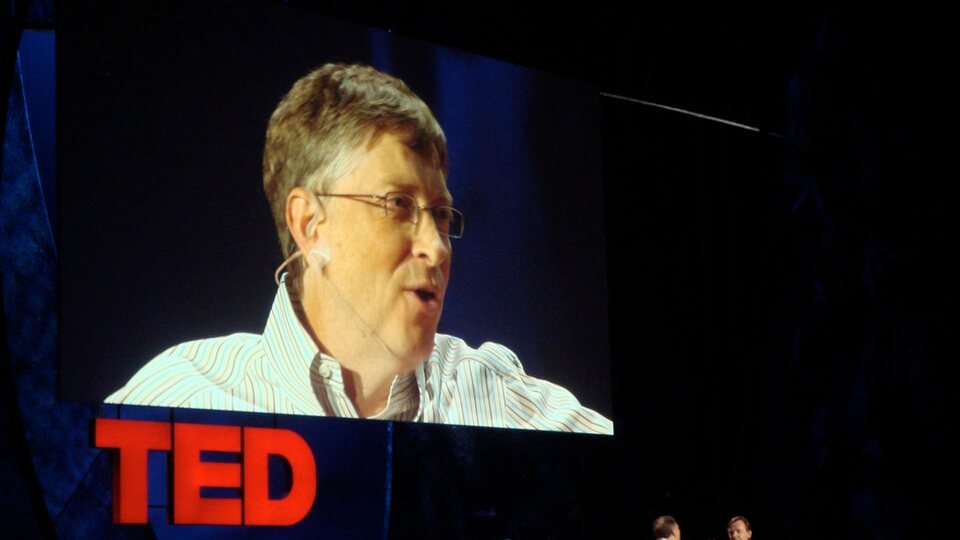
In 2009 Bill Gates opened a jar of mosquitoes on the TED stage and let them fly into the audience. In a few seconds, a disease that most people in the room had never worried about became something they could feel.

Brand
Bill Gates and the Gates Foundation
Year(s)
2009
Channel(s)
Live talk at TED2009, TED.com, news coverage, Twitter
Goal
Get a wealthy, comfortable audience to care about malaria
Topic
Presenting Like Pros
~1 million
Yearly malaria deaths Gates cited in the talk (TED Blog, 2009)
200 million+
People Gates said were sick with malaria at any given time (TED Blog, 2009)
$168.7M
Gates Foundation pledge for a malaria vaccine the year before (The Register, 2009)
5.3 million+
Plays of the talk on TED.com (TED, 2026)
The situation
In 2009 Bill Gates was spending his time on the Gates Foundation. Two of its big bets were fighting malaria and improving teaching in American schools.
TED invited him to speak at its 2009 conference in Long Beach, California. The audience was full of tech, media and design leaders, people who mostly lived far from any risk of malaria.
The challenge
Malaria was a huge killer, but to this room it was a statistic about other people in other places. Gates himself pointed out the gap with a joke: the world spends more on drugs for baldness than on malaria, because baldness happens to rich people.
He needed a way to close that distance in a short talk, without guilt-tripping a crowd that came to be inspired.
What they did
Gates walked through the history of malaria and why progress against it kept stalling. Then he picked up a jar. He explained that malaria spreads through mosquitoes, said he had brought some, and opened the lid. As the insects drifted out, he added that there was no reason only poor people should have the experience.
For a few moments the room did not know whether to laugh or duck. Then Gates told them the mosquitoes were not infected. He went on to the second half of his talk, which was about what makes a great teacher.
- A prop with risk: live insects meant the audience could not just watch. They were part of it.
- A line that reframed the problem: the joke about poor people turned a distant disease into a question of fairness.
- Delayed relief: he let the tension hang before saying the mosquitoes were safe.
- Numbers after the feeling: the death and infection figures landed harder once the room was paying attention.
What happened
- February 4, 2009: Gates released the mosquitoes during his TED2009 talk (Newser, 2009).
- Within hours, attendees were posting about it on Twitter and news outlets including NBC News and The Register picked it up (NBC News, 2009; The Register, 2009).
- TED curator Chris Anderson joked about the headline: Gates releases more bugs into the world (The Register, 2009).
- Some outlets called it a swarm. TED organizers said only a few mosquitoes were released (BizBash, 2009).
- The talk, titled Mosquitos, malaria and education, now shows more than 5.3 million plays on TED.com (TED, 2026).
- The catch: coverage spread fast, but there is no public measure of whether it changed giving or policy on malaria.
Why it worked
It moved the audience from watching to feeling. A statistic asks you to imagine. A mosquito near your face does not. For a moment, a comfortable crowd felt a small slice of the risk that malaria-area families live with every night.
The surprise was on message. Plenty of stunts grab attention and then leave people asking what the point was. This one was the point. You cannot tell the mosquito story without also telling people how malaria spreads and who it hits.
It made the talk retellable. Few people could repeat Gates’s charts. Almost everyone who heard about the talk could repeat that he let mosquitoes loose. That is how a talk travels after the room empties.
Where it gets complicated
- Some saw a rich man’s stunt. A World Bank blog called him a prankster, and others asked whether jokes about bugs would help the cause or just get laughs.
- The moment ate the message. The second half of the talk, about teacher quality, got far less attention. One big moment can drown out everything around it.
- Reporters got the facts wrong. One outlet said malaria killed 100 million people a year, a number far beyond what Gates said. Even a vivid talk needs clear numbers people can repeat correctly.
- Not every stage allows it. Releasing live insects worked at TED. In most rooms it would be a safety problem, so the lesson is the idea, not the jar.
The takeaway
The marketing principle
Facts inform, but experiences persuade. When your audience is far from the problem, find a safe way to bring a small piece of it into the room. Make sure the moment carries your message, or people will remember the stunt and forget why you did it.
Sources
- Mosquitos, malaria and education, TED (2009)
- Bill Gates’ talk (live blog), TED Blog (2009)
- Bill Gates releases mosquitoes into audience, NBC News (2009)
- Gates looses mosquitoes on tech conference bloodsuckers, The Register (2009)
- Gates Lets Mosquitoes Fly at Audience, Newser (2009)
- TED Conference Opens in Long Beach, as Bill Gates Releases Mosquitoes, BizBash (2009)
- Bill Gates mosquito stunt generates buzz, The Chronicle of Philanthropy (2009)
- Bill Gates, prankster, World Bank Blogs (2009)
- Bill Gates released swarming mosquitoes to make a point about malaria, CNBC (2017)
Group activity for this case
Bring the Problem Into the Room
Design a safe, small experience that lets your audience feel the problem your client solves. A 20-minute group activity. Dr. Morris gives the password in class.
Use this case in: Presenting Like Pros · All case studies
Use and share this case
Free to use in your own classroom, training or team, and to adapt for non-commercial teaching, with credit to Dr. Jules Morris, Haslam College of Business, University of Tennessee. The text is licensed CC BY-NC 4.0. Brand photos and trademarks belong to their owners and are not covered by this license.
Brand names, images and trademarks belong to their owners and appear here for educational purposes only.