Case study · Marketing 465 · Copywriting for Digital Channels
Innocent Drinks treated the back of every smoothie bottle as free ad space and filled it with chatty, silly, friendly copy. The voice became so famous that copywriters are still asked for “Innocent magic,” and so copied that critics gave the trend a name.
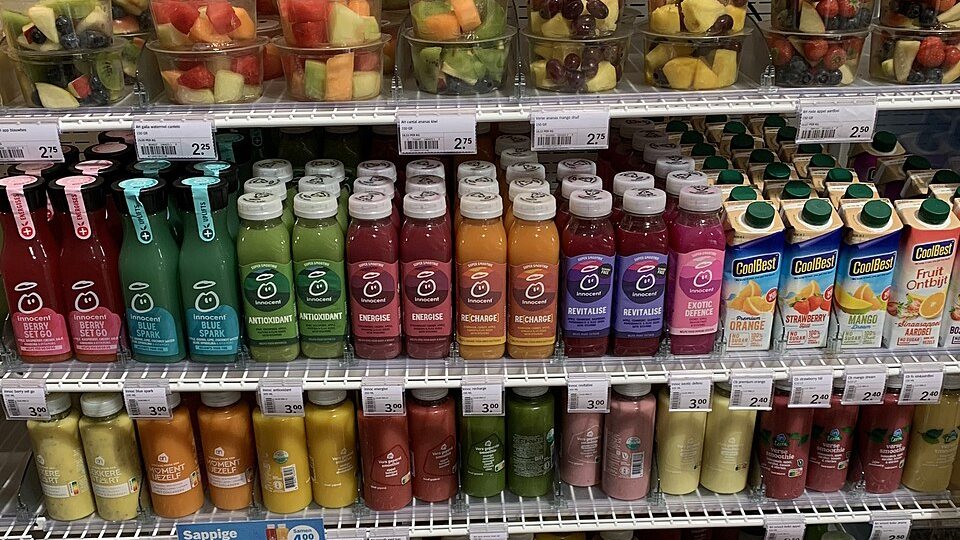

Brand
Innocent Drinks (UK, majority-owned by Coca-Cola since 2010)
Year(s)
1999 to 2026
Channel(s)
Bottle and carton labels, website, social media, charity campaigns
Goal
Build a big brand on a small budget by making the package do the talking
Topic
Copywriting for Digital Channels
90 to 100
Words of copy on the back of each bottle or carton (Creative Bloq)
£209M
Turnover in 2012, double its 2008 figure (Marketing Week, 2013)
90 to 99%
Share of Innocent that Coca-Cola moved to own in 2013, after a first £30M stake in 2009 (Marketing Week, 2013)
18
Markets where Innocent rolled out refreshed labels in 2024, keeping the playful back-of-pack copy (Packaging Europe, 2024)
The situation
Innocent started in the late 1990s when three friends sold smoothies at a London music festival. They asked customers whether they should quit their jobs, with a YES bin and a NO bin for the empty bottles. The YES bin won.
The founders had little money for advertising. What they did have was a bottle that every customer held in their hand for several minutes.
The challenge
Fruit drinks all make similar promises: natural, healthy, tasty. On a crowded shelf, a new brand with no ad budget can easily disappear.
Innocent needed a way to stand out and build a relationship with drinkers without paying for TV. It also needed a voice that matched what the company believed about honest ingredients and treating people well.
What they did
Innocent designed its first packaging in house and wrote its labels like notes from a friend. The back of each pack carries around 90 to 100 words, and head of creative Dan Germain has called that copy the most important part of the packaging.
The copy jokes, admits things and pokes fun at itself. One early ingredient list included “plump nuns” as a joke about purity, until a trading standards officer told the company to remove the nuns or put them in the drink.
- The pack is the ad: every bottle sold is a few minutes of attention the brand does not pay for.
- Talk like a person: short sentences, first person, no corporate words.
- Play, even in the boring parts: the nuns joke landed in an ingredient list, the last place anyone expects a laugh.
- Voice backs up values: the friendly tone sits on top of real claims about fruit and ingredients.
The same voice carried over to the company’s website, social media and its Big Knit charity campaign, where customers knit tiny hats for bottles.
What happened
- 2009: co-founder Richard Reed and Dan Germain published a book about the company’s story and voice, and design writers called the tone an icon of effective communication (Eye, 2009).
- April 2009: Coca-Cola bought its first stake, about £30 million (Wikipedia; Eye, 2009).
- 2011: writers were already complaining about a wave of copycat brands using the same chatty voice, a trend critics called wackaging (The Writer, 2011).
- February 2013: Coca-Cola moved to own 90 to 99% of the company; Nielsen ranked Innocent the top smoothie brand in Europe (Marketing Week, 2013).
- October 2024: Innocent began rolling out new labels across 18 markets, keeping playful copy on the back of every pack (Packaging Europe, 2024).
- The catch: Innocent’s growth also came from product, distribution and timing, so the voice cannot take all the credit.
Why it worked
It used space nobody else used. Most brands put legal text and nutrition facts on the back. Innocent filled it with something people wanted to read. That turned a required surface into a media channel.
It rewarded attention. People read the bottle while they drink. A joke where they expect boilerplate gives them a reason to keep reading and to show a friend.
The voice matched the product. Friendly, simple words fit a drink sold as simple and natural. Eye’s reviewer argued the tone grew out of what the company actually believed, which is why it felt real instead of forced.
Where it gets complicated
- About that famous line. “Stop looking at my bottom” is widely quoted as Innocent copy from the base of a carton. We could not trace it to a dated pack or an Innocent source, so treat it as reported.
- Who invented the voice is disputed. Copywriter Paul Burke has written that he created the tone at an ad agency and now regrets it. Innocent has said the tone was not a deliberate choice.
- Cute can curdle. Critics say the style became twee, and that hundreds of copycats made chatty packaging feel like a cliché. A voice that works for one brand can feel fake on another.
- Friendly is not the same as true. Innocent has faced regulator rulings on health and environmental claims. A charming voice does not excuse a claim you cannot back up.
The takeaway
The marketing principle
Every surface your customer touches is a chance to talk to them. Write the way your brand would talk if it were a person at the table, and hide a reward for the people who read closely. Just make sure the voice is yours, and that every friendly claim is still true.
Sources
- Case study: Innocent drinks, Creative Bloq (n.d.)
- All the juice that fits, in bite-size bits, Eye Magazine (2009)
- Why I regret inventing the Innocent smoothie brand, The Spectator (2019)
- Hello, I’m your crisp packet, please be my friend, The Writer (2011)
- Coke increases stake in Innocent to near 100%, Marketing Week (2013)
- Innocent Drinks refreshes labels to showcase products and guide consumers, Packaging Europe (2024)
- Innocent Drinks, Wikipedia (2026)
Group activity for this case
Write the Back of the Bottle
Find an unused surface your client’s customers already look at and write copy for it in your client’s voice. A 20-minute group activity. Dr. Morris gives the password in class.
Use this case in: Copywriting for Digital Channels · All case studies
Use and share this case
Free to use in your own classroom, training or team, and to adapt for non-commercial teaching, with credit to Dr. Jules Morris, Haslam College of Business, University of Tennessee. The text is licensed CC BY-NC 4.0. Brand photos and trademarks belong to their owners and are not covered by this license.
Brand names, images and trademarks belong to their owners and appear here for educational purposes only.