Case study · Marketing 465 · Presenting Like Pros
Al Gore gave the same climate slideshow more than 1,000 times before it became An Inconvenient Truth, a film that won two Oscars. The talk worked because he kept rebuilding it around one clear story and one unforgettable picture.

Brand
Al Gore and An Inconvenient Truth
Year(s)
1989 to 2006, and still touring
Channel(s)
Live talks, a feature documentary, a trained network of volunteer presenters
Goal
Make a slow, abstract problem feel urgent to everyday audiences
Topic
Presenting Like Pros
1,000+
Times Gore had given the slideshow by the time the film was made (Duarte; Wikipedia)
$1.5M to $50M
The film’s budget compared with its worldwide box office (Wikipedia)
2
Oscars won, the first documentary to take home two (Wikipedia)
12,000
People from 136 countries trained to give a version of the talk (Pacific Standard)
The situation
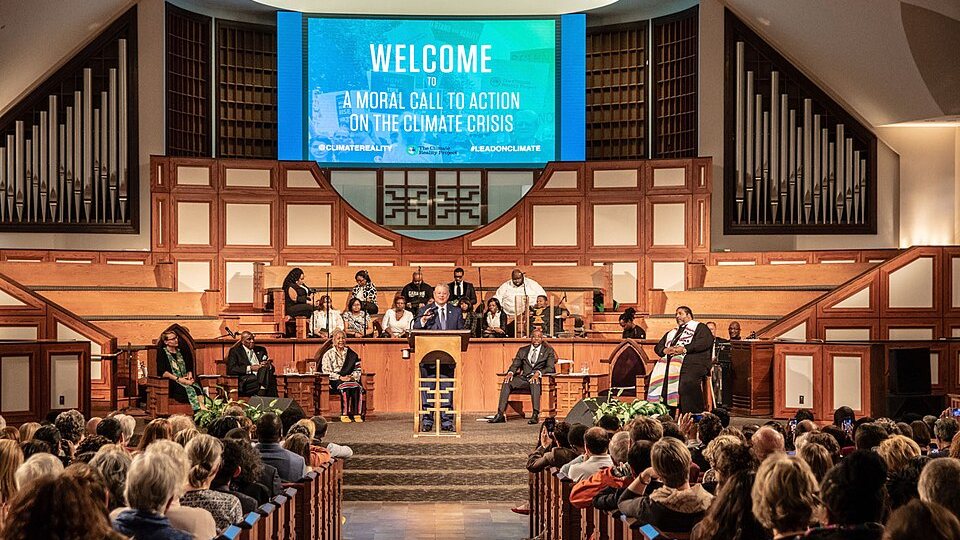
Al Gore started giving a climate change talk in 1989 and never really stopped. He began with old 35mm slides in a carousel, then moved to a digital deck that he revised for every audience and city.
By the mid-2000s he had delivered it more than 1,000 times. In 2004, producer Laurie David saw a short version at a New York town hall and decided it belonged on a movie screen. Director Davis Guggenheim was skeptical until he watched the talk himself.
The challenge
Climate change is a hard thing to present. The data spans hundreds of thousands of years, the effects arrive slowly, and most audiences have never seen an ice core. A chart full of lines can be accurate and still leave a room feeling nothing.
Gore also faced audiences who doubted him or the science. He needed a talk that a general audience could follow, that could stand up to critics, and that could be adjusted for politicians, scientists or church groups without losing its spine.
What they did
Gore worked with Duarte, a presentation design firm, to turn stacks of research into clean visuals. The team scanned his old slides, pulled fresh data from research papers, and sketched several versions of each slide before picking the strongest one with him.
The most famous moment is a single chart. A graph of carbon dioxide levels covering 650,000 years stretches across the stage. When Gore gets to the present day, the line climbs so high that he rides a mechanical lift up the side of the screen to follow it into the projected future. The audience laughs, then goes quiet.
- One story: the whole talk builds toward a single idea, that the change is real, human-caused and fixable.
- Big visuals, few words: dark backgrounds, simple line drawings, photos of real places, and charts with one point each.
- A physical moment: the lift turns a data point into something people watch happen.
- Local versions: Gore swapped in regional photos and examples so each audience saw its own backyard.
- Constant revision: he kept a growing library of over 1,000 slides and rebuilt the talk as the science changed.
The film version kept the lecture at its center and wrapped it with scenes from Gore’s life on the road.
What happened
- January 24, 2006: the film premiered at the Sundance Film Festival (Wikipedia).
- May 24, 2006: it opened in New York and Los Angeles; NPR critics singled out the lift scene the same week (NPR, 2006).
- 2006: Gore founded the group now called the Climate Reality Project, which trained volunteers to give his talk in their own communities (Wikipedia).
- February 2007: the film won Oscars for Best Documentary Feature and Best Original Song (Wikipedia).
- Later years: Gore kept giving the talk more than 100 times a year and saw a sequel film released in 2017 (Pacific Standard).
- The catch: public opinion on climate has many causes, so the film’s exact effect on attitudes is hard to measure.
Why it worked
He had rehearsed it a thousand times. The film did not invent a presentation. It captured one that had been tested in front of real rooms for years. Every joke, pause and transition had already been tried on audiences who did not want to be there.
One moment carried the data. Most people cannot remember a parts-per-million figure. They remember a man riding a lift because the line on the chart went off the top of the screen. The prop made the scale of the number something you could see in a body.
The talk bent without breaking. Gore kept the core story fixed and changed the examples for each audience. That let one presentation work for a statehouse, a church and a movie theater.
Where it gets complicated
- It was not exactly a cherry picker. The scene is often described that way, but descriptions of the film call it a mechanical or scissor-style lift. Small details drift as a story gets retold.
- A court found errors. In 2007 a UK High Court judge ruled the film was broadly accurate but listed nine points where it went beyond the science, and said schools must explain them when showing it.
- The numbers vary. Sources give different counts for how many times Gore gave the talk, from 1,000 to more than 1,800, and they even disagree on which slide software he used.
- The messenger mattered. Gore was a former vice president. Some audiences trusted the talk because of him, and some dismissed it for the same reason.
The takeaway
The marketing principle
Great presentations are rehearsed into shape, not written into shape. Give the same talk to real audiences, keep the one story that never changes, and find one moment that makes your biggest number physical. People forget the slides. They remember what they saw you do.
Sources
- Presenting Al Gore’s An Inconvenient Truth, Duarte (n.d.)
- An Inconvenient Truth, Wikipedia (2026)
- An Inconvenient Truth (review and discussion), NPR (2006)
- An Inconvenient Truth (2006), Filmsite (n.d.)
- The Slideshow That Wants to Save the World, Pacific Standard (n.d.)
- How to Improve Your PowerPoint Presentations, Datamation (n.d.)
Group activity for this case
Find Your Lift Moment
Pick your client’s most important number and design one moment that makes it impossible to forget. A 20-minute group activity. Dr. Morris gives the password in class.
Use this case in: Presenting Like Pros · Presenting Creative Work · All case studies
Use and share this case
Free to use in your own classroom, training or team, and to adapt for non-commercial teaching, with credit to Dr. Jules Morris, Haslam College of Business, University of Tennessee. The text is licensed CC BY-NC 4.0. Brand photos and trademarks belong to their owners and are not covered by this license.
Brand names, images and trademarks belong to their owners and appear here for educational purposes only.