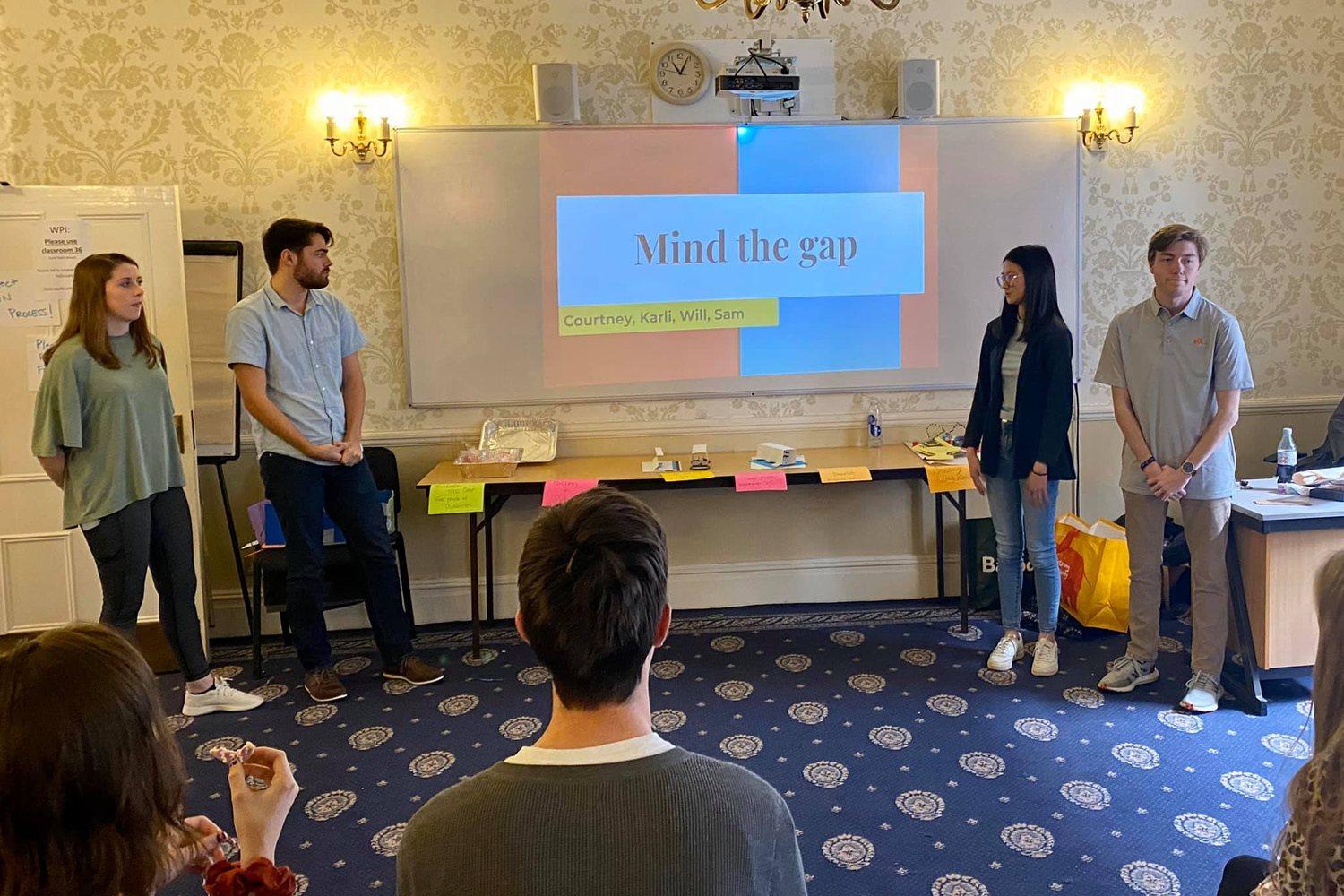
The big idea: Your Capstone is a 15 to 20 minute story of how your team got from people’s needs to a tested prototype, and your summer plan is the commitment that keeps that prototype moving into BUAD 497.
In 60 seconds
- The Capstone is a 15 to 20 minute team story from people’s needs to a tested prototype.
- Show the prototype, the testing and what changed, in more formats than slides.
- A summer plan with a meeting rhythm, measurable goals and named stakeholders carries the project into BUAD 497.
Do this: budget your Capstone to 15 to 20 minutes, rehearse it to the clock, and email your team a summer plan before Class 14 ends.
How the Capstone presentation works
In Class 14 your prototype team presents its Capstone: a 15 to 20 minute story of how you got from people’s needs to a tested prototype, and why we should believe in it. It is graded as Deliverable #4. It is also the first draft of the story you will tell all through senior year.
The time box
15 to 20 minutes, in class, as a team. Rehearse with a timer. Going long means cutting your strongest evidence on the fly.
Be creative
The outline does not have to run in order or in formal sections. Open with a video and follow with a few slides, build a mural and talk through it, act out the experience, even write a song. Some slides are fine. Make us believers.
The Capstone outline
The 2027 syllabus lists what your Capstone should cover. Each part draws on work you already did this semester.
| Part | What to cover | Draw on |
|---|---|---|
| Working title and team | A clear, engaging project name and every team member. | Your prototype team |
| Genesis | How did you get here? What prompted this prototype idea? | Part A interviews, Part B brainstorm |
| Ideal customer | Who is it for? Be specific about the person and the moment. | Part A, need finding, jobs to be done |
| What makes it unique | How it differs from what people use or do today. | Secondary research, Part A |
| Desirable, feasible, viable | Evidence for each lens, and sustainable too if it fits. | Part D lens notes |
| Your prototype | Briefly introduce it. Show it if you can. | Part C |
| Research, findings, testing and iterations | A short overview: who you heard from, what you learned, how each version changed. | Parts A to D |
| Spreading the word | How will people find out about your idea? | Findable pillar, feedback interviews |
| The experience | Take us inside it: what will the user think, feel and see? | Empathy map, Part D observations |
| Early business case | First ideas on value, cost and who pays. Optional to perfect, useful to start. | Viable lens, expert interviews |
The syllabus also asks you to share the relevant, credible evidence you have so far and how you plan to find the additional evidence the senior project will need. Your summer plan answers the second half.
What the Capstone rubric rewards
D#4 is graded on presentation and storytelling: share the prototyped idea, pitch your idea and your process, and say what worked and what did not.
Beginning
Tries to show a prototype to see how well it works, but cannot tell a story about the solution.
Developing
Describes the solution with some link to the user’s point of view or empathy. Feedback is organized into actionable results.
Meets expectations
Links prototyping, point of view and empathy for a user. Shows feedback on specific features and how it shaped new versions.
Highest level
A captivating, user-focused story that ties together empathy, point of view, prototyping and real-world testing with a range of users and scenarios.
Story craft lives elsewhere
For story arcs, opening hooks and pitching under time pressure, use Storytelling and the Final Presentation (IB 407) and Pitching Your Prototype (BUAD 497). This page covers what the BUAD 317 Capstone asks for and what comes next.
How the summer plan and BUAD 497 connect
Class 14 is not the end. Your prototype team stays together through senior year, and the syllabus says it plainly: the project is just beginning, and the work should continue through the summer. Three things carry it forward: a summer project plan, a slide and poster template, and the BUAD 497 technical report.
Your HCD project plan for the summer
When fall semester starts, your team gives an update on how far the prototype has come. Agree on these answers before you leave for the summer.
How you will work together
Your goals for meeting over the summer, and when you will meet in the fall besides class.
Strong answer: a set rhythm (“every other Sunday by video”), not “we’ll text.”
Your prototype timeline
How you will keep developing the prototype: a summer goal and a fall goal.
Strong answer: a number you can check (“version 4, tested with 5 more users”).
Who you will speak with
Your plan for getting more input from key stakeholders. Name them by role.
Strong answer: users, an expert and a decision maker, each with a reason.
One template, from Capstone to poster
The course’s PowerPoint and poster template has ten parts. You can use it to build your Capstone slides, and the same structure becomes your EUReCA poster in the spring of senior year.
Title and team info
Project name, team name and members, course, instructors, semester, Smith GLS logo.
Inquiry statement
The real-world challenge, why it matters to your users, how it emerged from listening and observing, framed as “How might we…?”
Generative research process
Your methods, who you involved and how you built trust, and one user quote or insight that guided you.
Insight and interpretation
Patterns, tensions and surprises. Optional visuals: empathy map, journey map, persona, insight clusters.
Ideation: your solution
What you created, how it was co-developed or tested, with a sketch, mock-up or prototype image.
Reflection and iteration
The feet-on-the-street feedback you received, how you revised, what worked and what did not.
Implementation: business plan elements
Who benefits, key parts of your Value Proposition Canvas and Business Model Canvas, social or community impact.
Action and learning loop
What you would do next (refine, re-test, scale, new stakeholders), what you still wonder, what you would do differently.
Key takeaway or theory of change
What you learned as researchers and designers. Optional: “If we [do this], then [this outcome] is more likely for [this group].”
QR code
A link to your full report, prototype, video pitch or slide deck.
Visual tips from the template
Make your inquiry and process visible. Use clear headings, diagrams and user-centered visuals. Avoid walls of text and go for flow and storytelling. Practice a 2 to 3 minute walk-through that moves from research to insight to impact.
Sneak preview: the BUAD 497 technical reportWhere your 317 work lands in senior year
The syllabus includes the full outline of the senior technical report so you can see how BUAD 317 and BUAD 497 build on each other. Much of it is work you have already started.
| What you did in BUAD 317 | Where it lands in the report |
|---|---|
| Secondary research with AI (D#2) | Literature review and the introductions to each phase |
| Feet on the Street interviews (Part A) | Generative action research approach: needer group, extremes and mainstreams, conversation starters, photos and notes, empathy map |
| Interpretation and brainstorm (Parts A and B) | Interpretation phase: themes, needs and pain points, the current versus ideal experience; ideation phase: How Might We, brainstorming methods, clustered ideas |
| Rapid prototype (Part C) | Prototype description and concept development: what you prototyped and why |
| Feedback interviews (Part D) | Prototype testing, iteration and refinement |
| Capstone and summer plan (D#4) | Executive summary story, deployment plan, pilot and define success |
Throughout the report, ideas are judged on the same four lenses you used this spring: desirable, feasible, viable and sustainable. The front matter (title page and executive summary) is read first but written last.
See The HCD Technical Report (BUAD 497) for the full outline and how to write each section.
Deliverable #5: team evaluationA short, confidential look back at your prototype team
D#5 is individual and confidential. Complete it on your own and do not share it with your GLS colleagues. You rate each prototype teammate from 1 to 5 on five criteria:
- Reliability. Fulfilled responsibilities on time and with quality.
- Collaboration. Worked well with others, contributed to discussions, helped resolve conflicts.
- Creativity. Contributed new ideas and solutions.
- Effort. Stayed engaged throughout the project.
- Communication. Expressed ideas clearly and gave constructive feedback.
You also describe how your team works together and any challenges, estimate the hours you spent outside class on secondary research, the first street interviews, building prototypes and prototype interviews, name one teammate’s especially valuable contribution, and suggest one area where a teammate could grow.
Tip: keep a simple time log from Class 3 on. Estimating hours from memory at the end of the semester is hard. For giving and receiving honest feedback, see Feedback, Imposter Syndrome and Blind Spots.
Try it: Capstone and Summer Planner
Tool · BUAD 317
Capstone and Summer Planner
Budget your 15 to 20 minute Capstone, pick how you will show each part, then commit to a summer plan.
- 1Time it
- 2Plan summer
- 3Share
Your Capstone
All checks
Put it to work: Deliverable #4 and your summer plan
Deliverable #4, the Capstone presentation, is a team grade presented in Class 14. Your summer project plan goes with it. Use Class 13 and the week after to build both.
Gather your evidence
Pull together the best of Parts A to D: two or three exact quotes, the number of people you heard from, photos of each prototype version and the change each round of feedback produced.
Your deliverable: an evidence folder your whole team can reach.
Budget the time
Give every part of the outline its minutes, so the total lands between 15 and 20. Protect time for research, testing and iterations, and for the user’s experience.
Your deliverable: a run of show from the Capstone and Summer Planner above.
Choose how you will show each part
Mix formats. Demo the prototype live, act out the experience, play a short video, or build a mural. Use slides where they help, not everywhere.
Your deliverable: slides or a poster built on the ten-part template, plus any video, prop or script.
Rehearse to the clock
Run it at least twice with a timer, once in front of another team. Ask them to retell your story in one sentence. If they cannot, simplify.
Your deliverable: a tight 15 to 20 minute talk with clear handoffs between speakers.
Present your Capstone
Tell one user’s story, show the prototype, say what worked and what did not, and say what evidence you still need.
Your deliverable: D#4, presented in Class 14.
Commit to the summer plan
Before the team scatters, agree on meeting rhythm, summer and fall prototype goals and the stakeholders you will speak with. Email it to everyone.
Your deliverable: your HCD project plan, the baseline for your fall update in BUAD 497.
Complete your team evaluation
On your own, rate each teammate on the five criteria and estimate your hours.
Your deliverable: D#5, confidential and individual.
Example: a hospital discharge teamA made-up 18-minute run of show
Project. “Home Ready”: a bedside teach-back conversation and a one-page going-home card for family caregivers taking an older parent home.
- Genesis, 2 minutes, told as a story. A daughter from the Part A interviews left the hospital with a thick folder and no idea what mattered that night.
- Customer and uniqueness, 2.5 minutes. First-time family caregivers. It teaches at the bedside instead of adding more paper.
- Lenses, 2 minutes. Most caregivers in feedback interviews asked for it (desirable). Nurses can run it in about ten minutes (feasible). Fewer follow-up calls (viable). One shared file each unit reprints (sustainable).
- Prototype, 3 minutes, live demo. Two teammates run the teach-back with the card.
- Research and iterations, 4 minutes. Street interviews, feedback interviews and three versions of the card, each change tied to a quote.
- The experience, 2 minutes, role play. The night before discharge: what the daughter thinks, feels and sees.
- Spreading the word and business case, 2 minutes. Nurses introduce it at admission. Early cost and savings ideas.
Summer plan. Video call every other Sunday. Test version four with five more caregivers and two discharge nurses. Speak with a nurse manager, a patient education specialist and a pharmacist.
Do this, not thatWhat separates a strong Capstone
Do this
- Open with one real person’s moment.
- Show the prototype itself.
- Say what did not work and what you changed.
- Back each lens with evidence.
- Finish inside 20 minutes.
- Leave with a summer plan everyone agreed to.
Not that
- Opening with your topic and team logo for three minutes.
- A screenshot of the prototype on slide twelve.
- Presenting only the successes.
- “People liked it” as your desirability proof.
- Reading dense slides word for word.
- “We’ll figure out summer later.”
Before you presentA final check for D#4 and your summer plan
- [ ] Our talk runs 15 to 20 minutes in rehearsal.
- [ ] Every part of the outline appears somewhere, in whatever order works.
- [ ] The class will see, hold or watch the prototype, not just a picture of it.
- [ ] We share who we heard from, what we learned and how the prototype changed.
- [ ] We name evidence for desirable, feasible and viable, and sustainable if it fits.
- [ ] We take the audience into one user’s experience: think, feel, see.
- [ ] We say what evidence we still need and how we will get it.
- [ ] Our summer plan names a meeting rhythm, measurable goals and stakeholders by role.
- [ ] No participant names or identifying photos appear without permission.
Go deeper
Methods and resources
Related topics
BUAD 317 is taught by Lane Morris, PhD and Jules Morris, PhD.
In-class team activity · 25 min
Twenty Minutes and a Summer
By the end: A timed run of show for your Capstone, one rehearsed experience moment tested on another team, and a summer plan your whole prototype team agrees to. Your instructor will give you the password in class.
Part of BUAD 317, taught by Lane Morris, PhD and Jules Morris, PhD, in the Smith GLS human-centered leadership program, toward the Human Centered Consulting Certificate.
Frequently asked questions
How long is the BUAD 317 Capstone presentation?
The Capstone presentation, Deliverable #4, runs 15 to 20 minutes and is given by your prototype team in Class 14. Rehearse with a timer at least twice. If a run goes long, cut the parts that explain your process before you cut the prototype demo, the testing story or the user's experience.
What should a capstone prototype presentation include?
Cover your working title and team, how you got to the idea, your ideal customer, what makes it unique, how it is desirable, feasible and viable (sustainable too if it fits), the prototype, your research, testing and iterations, how people will hear about it, the user's experience and early business case ideas. The order and format are up to you.
Can our Capstone use something other than slides?
Yes. The brief encourages creativity: open with a video, build a mural and talk through it, act out the user's experience or even perform a song. Some slides are fine. The goal is to make the audience believe in the idea, so show the prototype itself and take them inside the experience.
What goes in the summer project plan?
Your prototype team agrees on how you will work together (summer meeting goals and fall meetings besides class), a timeline for developing the prototype with summer and fall goals, and which key stakeholders you will speak with for more input. When fall semester starts, your team updates the class on how far the project has come.
How does BUAD 317 connect to the BUAD 497 technical report?
Your prototype team stays together for senior year. The 317 work feeds the 497 technical report: secondary research becomes the literature review, street interviews become the research approach, interpretation and brainstorming become the ideation section, and the prototype and feedback interviews become the testing and iteration sections. The ten-part slide template also becomes your EUReCA poster.