Case study · Marketing 475 · Visual Marketing in the Wild
Wrapped turns each user’s listening history into shareable cards built in Spotify’s visual language, so every share works as an ad that people choose to post.
Brand
Spotify
Year(s)
2015 (as Year in Music) to today
Channel(s)
In-app story experience, social sharing, outdoor ads, real-world pop-ups
Goal
Celebrate users’ listening each December and drive organic sharing and sign-ups
Topic
Visual Marketing in the Wild
60M+
Users who engaged with Wrapped stories in the first week of 2019 (Forbes, 2019)
~3B
Streams of Wrapped playlists in that first week (Forbes, 2019)
1.2M+
Twitter posts mentioning Wrapped in that week (Forbes, 2019)
5,100
Unique billboards and outdoor placements for Wrapped 2019 (Forbes, 2019)
The situation
Spotify knows what every user listens to. In December 2015 it began turning that data into a year-end recap called “Year in Music.” From 2016 the recap was called Wrapped, and it has returned every December since, according to Spotify and Wikipedia.
Year-end lists are not new. Magazines and radio stations publish them every year. What Spotify had was personal data at a massive scale and a brand people already recognized.
The challenge
Personal data is easy to show and hard to make interesting. A plain list of songs and minutes looks like a bank statement. For Wrapped to spread, users had to want to post it, and the posts had to be recognizably Spotify so the brand got the credit.
What they did
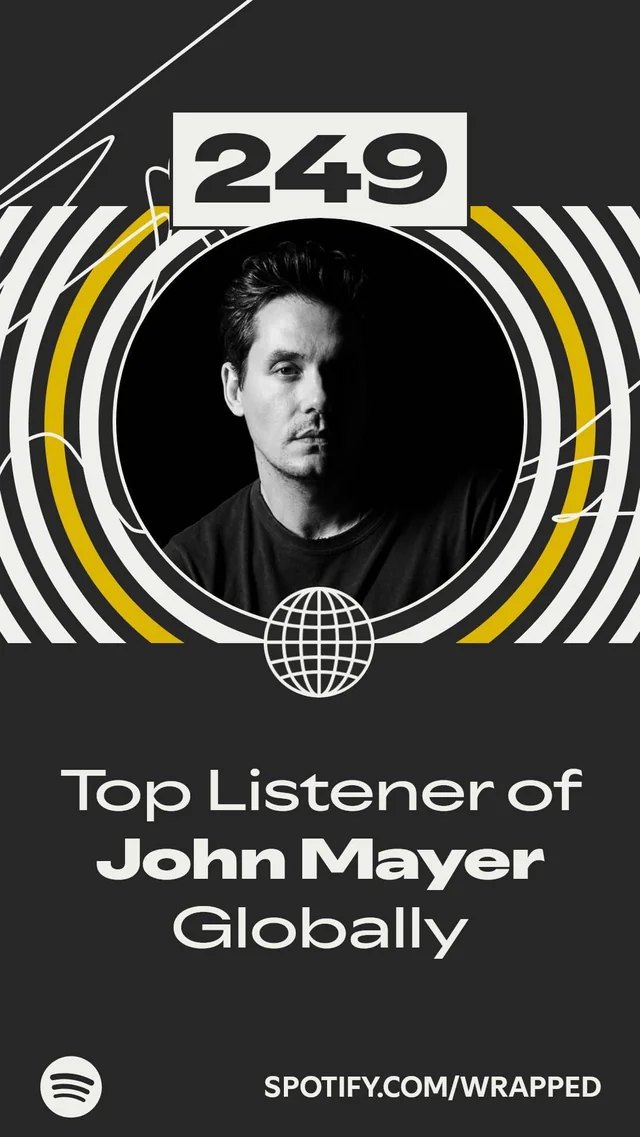
Spotify built Wrapped as a sequence of full-screen cards inside its app. In 2019 the experience moved to a stories format, like Instagram Stories, and the final screen invites users to share (Forbes; Wikipedia). Each card shows one stat, such as a top artist, top song or minutes listened, in bold graphics and color.
- Brand anchors. Spotify’s own design guidelines describe Spotify Green as the brand’s “resting color,” used “whenever Spotify’s voice needs to be recognizable,” and require the logo to appear the same way every time.
- Share-ready format. Cards are sized for social stories. In 2025 users could also send cards directly to friends through Spotify Messages or post them to social channels (Spotify Newsroom, 2025).
- The same campaign offline. In 2019 Spotify reported 5,100 unique billboards and other outdoor placements worldwide tied to Wrapped (Forbes, 2019). In 2025 it planned about 50 real-world pop-up experiences in cities including Seoul, Mexico City and New York (Spotify Newsroom, 2025).
- New features each year. The 2019 edition added a decade recap. The 2025 edition added a Top Song Quiz and “Wrapped Party” for listening with friends.
What happened
Wrapped became one of the most shared brand moments of each year, mostly through posts made by users, not ads bought by Spotify.
- In the first week of Wrapped 2019, more than 60 million users engaged with the in-app stories, which drove nearly 3 billion streams of Wrapped playlists (Forbes, 2019).
- At least 1.2 million posts on Twitter mentioned the campaign in that same week (Forbes, 2019).
- Wrapped expanded from 18 markets in 2018 to 21 in 2019 (Forbes, 2019). By 2025 it was available in nearly all markets where Spotify operates, for free and paid users (Spotify Newsroom, 2025).
- Spotify’s head of consumer and product marketing told Forbes in 2019 that the buzz creates a “FOMO effect” that draws in new users.
Why it worked
Recognition happens fast in a feed. When a Wrapped card appears in someone’s stories, the bright color, bold type and card format signal “Spotify” before the viewer reads a word. Every share becomes a branded ad, made and posted by the user.
The content is about the user, not the brand. People share Wrapped because it says something about their taste. The brand rides along on self-expression.
Timing builds habit. Wrapped arrives every year in late November or early December, so people expect it and watch for friends’ posts.
Where it gets complicated
Wrapped’s look is not frozen. Each year brings new graphics and features. What stays consistent are the anchors: the logo, Spotify Green, the card format and the timing. Students should notice that consistency here means stable core assets, not identical designs every year.
Critics point out what the campaign is. The Atlantic called it “a masterful coup of free advertising” in 2018, and a 2021 Guardian column called it “little more than free advertising.” Others have raised questions about how much listening data Spotify collects (as summarized on Wikipedia).
It also depends on data at scale. A small brand cannot copy Wrapped without millions of users and years of behavioral data. The lesson that transfers is the visual system, not the dataset.
The marketing principle
A yearly campaign gets noticed in a crowded feed when it rests on brand assets people already know. Spotify keeps its core anchors steady and lets each year’s Wrapped play inside them, so users spot it and share it on sight. Consistency in the core is what lets the creative change without losing the brand.
Sources
- Spotify Rolls Out New Wrapped Campaign To Help Users Remember Their Decade Of Music, Forbes (2019)
- What’s In Store for Your 2025 Wrapped, Spotify Newsroom (2025)
- Spotify: A Visual History, Spotify Newsroom (n.d.)
- Design guidelines, Spotify for Developers (n.d.)
- Spotify Wrapped, Wikipedia (2026)
Group activity for this case
Wrap Your Own Brand
Your group will have your brand’s core visual anchors and a shareable recap card built inside them. A 25-minute group activity. Dr. Morris gives the password in class.
Back to Visual Marketing in the Wild · All case studies
Brand names, images and trademarks belong to their owners and appear here for educational purposes only.