Case study · Marketing 465 · Strategy Foundations: Goals, Audiences and Channels
“You’re Not You When You’re Hungry” grew Snickers by marketing the problem customers hire it to solve, hunger that changes how you act, instead of the peanuts, caramel and nougat inside.
Brand
Snickers (Mars)
Year(s)
2010 to today
Channel(s)
TV (starting with the 2010 Super Bowl), social media, print, out-of-home, experiential
Goal
Unite a global brand under one idea and win back market share
Topic
Strategy foundations
15.9%
Global sales growth in the campaign’s first year (IPA Effectiveness Awards)
56 of 58
Markets where Snickers gained share during the campaign (IPA Effectiveness Awards)
2010
Launch of “You’re Not You When You’re Hungry” at the Super Bowl (Fortune, 2025)
The situation
Mars launched Snickers in 1930. By the late 2000s it was a huge global brand, but it was slipping. The IPA, the UK advertising industry body, notes in its effectiveness case that Snickers was losing market share to other global chocolate brands. Fortune reported in 2025 that the brand’s earlier, narrowly masculine marketing is partly blamed for a 10 percent loss in market share between 2006 and 2009.
Snickers was also fragmented. According to its Effie case summary, individual markets had been creating their own advertising, each with its own positioning and tone.
The challenge
Mars needed one idea that could work in dozens of countries and pull the brand back into popular culture. Talking about ingredients would not do it. Every candy bar has ingredients. The brand needed a reason to buy that was bigger than the product.
What they did
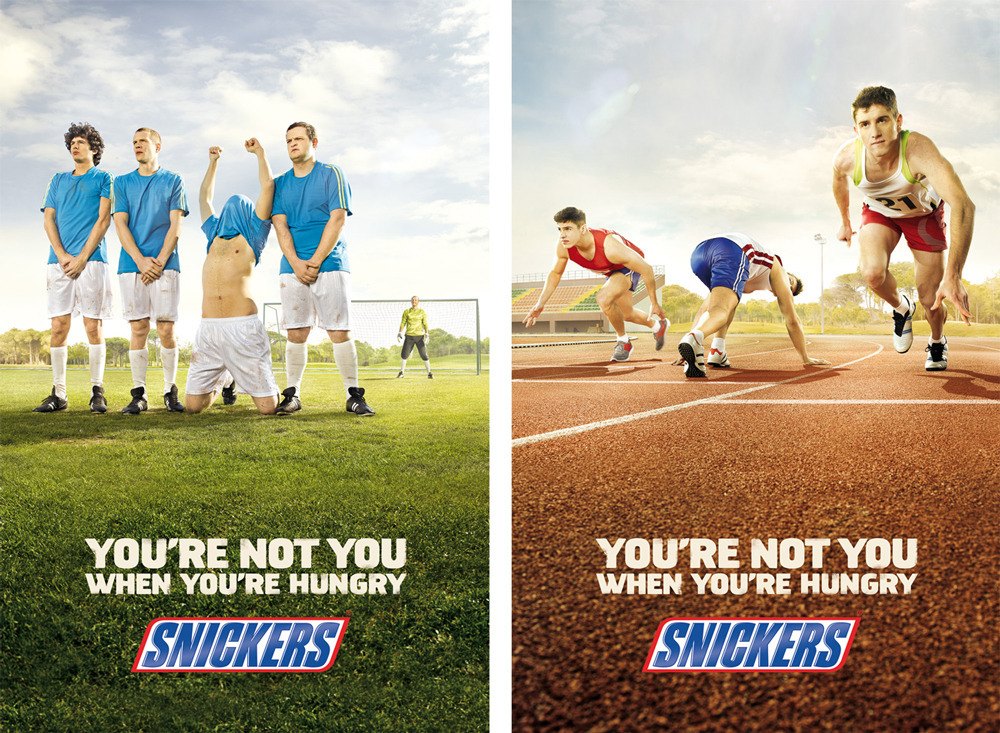
Mars and BBDO built the campaign around a simple observation: when you are hungry, you are not yourself. You get slow, cranky or unfocused. Snickers fixes that. The line became “You’re Not You When You’re Hungry.”
The campaign launched during the 2010 Super Bowl. In the first ad, Betty White and Abe Vigoda played football players too hungry to keep up. After a bite of Snickers, White’s character regains her energy and returns to the game. The formula was easy to repeat: a person acts strangely, a friend hands them a Snickers, and they become themselves again.
- Celebrities used to personify hunger, so the joke works across cultures
- Snickers “Emergency Cases” handed out in New York City subways (4A’s)
- Celebrities tweeting out of character on Twitter under the campaign hashtag (4A’s)
- The same structure adapted in many countries, so the idea stayed global
What happened
The campaign became one of the most cited effectiveness cases in modern advertising. The results below come from the IPA Effectiveness Awards case, where it won Gold for Best International.
- Sales rose 15.9 percent in the campaign’s first year, Snickers’ most successful period of growth (IPA)
- Market share grew in 56 of the 58 markets where the campaign ran (IPA)
- Fortune reported in 2025 that Snickers passed $1 billion in annual sales by 2013
- The campaign has won awards at Cannes Lions, the Effies and the One Show (Fortune, 2025)
Why it worked
This is Jobs to Be Done in action. In a 2016 Harvard Business Review article, Clayton Christensen and his coauthors argued that customers “hire” products to do a job, and that the circumstances matter more than customer demographics. Jobs also have social and emotional sides.
Snickers named the job clearly. People do not buy it for nougat. They buy it in a specific moment: they are hungry, they are acting off, and they want to feel normal again, fast. The ads show that moment and the progress the customer wants. The product appears only as the fix.
Focusing on the job also made the idea universal. Everyone has been hungry and irritable. That is why the same campaign could run in dozens of markets with local casts.
Where it gets complicated
A job is not owned by one brand. Any snack can claim to fix hunger. Snickers protected the idea through consistency, running the same line for more than a decade until people linked the feeling to the brand.
The early creative also leaned on gender humor. The IPA case describes the device as iconic women embodying hunger traits in male-focused settings, which is a joke about men “acting like” someone else. Fortune noted that a 2007 Snickers Super Bowl ad had been criticized by GLAAD for stereotyping. Students should ask how well that kind of humor ages.
Finally, Jobs to Be Done is a lens we apply. The case materials describe a human insight about hunger and group dynamics. Calling it JTBD helps explain why it worked, but the team did not need the label to find the insight.
The marketing principle
Strategy starts with understanding why people buy, not what you make. Snickers grew by marketing the job customers hire it to do: turn a hungry, off version of yourself back into you. Ask what progress your customer wants in a specific moment, then build the message around that progress.
Sources
- Snickers: You’re not you when you’re hungry, IPA (2012)
- Why the Snickers ‘You’re not you when you’re hungry’ campaign was so successful, Fortune (2025)
- Snickers resolves hunger-induced identity crisis, 4A’s (n.d.)
- Snickers (Effie case summary), Effie Awards (2011)
- Know Your Customers’ “Jobs to Be Done”, Harvard Business Review (2016)
Group activity for this case
Hire Us For The Job
A clear job-to-be-done for your brand and a campaign line built on it. A 20-minute group activity. Dr. Morris gives the password in class.
Back to Strategy Foundations: Goals, Audiences and Channels · All case studies
Brand names, images and trademarks belong to their owners and appear here for educational purposes only.