Case study · Marketing 475 · Visual Marketing in the Wild
Gillette and Dollar Shave Club both sold razor blades, but their visual and verbal styles told two different groups of men who the product was for.
Brand
Dollar Shave Club and Gillette (Procter & Gamble)
Year(s)
2012 to 2023
Channel(s)
Online video, e-commerce and subscription, packaging, retail
Goal
Dollar Shave Club: win men tired of expensive razors. Gillette: defend a market it dominated.
Topic
Visual Marketing in the Wild
~$4,500
Cost to make Dollar Shave Club’s 2012 launch video (Forbes, 2012)
2.4M
Dollar Shave Club members, November 2015 (The Boston Globe, 2015)
~70%
Gillette’s share of the U.S. men’s razor and blade market, 2015 (Euromonitor via The Boston Globe)
$1B
Reported price Unilever paid for Dollar Shave Club in 2016 (Fortune, 2016)
The situation
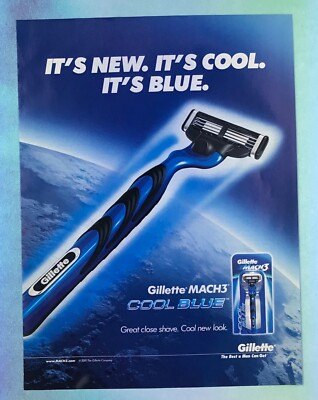
For decades, Gillette defined how a razor should look and sound. As of 2015, it held nearly 70% of the U.S. men’s razor and blade market, according to Euromonitor data reported by The Boston Globe. Its products and ads lean on cool blues, silver and metallic finishes, and its language is about engineering. Its website today still describes “5 anti-friction blades” and “FlexBall Technology” that “responds to contours.” The visual message is precision, performance and premium.
Those razors were also expensive. In 2012, a Forbes writer noted he paid over $5 for a single Fusion ProGlide cartridge at a New York drugstore.
The challenge
Dollar Shave Club, a startup founded by Michael Dubin and Mark Levine, sold razors by monthly subscription online. Forbes reported in 2012 that its plans started at $2 a month for five twin-blade cartridges. Dubin admitted the blades were not unique: “It’s not too hard to copy the techniques of the big guys.”
If the product is similar, the brand has to do the work. Dollar Shave Club could not out-engineer Gillette, and it could not afford to look like a cheaper copy of Gillette. It needed a different visual and verbal world.
What they did
In March 2012, Dollar Shave Club released a launch video titled “Our Blades Are F***ing Great.” Dubin, a former improv performer at the Upright Citizens Brigade, starred in it himself, walking through a warehouse and mocking the cost and complexity of big-brand razors. Forbes reported the video cost about $4,500 to make.
The look and voice matched the video:
- Plain, friendly design instead of chrome and technical diagrams.
- Joking, conversational copy. Dubin pointed to one line from the website: “This razor does not front.”
- A positioning built on frustration, not technology. “Our customers feel like they’ve made a decision to liberate themselves from brand name slavery,” Dubin told Forbes.
- Direct-to-consumer delivery, so the brand did not need to fight for space on drugstore shelves where Gillette dominated.
What happened
The video spread quickly. Forbes reported in early April 2012 that about 4 million people had already watched it. The company grew fast from there.
- Dollar Shave Club reported 2.4 million members in November 2015 (The Boston Globe, 2015).
- In 2015, Slice Intelligence estimated Dollar Shave Club held nearly 53% of U.S. online razor sales, compared with 20% for Gillette (The Boston Globe, 2015).
- Gillette responded in 2015 with its own subscription service, Gillette Shave Club. In December 2015, P&G sued Dollar Shave Club for patent infringement over blade coatings. The two companies settled the case in March 2019 (Bloomberg Law, 2019).
- In July 2016, Unilever bought Dollar Shave Club. Fortune reported the price as $1 billion in cash, citing multiple sources; the price was not officially disclosed.
Why it worked
Dollar Shave Club chose a visual world that was the opposite of the category leader. Where Gillette looked like a lab, Dollar Shave Club looked like a friend making fun of the lab. That contrast told a specific group of men, those who felt overcharged and talked down to, that this brand was for them.
The style also fit the channel. A low-budget, funny video felt natural on YouTube in 2012 in a way a polished razor commercial did not. The cheap look was not a weakness to hide. It supported the message that you should not pay extra for marketing.
And Gillette’s own reaction shows the threat was real. A market leader with nearly 70% share launched a copycat subscription and went to court.
Where it gets complicated
A distinctive visual identity can win attention, but it does not guarantee a lasting business. Gillette still held most of the overall market, and rivals like Harry’s copied the direct-to-consumer model. The Boston Globe reported that Harry’s had about 2.6 million active members in 2015, slightly more than Dollar Shave Club.
Unilever’s big bet also did not last. In October 2023, Unilever announced it was selling a majority stake in Dollar Shave Club to the investment firm Nexus Capital Management, keeping 35%. Unilever said the sale was part of focusing its portfolio on core growth areas. Terms were not disclosed.
Finally, much of the startup’s success came from price and convenience, not just design. The visual world made the offer memorable. It did not replace the offer.
The marketing principle
When products are similar, visual positioning decides who a brand is for. Gillette’s chrome and engineering language speaks to men who want the best technology. Dollar Shave Club’s simple, joking style spoke to men who felt overcharged. Choose a visual world that is clearly different from the category leader and true to your offer, then remember that the look has to be backed by a business model that lasts.
Sources
- Dollar Shave Club: Breaking The Razor Blade Monopoly, Forbes (2012)
- Gillette sues Dollar Shave Club for patent infringement, The Boston Globe (2015)
- Unilever Buys Dollar Shave Club for $1 Billion, Fortune (2016)
- Unilever announces the sale of Dollar Shave Club, Unilever (2023)
- Gillette (US home page), Gillette / Procter & Gamble (2026)
- Gillette, Dollar Shave Club Settle Razor Patent Case, Bloomberg Law (2019)
Group activity for this case
Pick Your Visual Opposite
Your group will have a side-by-side of your category leader’s visual world and the opposite visual world your brand will own. A 20-minute group activity. Dr. Morris gives the password in class.
Back to Visual Marketing in the Wild · All case studies
Brand names, images and trademarks belong to their owners and appear here for educational purposes only.