Case study · Marketing 475 · Visual Marketing in the Wild
Glossier grew from a beauty blog into a company valued at $1.8 billion by building a consistent, shareable visual world and letting customers spread it, though its later struggles show that a look alone cannot carry a business.
Brand
Glossier
Year(s)
2010 (Into The Gloss) to 2022
Channel(s)
Blog, Instagram, packaging, showrooms and stores, out-of-home ads
Goal
Build a beauty brand with its community instead of through traditional advertising
Topic
Visual Marketing in the Wild
$1.8B
Glossier valuation as of July 2021 (Forbes, 2022)
70%
share of online sales and traffic from customer referrals, according to Weiss (Entrepreneur, 2017)
4
products at Glossier’s launch in 2014 (Wikipedia)
The situation
In 2010, Emily Weiss, then 25 and working at Vogue, started a beauty blog called Into The Gloss. A popular series, ‘Top Shelf,’ photographed the bathroom shelves of the women it interviewed. The blog was about real routines and real products in real bathrooms.
In October 2014, Weiss launched Glossier with four products: a balm, a face mist, a skin tint and a moisturizer. She raised $2 million to launch the site.
The challenge
Beauty is crowded and expensive to market. Legacy brands spend heavily on advertising, celebrity faces and department store counters. A new direct-to-consumer brand could not match that spending. It needed a different way to be recognized and talked about.
What they did
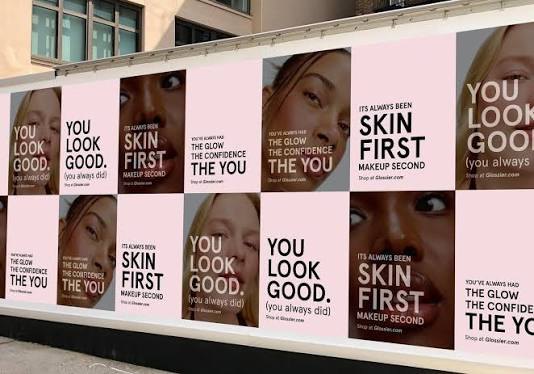
Glossier built a look and a philosophy that matched each other. Its stated ethos is ‘Skin First. Makeup Second.’ Makeup should enhance how you look, not mask it. The visuals followed that idea.
- Packaging designed to be photographed: bottles with lots of white space, and emoji-style stickers in each order so customers could personalize and post their products (Entrepreneur, 2017).
- A consistent pink-and-white palette that carried from packaging into the Manhattan showroom, where pink-and-white products sat on pink displays (Entrepreneur, 2017).
- Instagram as a two-way channel: staff took turns answering comments and messages, and a February 2016 post asking followers about a richer moisturizer drew more than 1,000 replies and led to a new product.
- Customers as the media: a 2017 ambassador program had more than 420 community members selling to friends and followers.
What happened
Weiss told Entrepreneur in 2017 that in the early days, ‘We weren’t paying for marketing,’ and that growth was ‘all social-driven.’ She said 70% of online sales and traffic came from customer referrals. The company kept raising money at rising valuations.
- March 2019: a $100 million round valued Glossier at $1.2 billion (Forbes and WSJ, as cited on Wikipedia).
- July 2021: Glossier was valued at $1.8 billion, with $266 million raised since launch (Forbes, 2022).
- In 2019, TIME named Weiss to its TIME100 Next list, crediting her with turning the #shelfie into a cultural staple.
Why it worked
Glossier’s visuals were not decoration. They were a promise that matched the product: clean, light, real skin. Because the look was the same on the blog, the packaging, Instagram and in stores, every customer photo reinforced the brand. Customers did much of the visual marketing for free because the products were designed to be shared.
The Into The Gloss roots mattered too. Glossier began with an audience that already trusted Weiss’s taste. The visual world gave that audience something to recognize and pass on.
Where it gets complicated
The card version of this story says Glossier grew without advertising. That is only partly true. Weiss said early growth was social-driven, but by 2017 Glossier was already running out-of-home ads on New York’s High Line and on Los Angeles construction barriers. Visual consistency reduced the need for paid media. It did not remove it.
The look also could not fix operational problems. In February 2020, Glossier paused its color line, Glossier Play, about a year after launch. In August 2020, former retail workers published an open letter describing racist treatment by customers and weak management responses. Former employees told Fortune this clashed with the brand’s public message of inclusion and its $1 million pledge to racial justice causes. In January 2022, Glossier laid off more than 80 employees, about a third of corporate staff. The company said it ‘got ahead of ourselves on hiring,’ and Weiss said ‘these missteps are on me.’ She stepped down as CEO in May 2022.
A strong visual identity can build demand. It cannot stand in for product focus, operations or how people are treated.
The marketing principle
Visual consistency can do much of the work that ad budgets usually do, especially when the look expresses a real point of view and is designed for customers to share. Glossier proves the upside. Its later struggles show the limit: the visual world has to be backed by the business behind it.
Sources
- Emily Weiss Steps Down As Glossier CEO Months After Company Layoffs, Forbes (2022)
- How Glossier Hacked Social Media to Build A Cult-Like Following, Entrepreneur (2017)
- About Glossier, Glossier (n.d. (accessed 2026))
- Emily Weiss, TIME100 Next 2019, TIME (2019)
- Exclusive: Ex-Glossier employees describe a company that failed to support Black workers, Fortune (2020)
- Glossier, Wikipedia (accessed 2026)
Group activity for this case
Design It to Be Posted
Your group will have one shareable brand moment designed so customers want to photograph and post it. A 20-minute group activity. Dr. Morris gives the password in class.
Back to Visual Marketing in the Wild · All case studies
Brand names, images and trademarks belong to their owners and appear here for educational purposes only.