Case study · Marketing 475 · Short-Form Video: Hooks and Scripts
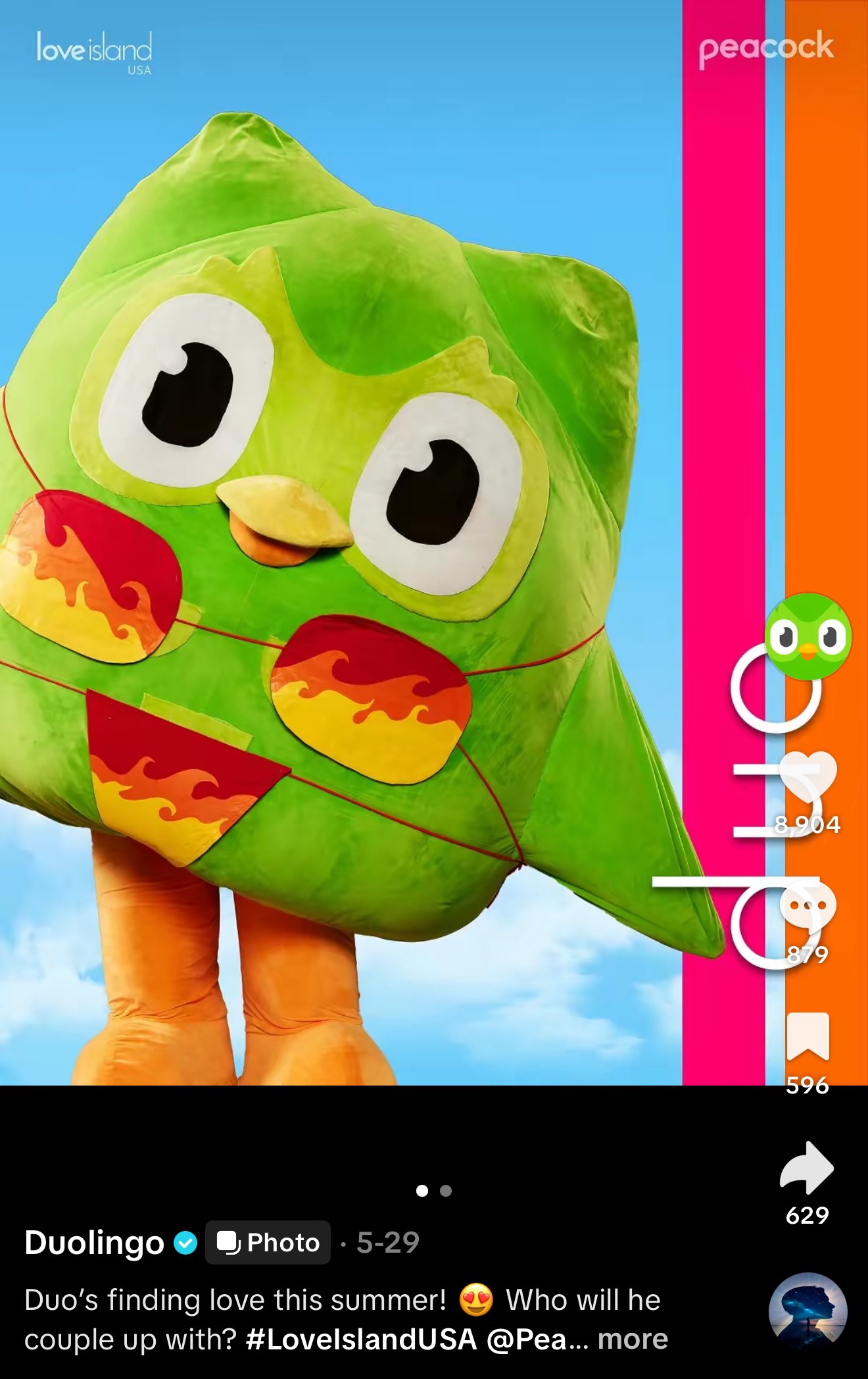
Duolingo turned its green owl into a character with a consistent, irreverent personality and made short videos that look like they belong on TikTok, and that personality became one of its biggest marketing assets.
Brand
Duolingo
Year(s)
2020s (Dead Duo campaign: February 2025)
Channel(s)
TikTok, Instagram and other short-form video platforms
Goal
Build awareness and daily use of a free learning app through a mascot people want to watch and share
Topic
Short-Form Video
49%
Year-over-year DAU growth in Q1 2025, which Duolingo credits in part to the Dead Duo campaign (Duolingo shareholder letter, 2026)
6.7M
Duolingo TikTok followers in May 2025 (Fast Company)
116M+
Monthly active users as of March 2025 (Fast Company)
The situation
Duolingo is a language-learning app with a green owl mascot named Duo. Inside the app, Duo nudges you to keep your daily “streak” going. Online, users had already turned that into a joke: memes showed Duo as persistent, even threatening, about missed lessons.
Duolingo says on its investor site that most of its growth has come from word of mouth. For a brand that grows that way, the question is how to give people something to talk about.
The challenge
Short-form video platforms reward content that looks and feels like what regular users post. Polished ads tend to stand out in the wrong way. A language app also has a hard sell: learning is good for you, but it is not exciting to watch.
Duolingo needed a way to show up in feeds as entertainment, not as an advertisement for studying.
What they did
Duolingo leaned into the joke its users had already made. Instead of presenting Duo as a cute, helpful teacher, its social team made him a chaotic character with one consistent personality: dramatic, a little unhinged, and obsessed with your streak.
- Platform-native style: short, casual videos, often featuring a person in a Duo costume or mask, made to look like the posts around them rather than TV spots.
- One character voice across every post, so viewers recognize Duo even before they see the logo.
- A strong, simple visual: the bright green owl is easy to spot in a fast-scrolling feed.
- Storylines, not just one-off posts. In February 2025, Duolingo announced that Duo had “died,” and asked users to earn experience points in the app to bring him back. It later posted a video of his return.
What happened
The account became one of the best-known brand presences on social media. Fast Company described Duolingo in May 2025 as having a “famously irreverent social media presence” and said it had “cultivated an enormous following with quirky posts.” The same article put the TikTok account at 6.7 million followers.
- Fast Company called the Dead Duo storyline Duolingo’s “most successful social media campaign ever” (May 2025).
- Duolingo’s own shareholder letter says daily active users grew 49% year over year in Q1 2025, “when we benefitted from our ‘Dead Duo’ campaign” (Duolingo Q1 2026 shareholder letter).
- Fast Company reported 2024 revenue of $748 million, up 41% year over year, and more than 116 million monthly active users as of March 2025.
Why it worked
The videos were made for the platform, not adapted to it. They looked and moved like the creator posts around them, so viewers were less likely to scroll past them as ads.
The personality came from the audience. Users had already joked that Duo was menacing. By playing along, Duolingo showed it was in on the joke, which made the brand feel like part of the community.
The character connected back to the product. The running joke, Duo chasing you to do your lesson, is also the habit Duolingo wants users to build. Entertainment and the business goal pointed in the same direction.
Where it gets complicated
A personality brand is only as strong as the company’s reputation behind it. In late April 2025, CEO Luis von Ahn posted on LinkedIn that Duolingo would become “AI-first” and phase out some human contractors. Users flooded Duolingo’s TikTok and Instagram comments with criticism. In May 2025, the company removed nearly all its videos from both platforms, then returned with a satirical video featuring a three-eyed Duo mask. Fast Company argued the company could not fix a policy problem with another clever post.
There are also limits to the numbers. The 49% user growth in early 2025 was followed by 21% growth in Q1 2026, which Duolingo’s letter described as lapping the Dead Duo quarter. Viral attention can be hard to repeat. And not every brand can or should be “unhinged.” The tone worked for Duolingo because its audience had already created it.
The marketing principle
Short-form video works when it looks native to the platform and carries a personality people want to share. Duolingo shows the value of one consistent character, a simple visual and stories that tie back to the product. It also shows the risk: when the audience loves your personality, it expects the company’s real decisions to match it.
Sources
- Duolingo deletes all its TikTok videos after AI backlash, and then returns with a strange message, Fast Company (2025)
- Duolingo deletes all TikTok videos and sends CEO bizarre message after ‘AI-first’ backlash, Cybernews (2025)
- Q1 2026 Shareholder Letter, Duolingo (2026)
- Duolingo Investor Relations, Duolingo (2026)
Group activity for this case
Unhinge Your Mascot
Your group will have a character for your brand with one consistent personality and a first short-video storyline. A 20-minute group activity. Dr. Morris gives the password in class.
Back to Short-Form Video: Hooks and Scripts · All case studies
Brand names, images and trademarks belong to their owners and appear here for educational purposes only.