Case study · Marketing 465 · AI in Marketing
When a trusted media brand published product reviews under fake, AI-generated author profiles and then denied the problem, the damage to trust landed faster and harder than any savings the shortcut could have produced.
Brand
Sports Illustrated (published at the time by The Arena Group)
Year(s)
2023 to 2024
Channel(s)
SI.com product review and affiliate content
Goal
Produce cheap, high-volume commerce content
Topic
AI in Marketing
28%
One-day drop in The Arena Group’s share price after the Futurism report (Sportico, November 2023)
$3.75M
Missed quarterly payment cited when Authentic Brands revoked Arena’s SI license (AP, January 2024)
Under 2 months
Time from the Futurism report to Arena losing the SI license (November 27, 2023 to January 19, 2024)
The situation
Sports Illustrated has been one of the best-known names in American sports journalism for decades. Its value rests on one thing: readers believe a real reporter stands behind every byline.
By 2023, the SI brand was owned by Authentic Brands Group and licensed to a publisher, The Arena Group, which ran the magazine and SI.com. Like many publishers, Arena was under pressure to grow digital revenue. One common route is commerce content: product reviews and buying guides that earn affiliate fees when readers click through and buy.
The challenge
Commerce content pays per click, so volume matters. That creates a temptation to produce it as cheaply as possible. Generative AI made that temptation much easier to act on in 2023.
The risk is that this low-cost content sits on the same site, under the same logo, as the brand’s real journalism. Readers do not separate the two. If one part of the site is fake, the whole brand looks fake.
What they did
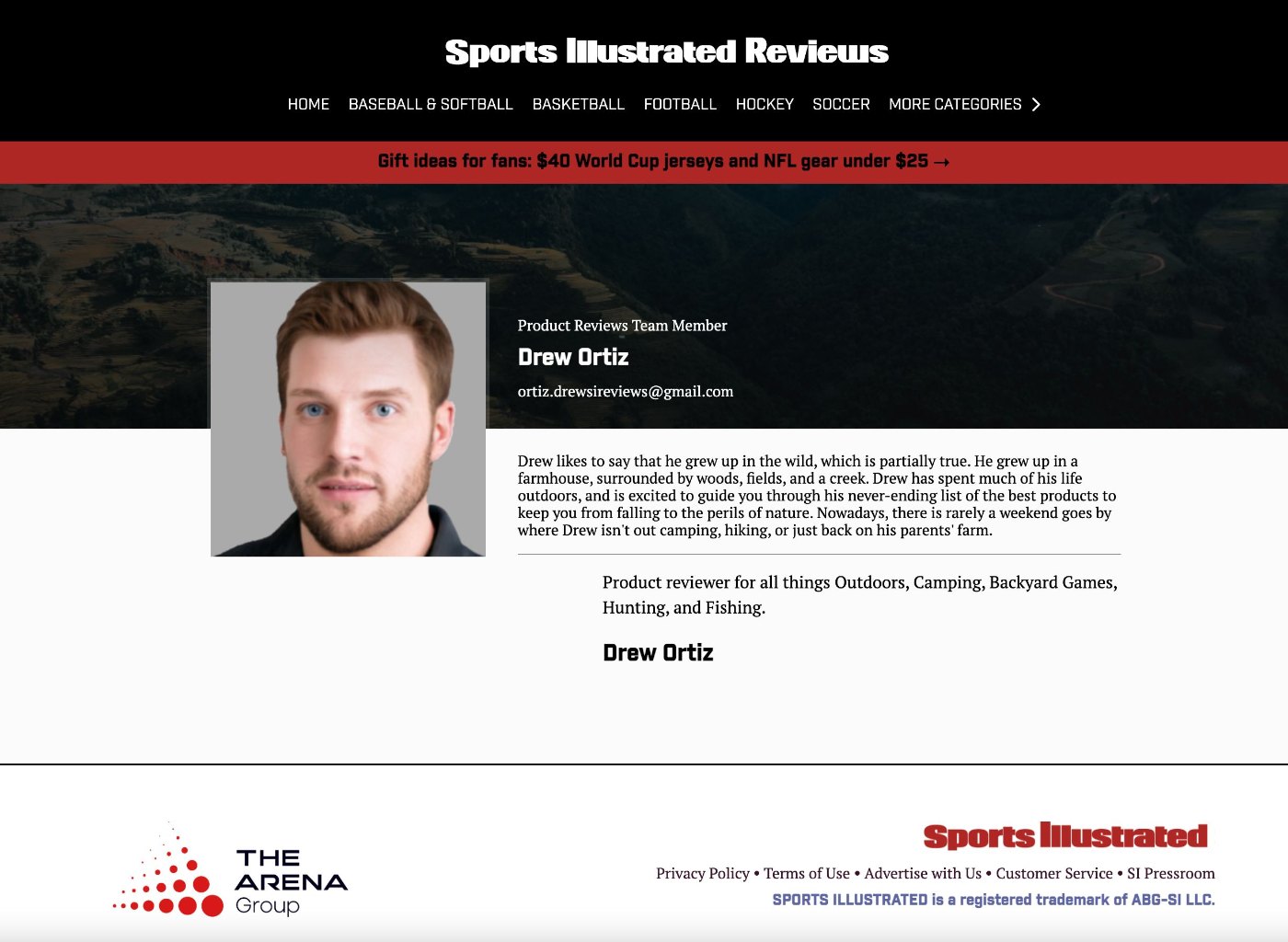
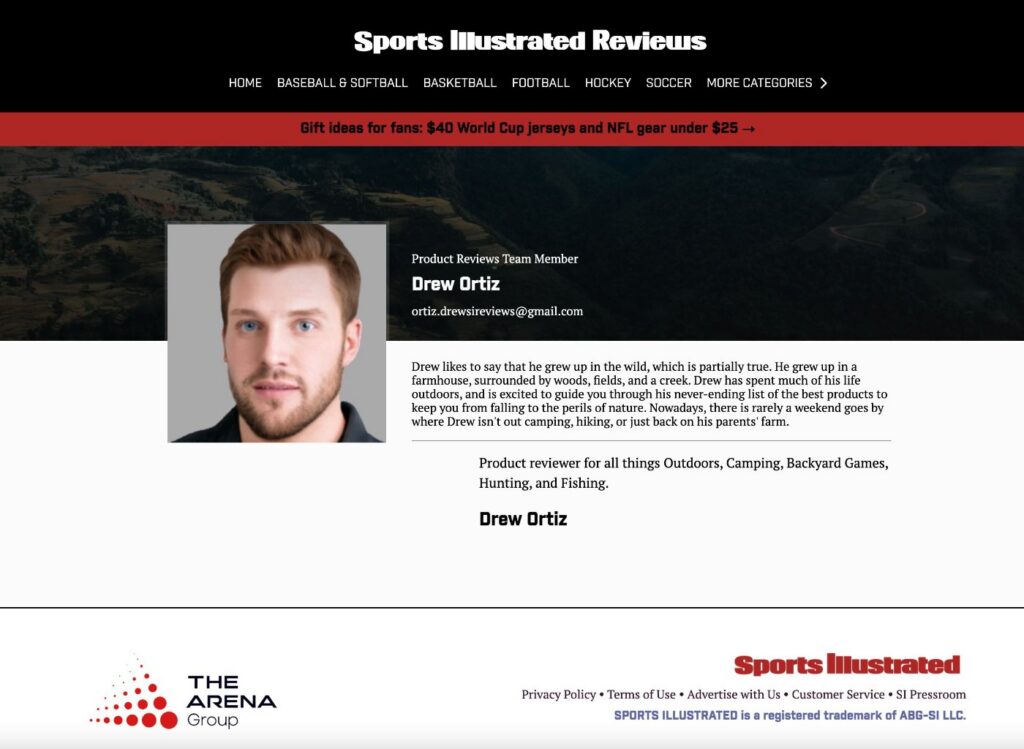
On November 27, 2023, the tech site Futurism reported that SI.com had published product reviews under author names that did not appear to belong to real people. One was “Drew Ortiz,” described as an outdoorsy reviewer. Another was “Sora Tanaka,” described as a fitness and nutrition expert.
Futurism found both headshots for sale on a website that sells AI-generated portraits. A person involved in creating the content told Futurism, “This person does not exist.” A second source said the articles themselves were AI-generated. After Futurism asked questions, the author profiles disappeared from the site without explanation.
- Arena said the content came from a third-party vendor, AdVon Commerce.
- Arena said AdVon had assured it that the articles were “written and edited by humans.”
- Arena acknowledged that AdVon writers used pen names, said it had ended the partnership, and removed the content.
- Futurism’s sources disputed the company’s account.
What happened
The story spread quickly through national news outlets. The reaction was swift because the core facts were easy to understand: a famous journalism brand had put fake people’s faces on its content.
- The Arena Group’s shares fell 28% on the Tuesday after the Futurism report, closing at $2.01 (Sportico, November 2023).
- In early December 2023, Arena fired three senior executives, including its chief operating officer (CBS News, December 2023).
- On December 11, 2023, Arena fired CEO Ross Levinsohn after the public backlash. The company described the board meeting as being about efficiency and revenue and did not formally name the AI story as the reason (CBS News, December 2023).
- On January 19, 2024, Authentic Brands Group revoked Arena’s license to publish Sports Illustrated after Arena missed a $3.75 million quarterly payment. Arena told staff working on SI that they would be laid off (Associated Press, January 2024).
- On March 18, 2024, Authentic licensed SI to a new publisher, Minute Media, and the brand continued (Associated Press, March 2024).
Why it worked
In this case the better question is why it failed. The shortcut saved money on content that was a small part of SI’s value. It put at risk the part that was all of SI’s value: belief that real people stand behind the words.
The fake bios were the real breach. Using a tool to help write a buying guide is a process choice. Inventing human experts with stock AI faces is a claim about who is talking to the reader, and that claim was false.
The response made it worse. Blaming a vendor and repeating the vendor’s assurance, while removing the content, looked like denial. Audiences forgive mistakes more readily than they forgive cover stories.
Where it gets complicated
It is easy to tell this as a simple morality tale, but the facts are messier. Arena never admitted that the articles were AI-written. Its position was that a vendor’s human writers used pen names. Students should notice that the public treated the fake headshots as proof regardless.
The license loss was not caused by the AI story alone. Authentic ended the deal after a missed payment, and Arena already had financial trouble. The scandal and the leadership turnover came first, but the business problems ran deeper.
Finally, the people who paid the steepest price were not only executives. Many SI journalists who had nothing to do with the vendor content faced layoffs when the license was pulled. Brand damage spreads to everyone who works under the logo.
The marketing principle
AI can lower the cost of content, but trust is the asset that makes content worth anything. Disclosure and human oversight are not optional extras on a trusted brand. If you would be embarrassed for your audience to learn how a piece was made, that is the signal to stop, not to hide it.
Sources
- Sports Illustrated Published Articles by Fake, AI-Generated Writers, Futurism (2023)
- Fake sportswriters, it seems, create real consequences (Arena Group stock report), Sportico (2023)
- Sports Illustrated publisher Arena Group fires CEO following AI controversy, CBS News (2023)
- Sports Illustrated planning significant layoffs after license to use its brand name was revoked, Associated Press (via WDIV ClickOnDetroit) (2024)
- Sports Illustrated will continue operations after agreement reached with new publisher, Associated Press (via WDIV ClickOnDetroit) (2024)
Group activity for this case
The Byline Trust Test
An embarrassment test for two AI shortcuts your brand could take, plus a one-line AI disclosure you would stand behind. A 20-minute group activity. Dr. Morris gives the password in class.
Back to AI in Marketing · All case studies
Brand names, images and trademarks belong to their owners and appear here for educational purposes only.