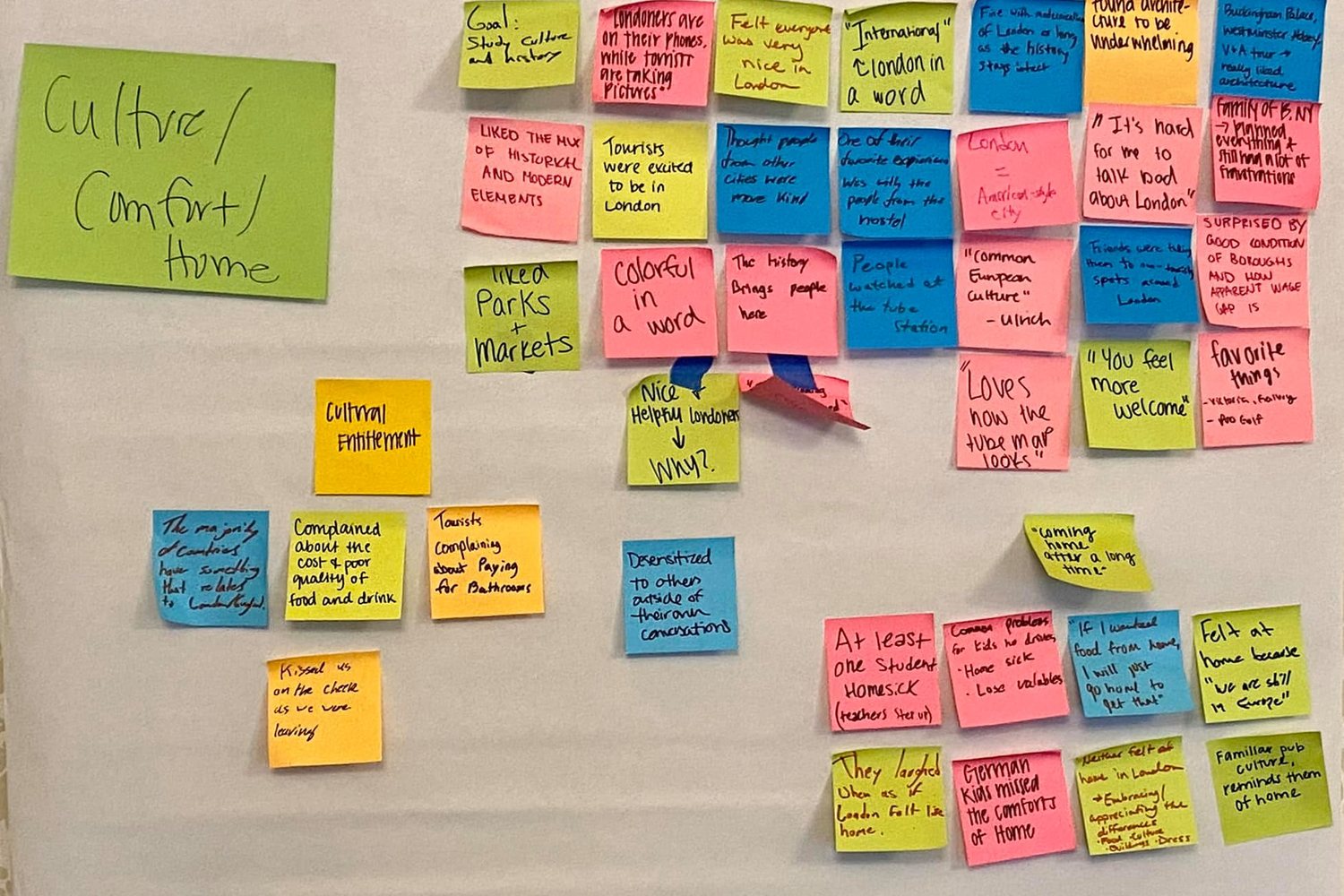
The big idea: Quotes are evidence, not answers: interpretation finds the pattern across people, explains why it exists, and turns it into a question that pours out ideas.
In 60 seconds
- Tag sticky notes with the six Global Synthesis Tags so themes show goals and motives, not only complaints.
- An insight explains a behavior and its motive, and a need is written as a verb.
- A good How Might We pours out 5 to 10 ideas fast, and Part B rewards a wide range from many techniques.
Do this: climb from tagged sticky notes to a tested How Might We, then brainstorm 20 or more ideas with more than one technique.
How interpretation works
Class 8 is where your 10 or more street interviews turn into meaning. Each interview team shares its interviewees’ stories, then climbs from sticky notes to themes, insights and How Might We questions. You learned the three synthesis steps in London (download your learnings, find themes and insights, craft HMWs). This page adds what BUAD 317 expects on top of them.
Download
One board per person: code and role at the top, one quote or observation per sticky note, the photo.
Rule: facts now, interpretation later.
Tag
Label notes with the six Global Synthesis Tags below, so you see the whole person, not just complaints.
Look for: goals and each pain point in their way.
Theme
Move the most compelling notes to a new board and cluster them. Name each cluster as a sentence.
Look for: unmet needs, barriers, surprising enablers.
Insight
Say what the theme means about people and why they act this way.
Test: the three criteria below.
How might we
Turn your best insights into questions, ladder them, and pick 1 to 3 to brainstorm.
Test: the faucet.
Global Synthesis Tags
Tag each sticky note with one of these six labels from the Class 8 slides. A board of nothing but pain point notes tells you what hurts but not what people are reaching for.
Goal
The outcome the person is trying to accomplish.
Example: “Keep my blood sugar steady so I can keep working.”
Need
Something the person needs in order to reach that goal.
Example: to know whether to come in if they feel better.
Motivation
Why the person wants that goal.
Example: “I don’t want them to think I’m irresponsible.”
Task
Something the person does to reach the goal.
Example: rearranges two job schedules every week.
Pain point
A barrier, challenge or difficulty on the way to the goal.
Example: a 20-minute phone hold to cancel.
Tools
Anything the person uses to try to reach the goal.
Example: a reminder card tucked behind a bus pass.
Examples come from a sample project on a county clinic’s missed appointments, used in the tool below.
What counts as an insight statement
- A discovery about behavior. It names what people do and the motive underneath it.
- It challenges a belief. It upends something your team, or the client, assumed about these people.
- It changes the view. It reveals a principle that makes you see the people you design for in a new way.
The HMW faucet test
- Too narrow: a trickle. Only one or two ideas come out, usually because a solution is baked in.
- Too broad: trying to fill the ocean. Nobody knows where to start.
- Just right: 5 to 10 ideas pour out almost at once.
- Stay positive: “How might we,” never “how should we” or “how must we.” Frame the change you want, not what you want to avoid.
Ladder your HMW up and down
Ask “Why?” to go up
Why does this HMW matter? The answer is a broader question.
Up: HMW help patients stay connected to their care when life gets in the way?
Your starting HMW
Built from your strongest insight.
Start: HMW make changing a clinic visit as easy and judgment-free as skipping it?
Ask “What’s stopping us?” to go down
What blocks the starting HMW? The answer is a narrower, concrete question.
Down: HMW let patients reschedule in under a minute without waiting on hold?
Write several, then pick 1 to 3 HMWs for brainstorming that are neither too broad nor too narrow.
Needs are verbs, not nouns
The Part A Interpret rubric checks this directly. “A reminder app” is a noun and a solution. “To change a visit without feeling judged” is a verb and leaves room for many answers.
Reframe the challenge
Your class challenge came with a starting HMW. Strong teams reframe it around a specific person and need they discovered on the street. Weak teams hand back the original question.
Share each interviewee’s storyHow the Class 8 share-out runs
- Write the person’s code and role at the top of the board. A quick sketch of them in their setting helps people remember.
- Each teammate quietly writes memorable quotes and observations, one per sticky note, big enough to read across a table.
- Read notes aloud as you post them. Add the story behind each one and build on each other’s observations.
- Agree on your main takeaways from each interview.
- Present each interviewee’s “story” to the class. In the class slides, teams get 20 minutes to share, so decide in advance who goes first and how long each story gets.
Find themes on the boardCluster, name, debate, repeat
- Remind yourselves of the design challenge.
- Move the most compelling, common and inspiring notes to a fresh board.
- Cluster notes that belong together. Look for patterns and relationships between clusters, and keep moving notes.
- Name each cluster on its own sticky note, in a different color or size, and place it above the group.
- Write insights near each theme: what is important or interesting about it.
- Keep going until the whole team agrees the clusters are real opportunities for design.
Not every note will fit. A finding heard only once can still deserve its own group if it surprised you.
Interpret wiselyStay close to the data
- Count voices. How many people, and how many roles, sit in each cluster? One dramatic story is not a theme.
- Keep the contradictions. When what people say and what they do disagree, you have found something worth chasing.
- Link every claim to evidence. If you cannot point to notes from three different people, call it a hunch.
- Do not sell it. Let the findings speak instead of pitching your favorite idea.
Using AI in interpretationWhere it helps and where it gets you in trouble
- Helps: suggesting possible clusters, spotting repeated words, offering rewordings of a clunky HMW.
- Your job: check every AI theme against real notes. You were in the room. It was not.
- Never: let AI invent or “clean up” quotes, or paste names and private details into a public AI tool. The course AI policy rules out fabricated data and confidential data in public tools, and asks you to disclose how you used AI.
Brainstorm (Part B): from HMW to 100 ideas
Class 9 takes your 1 to 3 HMWs into a brainstorm. That is Deliverable #3, Part B. The seven brainstorm rules, the Ten Faces of Innovation and safe, stretch and wild ideas are all on the IB 407 page Ideation That Goes Somewhere. Use it as your refresher. Here is what BUAD 317 adds.
The target: 100 ideas in 60 minutes
The class slides set the bar: a good session can produce up to 100 ideas in an hour. That means short ideas, posted fast, one per sticky note, sketched when you can. Quantity first. You choose later.
Your final teams start here
By the end of Class 9 you are placed in prototype teams. These are your final project teams through senior year, so pick a topic you care about. Your Part B brainstorm feeds straight into the rapid prototype you build in Class 11.
What the Part B rubric rewards
Some ideas, judgment deferred
You come up with ideas and record others’ ideas without shooting them down.
Risk: converging too early, so the range stays small.
20 ideas off one HMW
You build on each other’s ideas and include some wild ones.
Show: the count and the wild ones.
A spectrum, then narrow (meets expectations)
A large, varied range from low-hanging to wild, then a few actionable ideas chosen to keep that variety.
Show: the range and why you picked what you picked.
Many techniques, repeated
Several ideation techniques on a single insight, run more than once. An overwhelming number of ideas, from very practical to nearly impossible.
Show: each round and what it added.
Mix your techniques
The top level asks for more than one technique. Run a classic brainstorm first, then try at least one of these on the same HMW.
Silent sticky notes
Everyone writes alone for five minutes before anyone speaks. Quiet teammates get heard, and loud ideas do not anchor the room.
Ladder switch
Brainstorm on your ladder-up HMW, then on your ladder-down HMW. Each level unlocks a different kind of idea.
Borrow from elsewhere
How would an airline, an ER or a theme park handle this? Analogies pull you out of the obvious.
Worst idea first
List the worst possible ideas, then flip each one. It loosens the room and often reveals a real constraint.
Build on a tag
Pick one Global Synthesis Tag, such as a pain point or a motivation, and brainstorm only for that.
Then narrow
Group similar ideas, vote, and keep a mix: one safe, one stretch, one wild. Write down why each one made the cut.
The seven rules still apply in every round: defer judgment, encourage wild ideas, build on the ideas of others, stay focused on the topic, one conversation at a time, be visual, go for quantity.
Try it: Insight to HMW Ladder
Tool · BUAD 317
Insight to HMW Ladder
Tag your sticky notes, climb to an insight, then test your How Might We with the faucet.
- 1Tag notes
- 2Climb
- 3Faucet test
Your How Might We
All checks
Put it to work: Deliverable #3 Part A Interpret and Part B Brainstorm
Interpretation is graded twice. The Interpret part of Deliverable #3 Part A asks your interview team to turn 10 or more solid interviews into insights and a point of view built on user needs. Part B grades the brainstorm that grows from your HMWs. Both are team scores.
From boards to brainstorm in six steps
Download before Class 8
Every interview on its own board: code and role, sticky notes, photo. Look across boards for ah-has and patterns before class.
Your deliverable: boards ready to present at the start of Class 8.
Tell the stories
Present each interviewee’s story to the class. Keep it human: what they did, said and felt.
Your deliverable: a share-out your whole team agreed on.
Tag and cluster
Tag notes with the Global Synthesis Tags, cluster across interviews and name each theme as a sentence.
Your deliverable: three to five themes, each backed by notes from several people.
Write insights and needs
Under each strong theme, write an insight that passes the three criteria and a need stated as a verb.
Your deliverable: insights and verb needs your team can defend with quotes.
Reframe and pick HMWs
Reframe the class challenge around the people and needs you found. Write HMWs, ladder them up and down, run the faucet test, and pick 1 to 3.
Your deliverable: one or more problem statements and the HMWs you will brainstorm.
Brainstorm in Class 9
Aim for 20 or more ideas per HMW, then add a second technique. Narrow to a few actionable ideas that keep the range.
Your deliverable: Part B: the full idea wall, the techniques you used and the few ideas you chose.
What the Part A Interpret rubric rewardsFour levels, from the BUAD 317 syllabus
| Level | What it looks like |
|---|---|
| Multiple complex problem statements (top level) | Your team writes several problem statements with no guidance. You synthesize deep insights from the whole system, and your reframe is compelling and new. |
| One strong problem statement (meets expectations) | Several deep insights from non-obvious sources, combined into one problem statement with little or no guidance. The challenge is clearly reframed around a user, and needs are stated as verbs. |
| One statement, with guidance | You prioritize insights by perceived need, but the original challenge is not clearly reframed, and needs are stated as nouns. |
| One insight picked | One insight chosen from many, or a fill-in-the-blank statement. The challenge is not reframed. |
A worked exampleExample: a county clinic’s missed appointments
| Layer | Entry | Why it counts |
|---|---|---|
| Quote (Pain point) | “I didn’t cancel because the phone line is a 20-minute hold.” | Exact words. Evidence. |
| Quote (Motivation) | “I don’t want them to think I’m irresponsible.” | Shows the feeling behind the behavior. |
| Theme | Patients skip rather than cancel when canceling feels harder than not showing up. | A pattern across several patients, named as a sentence. |
| Insight | Patients who miss visits are not careless: canceling takes more effort and more embarrassment than staying home, so silence feels like the polite choice. | Challenges the belief that no-shows do not care. |
| Need (verb) | To change a visit without a long call or feeling judged. | A verb, not a product. |
| HMW | How might we make changing a clinic visit as easy and judgment-free as skipping it? | Passed the faucet test with six ideas in a minute. |
Do this, not thatHabits that make your board convincing
Do this
- One idea per sticky note, with the interview code.
- Tag notes so goals and motives show, not only complaints.
- Name themes as sentences.
- State needs as verbs.
- Reframe the challenge around a real person.
- Run more than one brainstorm technique.
Not that
- A wall of quotes with no interpretation.
- One-word themes like “Communication.”
- A theme built on one dramatic story.
- Insights that are really solutions.
- Handing back the original challenge unchanged.
- Picking your favorite idea before you hit 20.
Before you submitCheck these before Class 8 and Class 9
- [ ] Every solid interview is on its own board, with a photo taken with permission.
- [ ] Notes are tagged with at least three of the Global Synthesis Tags.
- [ ] Each theme is a sentence with notes from several people and roles.
- [ ] Each insight passes the three criteria and is not a quote or a solution.
- [ ] Needs are written as verbs.
- [ ] We reframed the challenge around a user, in one or more problem statements.
- [ ] Our 1 to 3 HMWs each passed the faucet test.
- [ ] In Class 9 we reached 20 or more ideas per HMW and used more than one technique.
- [ ] We can explain why we chose the few ideas we narrowed to.
Go deeper
Refresh from IB 407, then look ahead
The Global Synthesis Tags, insight criteria and rubrics on this page come from BUAD 317, taught by Lane Morris, PhD and Jules Morris, PhD. Synthesis steps and brainstorm rules are summarized from IDEO.org’s Field Guide.
Back to all BUAD 317 topics · Next: Need Finding and Jobs to Be Done
In-class team activity · 30 min
Faucet Test Relay
By the end: One tagged cluster, an insight that passes the three criteria, a verb need, and a How Might We that another team has proven pours out at least five ideas in a minute. Your instructor will give you the password in class.
Part of BUAD 317, taught by Lane Morris, PhD and Jules Morris, PhD, in the Smith GLS human-centered leadership program, toward the Human Centered Consulting Certificate.
Frequently asked questions
What are Global Synthesis Tags?
They are six labels from the BUAD 317 Class 8 slides for tagging sticky notes: Goal, the outcome a person wants; Need, what they need to reach it; Motivation, why they want it; Task, what they do; Pain point, what gets in the way; and Tools, what they use. Tagging shows the whole person, not only complaints, so your themes point at real design opportunities.
What counts as an insight statement?
An insight is a discovery about human behavior and the motive behind it. It challenges something you or the client believed about people, and it makes you see them in a new way. A quote is not an insight, because it is evidence. A solution is not an insight either. Connect the behavior to its reason with words like because, but or so.
What is the How Might We faucet test?
A good How Might We question works like a faucet. If it is too narrow, only a trickle of ideas comes out, often because a solution is baked in. If it is too broad, nobody knows where to start. A good HMW sparks 5 to 10 ideas almost at once. Ask why to ladder up and what is stopping us to ladder down.
What does the Part B brainstorm rubric reward?
Deliverable #3 Part B rewards range and method. A basic brainstorm defers judgment. A stronger one reaches 20 ideas off one HMW. Meeting expectations means a spectrum from low-hanging to wild ideas, then narrowing to a few actionable ones. The top level uses several ideation techniques on one insight, repeated, producing an overwhelming number of ideas from practical to nearly impossible.
Why should needs be written as verbs?
The Part A Interpret rubric checks it directly. A noun need such as a reminder app is really a solution, so it shuts out every other idea. A verb need such as to change a visit without feeling judged describes what the person is trying to do and leaves room for many solutions. Ask why until the need becomes an action.