The big idea: Great ideas come from many ideas: go wide with clear brainstorm rules, then bundle and vote so a few strong, different concepts survive.
In 60 seconds
- Ideation turns one strong How Might We question into many ideas, then into a few concepts worth building. Go wide first and judge later.
- Clear brainstorm rules keep ideas flowing: defer judgment, build on the ideas of others, encourage wild ideas and go for quantity.
- Bundle ideas into named concepts before you vote, and keep a spread from very practical to bold.
Do this: run at least two ideation techniques on one HMW question and choose two or three different concepts to prototype for your Ideate grade.
How ideation works
Ideation turns one strong How Might We question into a pile of possible answers, then into a few concepts worth building. Go wide first. Judge later.
Set up
Write one HMW question at the top of the board. Post the rules where everyone can see them.
You see: one question, sticky notes, markers, a timer.
Go wide
Push for quantity. Safe ideas, stretch ideas and wild ones all count.
You see: a wall filling up faster than anyone can judge it.
Build and bundle
Combine ideas that work together into bigger concepts.
You see: clusters with names, not just loose notes.
Vote and choose
Narrow to a few actionable concepts that still show range.
You see: two or three concepts ready to prototype.
Quantity, then quality
Your best idea is rarely your first one. Early ideas are the obvious ones everyone already thought of. Tom and David Kelley put it simply in Creative Confidence: “shoot for 100 instead of 10.” Get the obvious ideas out of the way, then keep going. Choosing comes after.
The brainstorm rules
The rules (on the wall)
- Defer judgment. No “that won’t work” during the go-wide round. Judging comes later.
- Encourage wild ideas. An impossible idea often points to a possible one.
- Build on the ideas of others. Say “yes, and” instead of “yes, but.”
- Stay focused on the topic. Keep the HMW question in view.
- One conversation at a time. Everyone hears every idea.
- Be visual. Sketch it. A stick figure beats a paragraph.
- Go for quantity. Set a number and race it.
What the facilitator does
- Frames it. Reads the HMW question aloud and sets a goal, such as 50 ideas in 15 minutes.
- Keeps it moving. Asks people to say the idea as a headline, then write it on one note.
- Catches judgment. Redirects “that’s too expensive” into “how could it cost less?”
- Feeds new angles. Tosses in a prompt when the room goes quiet (see the panel below).
- Calls the switch. Ends the go-wide round, then starts bundling and voting.
Wild ideas earn their keep
In Creative Confidence, the Kelleys describe Air New Zealand teams brainstorming seats that seemed silly, including hammocks and bunk beds. That willingness to play led to the Skycouch, a row of economy seats that turns into a flat platform.
Bundling beats picking one
A strong concept is often three ideas stuck together: a safe one that makes it doable, a stretch one that makes it better, and a wild one that makes it memorable.
Ten Faces of Innovation: roles you can play in the room
Tom Kelley of IDEO describes ten roles people play on innovation teams. They are roles, not personality types. Anyone can switch into one when the team needs it. Use them as lenses when the ideas slow down. These are short summaries in our own words.
Learning roles
Anthropologist: watches what people actually do and brings back surprises.
Experimenter: tries things fast and cheap to learn by doing.
Cross-Pollinator: borrows ideas from other industries and cultures.
Ask: What did we see? What could we try today? Who else solved this?
Organizing roles
Hurdler: finds a way around obstacles, budgets and rules.
Collaborator: pulls different people and groups together.
Director: sees the whole picture and gets the best out of the team.
Ask: What is in the way? Who else should be here? What is our plan?
Building roles
Experience Architect: designs each moment a person goes through.
Set Designer: shapes the space so people do their best work.
Caregiver: anticipates needs and treats people as people.
Storyteller: carries the idea in a story people remember.
Ask: What will it feel like, step by step? Who looks after them? What is the story?
Prompts for when the room goes quietEight ways to restart the flow
Steal from another industry
How would an airport, a Formula 1 pit crew or an emergency room handle this?
Design for the extreme user
What would work for the busiest, oldest, newest or most frustrated person you met?
Change the budget
What if it had to cost nothing? What if money were no object?
Change the clock
What could you launch by tomorrow morning? What would take ten years?
Worst idea first
List terrible ideas on purpose, then flip each one into its opposite.
Remove a step
What if the line, the form or the wait did not exist at all?
Go back to a quote
Read one thing a person told you in an interview. Ideate only on that.
Wear a face
Each person picks one of the Ten Faces and posts three ideas from that role.
Bundling and narrowing without killing the good stuffHow to converge so the range survives
- Cluster first, vote second. Votes on single notes favor the obvious. Votes on bundles favor strong concepts.
- Name each bundle as a concept. “Order ahead plus pickup shelf plus text alert” becomes “Skip the line.”
- Keep a spread. Choose concepts that are different from each other, from very practical to bold. Three versions of the same idea is one idea.
- Check against your insight. Read your HMW question and your top insight from Define. Does each concept answer them?
- Keep the parking lot. Photograph the whole wall. Ideas you skip today can rescue you after a failed test.
Using AI in ideationWhere it helps and where your team has to lead
The course AI policy allows AI for idea generation, as long as you are open about it, cite it and apply your own judgment. AI is good at adding volume and pulling in analogies from other industries. It is weak at the part that matters most here: it did not meet the people you interviewed. Use it after your own round, not before, so it does not anchor your thinking. Mark AI ideas on the wall and note the prompt you used.
Try it: Brainstorm Facilitator
Tool · IB 407
Brainstorm Facilitator
Go wide from safe to wild, spark a new angle when you stall, then bundle ideas into concepts and vote with dots.
- 1Go wide
- 2Bundle
- 3Vote
Safe doable now
Stretch takes work
Wild maybe impossible
Your wall
Concepts (bundles)
All checks
Put it to work: your Ideate grade in London
Ideate is one of the five HCD grades in London (40 points). Your team starts from the HMW question you built in Interpret/Define and shows a wide spectrum of ideas, more than one technique, and a few actionable concepts you will prototype next.
Build it in five steps
Pick one HMW question
Choose the HMW from Define that is tied to your strongest insight. Not too broad, not too narrow. Write it at the top of the board.
Your deliverable: the HMW question in big letters at the top of a photo of your board.
Round one: go wide
Post the rules. Set a target and a timer. One idea per note, said out loud, sketched where you can.
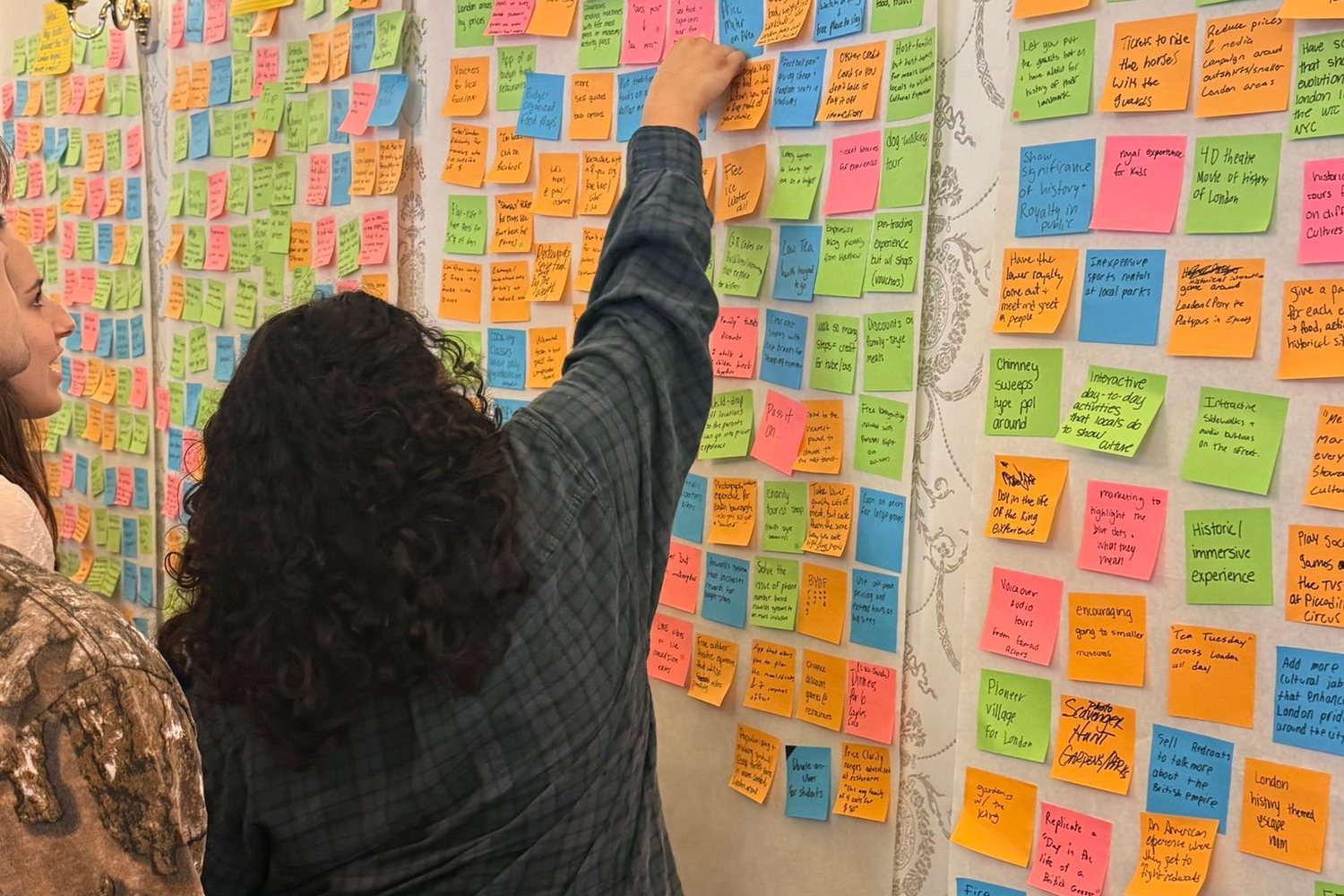
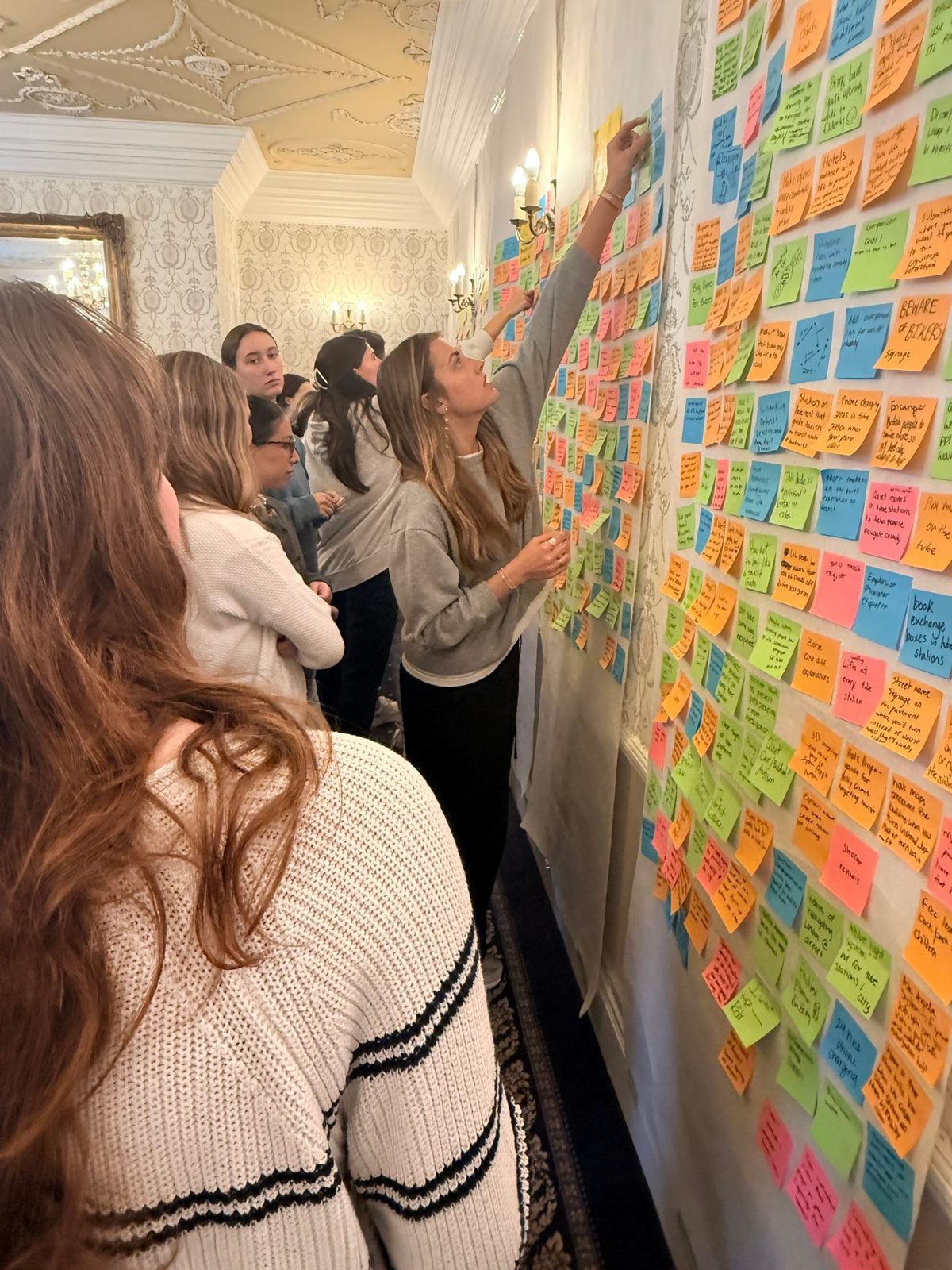
Your deliverable: a full wall, well past 20 ideas, from very practical to nearly impossible.
Round two: change the technique
Use a different method on the same insight: Ten Faces roles, an analogy from another industry, a constraint, or worst idea first.
Your deliverable: a note in your notebook on which techniques you used and what new ideas each one produced.
Bundle into concepts
Cluster ideas that work together. Name each cluster as a concept a user would understand.
Your deliverable: three to five named concepts, each with the ideas inside it listed.
Vote and choose what to prototype
Dot vote, then talk it through. Keep a spread: at least one concept should feel a little risky.
Your deliverable: two or three concepts to prototype, with one sentence each on why they answer your HMW question. Post photos where your instructors ask for documentation.
What the Ideate rubric rewardsThe four levels in plain words
| Points | What it looks like |
|---|---|
| 10 | Some ideas, judgment deferred, but a narrow range. The team mostly records what others said. |
| 20 | About 20 ideas from one HMW question. Team members build on each other and include wild ideas. |
| 30 | A large, diverse range from low-hanging to wild, narrowed to a few actionable concepts that still show that range. |
| 40 | All of that, plus several techniques on one insight, repeated. An overwhelming amount of ideas, from very practical to nearly impossible. |
Examples from outside marketingHow bundles look in operations, health care and finance
Hospital discharge
HMW: help patients go home sure of what to do next?
Bundle “First 48 hours”: a one-page plan the nurse fills in with the patient (safe), a check-in text the next morning (stretch), a pharmacist video call before the first dose (wild for now).
City bus stop
HMW: make waiting for a late bus feel less uncertain?
Bundle “Know before you go”: live arrival signs (safe), a text line for each stop (stretch), a shelter that lights up as the bus nears (wild).
Finance team close
HMW: help a small finance team close the month without late nights?
Bundle “Close calendar”: a shared checklist (safe), a mid-month mini close (stretch), a no-email day before close (wild).
These are made-up examples to show the shape of a bundle.
Before you submitCheck these before the Ideate grade
- [ ] Our HMW question is written at the top and ties to an insight from Define.
- [ ] We have well over 20 ideas, from very practical to nearly impossible.
- [ ] We used at least two different ideation techniques on the same insight.
- [ ] Every teammate added ideas, not just one or two people.
- [ ] We bundled ideas into named concepts.
- [ ] Our chosen concepts are different from each other and answer the HMW question.
- [ ] We photographed the full wall and noted any AI help and the prompts we used.
Go deeper
Back to all IB 407 topics · Next: Prototype and Test
In-class team activity · 30 min
Fifty Notes, Three Concepts
By the end: A full idea wall on one HMW question for your team's challenge, at least two techniques used, and three named concepts with one chosen to prototype. Your instructor will give you the password in class.
Part of the Smith GLS human-centered leadership sequence: IB 407, BUAD 317 and BUAD 497, toward the Human Centered Consulting Certificate.
Frequently asked questions
What is ideation in design thinking?
Ideation turns one strong How Might We question into a pile of possible answers, then into a few concepts worth building. It has four parts: set up the question and rules, go wide for quantity, build and bundle ideas into concepts, then vote and choose two or three to prototype. The core habit is simple: go wide first and judge later.
What are the rules of brainstorming?
The brainstorm rules are: defer judgment, encourage wild ideas, build on the ideas of others, stay focused on the topic, have one conversation at a time, be visual and go for quantity. Post them where everyone can see them. Saying "yes, and" instead of "yes, but" keeps ideas growing, and a quick sketch often beats a paragraph.
How do you run a 30-minute brainstorm?
Spend two minutes setting up one HMW question, sticky notes and posted rules. Go wide for fifteen minutes, one idea per note, aiming for a number like 50. Spend five minutes building on the wall, five minutes bundling notes into named clusters, and three minutes dot voting, with each person putting at least one dot on something that feels a little risky.
Why should you bundle brainstorm ideas instead of picking one?
Votes on single notes favor the obvious, while votes on bundles favor strong concepts. A strong concept is often three ideas combined: a safe one that makes it doable, a stretch one that makes it better and a wild one that makes it memorable. For example, order ahead, a pickup shelf and a text alert become one concept called "Skip the line."
What are the Ten Faces of Innovation?
The Ten Faces of Innovation are ten roles Tom Kelley of IDEO describes on innovation teams, grouped as learning, organizing and building roles. They are the Anthropologist, Experimenter, Cross-Pollinator, Hurdler, Collaborator, Director, Experience Architect, Set Designer, Caregiver and Storyteller. They are roles, not personality types, so anyone can switch into one when ideas slow down.