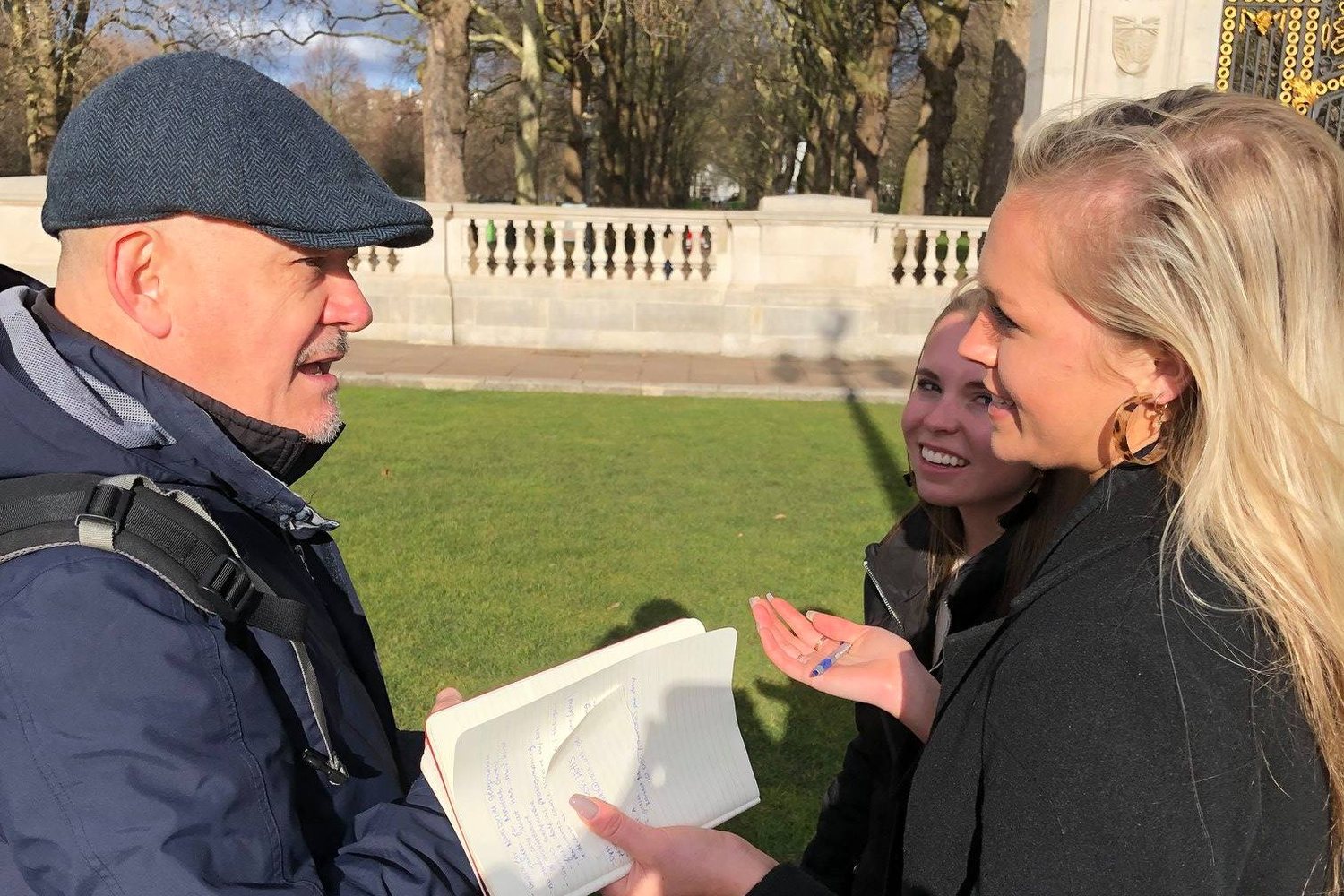
The big idea: No single method shows the whole person, so plan fieldwork that watches what people do, asks what they say and examines what they make.
In 60 seconds
- Field methods reach different knowledge: doing shows behavior, saying shows what people can explain, and making shows tacit and latent needs.
- Reconnaissance (self-reflection, description and a working hypothesis) comes before you choose methods.
- A strong plan mixes mainstreams and extremes and fills all four boxes of the current vs. ideal matrix.
Do this: plan your interview team’s fieldwork with at least one Do, one Say and one Make source before your first conversation.
How field research works: do, say, make
Field research is how your interview team learns from people in their own world. The method you choose depends on the problem. In Classes 2 and 3 we sort field methods by what they reach: what people do, what they say, and what they make or leave behind.
Qualitative
Words, stories, photos and observations from a small, chosen group. It answers why and how.
In BUAD 317: most of your fieldwork lives here.
Quantitative
Numbers from many people or records. It answers how many, how often and how much.
Use it: to check whether a pattern you heard is common.
Mixed methods
Both, in a planned order. Talk to people first to learn what matters, then count it if you need to.
Example: ten conversations, then a two-question poll.
Three ways into people’s experience
Experiencing (Do)
Direct observation. Treat it like an anthropological expedition: go where the experience happens and watch.
Field Guide: immersion (p. 52), analogous inspiration (pp. 53 to 55), peers observing peers (p. 60).
Enquiring (Say)
The researcher asks. Casual learning conversations are the core, supported by activities that let people show and sort.
Field Guide: interview (pp. 39 to 43, 45 to 47), card sort (pp. 57 to 59), collage (pp. 61 to 63), guided tour (p. 64), draw it (p. 65), resource flow (pp. 67 to 69), conversation starters. Also questionnaires, surveys, scales and polls.
Examining (Make)
Records and artifacts people already made. They give context and a way to check the stories you hear.
Sources: secondary research, archival documents, journals, maps, photos, video and audio recordings, film and other artifacts.
The labels Experiencing, Enquiring and Examining come from qualitative researcher Harry Wolcott and are used in Mills’s action research text, an optional supplemental book for this course.
Say, do, make: levels of knowledge
Design researcher Elizabeth Sanders explains why you need all three. What people say gives you explicit knowledge, the things they can put into words. What people do gives you observable knowledge. What people make, when you invite them to build, draw or sort, helps them show tacit knowledge (what they know but cannot easily explain) and latent needs (needs they do not yet know they have).
Same tools, two labels
The Field Guide lists card sort, collage and draw it under asking. In Sanders’s view they are making activities, because the person builds something. Either way, use them when people struggle to explain a feeling or a choice in words.
Current vs. ideal: what each conversation should uncover
Before you pick methods, decide what you need to learn. This two-by-two from the Class 3 supplemental slides separates how people feel from the thing that makes them feel that way, today and in the future.
| Time | Experience | Thing to be designed |
|---|---|---|
| Current | How does the person feel today when using the product, service or space? | What about the thing is making the person feel this way today? |
| Ideal | How does the person want to feel in the future when using it? | What does the thing need to do in the future to deliver that experience? |
Start with the experience column. The design follows from how people feel, not the other way around.
Uncovering needs along the path of expression
Sanders and Stappers describe a good session as a path. You start with what people experience now, travel back to memories, dig into the feelings underneath, then look forward to what they hope for. Making activities help at every step.
Now
Current experience: what a normal day with this looks like.
Try: guided tour, “walk me through.”
Then
Memories: the first time, the worst time, the best time.
Try: draw it as a timeline.
Underneath
Feelings and values that explain the choices.
Try: collage, card sort.
Next
Dreams and ideas for a better future.
Try: “If you could change one thing…”
Field Guide methods, one line eachWith a free Design Kit page for every method
| Method | Group | What you do |
|---|---|---|
| Immersion (opens in a new tab) | Do | Spend time in people’s daily setting. Shadow them and notice what they deal with. |
| Analogous inspiration (opens in a new tab) | Do | Watch a different setting with a similar problem. A pit crew can teach a hospital about fast handoffs. |
| Peers observing peers (opens in a new tab) | Do | Ask people to document their own peers with photos or notes, so you see what an outsider would miss. |
| Interview (opens in a new tab) | Say | A casual learning conversation, ideally where the person lives or works. |
| Conversation starters (opens in a new tab) | Say | Share a few provocative ideas and listen to how people react and argue with them. |
| Card sort (opens in a new tab) | Say | People rank word or picture cards and explain the order. Priorities appear fast. |
| Collage (opens in a new tab) | Say | People build a collage about a topic and talk you through it. Values show up in what they pick. |
| Guided tour (opens in a new tab) | Say | People show you their space and routines while they explain them. |
| Draw it (opens in a new tab) | Say | People sketch a timeline, a map or a process, which starts a deeper conversation. |
| Resource flow (opens in a new tab) | Say | People map what comes in and goes out (money, time, supplies) to reveal patterns. |
| Secondary research (opens in a new tab) | Make | Learn what is already known from articles, reports and records before and during fieldwork. |
Sampling: who to learn fromExtremes and mainstreams, and why ten of one kind is one story
The Field Guide’s sampling advice is to talk with both extremes and mainstreams (opens in a new tab).
- Mainstreams show what most people face on a normal day.
- Extremes use the service far more, far less, or in an unusual way. Their needs are louder, so they are easier to see, and they often point to what everyone else feels quietly.
- Insiders (staff, suppliers, experts) see the system from behind the counter.
Plan your 10+ interviews across these groups. For purposeful, snowball and convenience sampling and how to describe your sample later, see Your Interviewee Log and Sample (BUAD 497).
Say vs. doWhy one method is never enough
What people say and what they do often differ. A nurse may say she always uses the handoff sheet, while you watch her skip it at shift change. That gap is not a lie. It is an insight. Pair a Say method with a Do method to find it, and check both against a record or artifact when you can.
For how to run the conversations themselves, including TEDW openers and the five question types, see Casual Learning Conversations.
Plan it: methods by stage and your research plan
Generative research is not one method you use once. Different methods fit different stages of human-centered design, and your interview team plans its fieldwork with a short reconnaissance first.
| HCD stage | Core methods | What they do | In BUAD 317 |
|---|---|---|---|
| Inspiration (empathize, discover) | Ethnographic observation, casual learning conversations, diary studies, direct observation | See real needs and behavior in context. Diaries let people record moments over days, so unspoken needs surface. | Classes 3 to 7: your 10+ solid interviews (Deliverable #3 Part A) |
| Interpretation (define) | Journey mapping, synthesis workshops, five whys | Map touchpoints and pain points, analyze findings as a group, and dig for root causes. | Class 8: download and interpret (Part A) |
| Ideation (design) | Co-design workshops, participatory prototyping, brainstorming | Invite the people you design for to help generate and shape ideas. | Class 9: brainstorm (Part B) |
| Prototype and test | Rapid prototyping, usability testing, concept walkthroughs | Make quick, rough versions and watch people use them. | Classes 11 to 13: prototype and feedback interviews with 7 to 10 people (Parts C and D) |
| Implementation (iterate) | Service pilots, continuous feedback loops | Run real-world test drives and keep listening after launch. | Summer work and BUAD 497 |
The methods list summarizes the Class 3 supplemental slides, which drew on Design Kit and several practitioner blogs. Wording here is our own.
Reconnaissance: get the scoop before you go out
Self-reflection
What is going on in your head? Name the theories, leadership values, history and personal experiences you bring, and how this work fits the larger business context.
Why: your assumptions shape what you notice.
Descriptive activities
What evidence says this is a problem? Which people are affected? How is it handled today? Answer who, what, when, where and how.
Use: secondary research and records.
Explanatory activities
Write a working hypothesis. Focus on why (or why not), and account for the key factors that affect the situation.
Then: pick methods that could prove it wrong.
Your generative research plan
Once reconnaissance is done, put the plan on one page. These parts follow the research plan in Nikki Anderson-Stanier’s dscout guide on your reading list, in our own words.
Background and problem
Why this study, and the central research question.
Objectives
Two to four things you need to learn. Each starts with understand, discover or learn.
Participants
Who you will talk with, including extremes and insiders, and how you will reach them.
Methods
Your Do, Say and Make mix, and why it fits the objectives.
Conversation guide
An opening, your questions by type, follow-up probes and a wrap-up.
Timeline
Recruiting, conversations across Classes 5 to 7, and downloading before Class 8.
Where things live
One shared place for notes, photos and your interviewee log.
Can you trust your data?Validity, consistency and triangulation in plain terms
- Validity: are you learning what you think you are learning? Ask whether your findings are believable and whether someone could trace them back to what people said and did.
- Reliability: in qualitative work this means consistency of technique. Use one shared guide, ask in a similar way, and log every conversation the same way.
- Generalizability: generative research does not try to prove something is true for everyone. It aims for a deep, accurate picture of the people you studied, described well enough that others can judge where it applies.
- Triangulation: when what people say, what they do and what the records show point the same way, trust grows. When they clash, dig in. The triangulation matrix from Class 2 lines up each research question against at least three sources.
Consent, ethics and trustworthy data have their own page: Feet on the Street Interviews: Consent, Ethics and Trustworthy Data.
Where did lead users and the repertory grid go?They moved to the need-finding class
Lead users, the repertory grid and the other techniques for hidden needs now sit with need finding and jobs to be done in Class 10, after your interviews. See Need Finding, Johari’s Window and Jobs to Be Done.
Try it: Do, Say, Make Method Mixer
Tool · BUAD 317
Do, Say, Make Method Mixer
Build a field research mix that reaches what people do, say and make, then check it before your team goes out.
- 1Frame
- 2Mix
- 3Share
Your mix
All checks
Put it to work: your interview team’s field plan
By the end of Class 3 you are placed in a feet on the street interview team (not your later prototype team). Your field plan drives Deliverable #3 Part A: 10+ solid interviews, downloaded on sticky notes with photos, ready at the start of Class 8. The same mix comes back in Part D, when you take your prototype to 7 to 10 people.
Build your team’s field plan in six steps
Do reconnaissance together
Each teammate shares one assumption they bring. Then list what you know about the problem and write one working hypothesis.
Your deliverable: a short reconnaissance note at the top of your team’s research plan.
Fill in current vs. ideal
Write what you need to learn in all four boxes. Start with how people feel.
Your deliverable: the matrix, used to choose which questions go in your guide.
Mix Do, Say and Make
Run your plan through the Method Mixer. Include at least one way to watch, one way to ask and one record or artifact to examine. Add a making activity if feelings are hard to put into words.
Your deliverable: your method mix and why it fits your research question.
Recruit mainstreams and extremes
Spread your 10+ interviews across groups, settings and days. Add insiders who see the system from behind the counter.
Your deliverable: a target list in your team’s interviewee log.
Capture more than words
Note the setting and what people do. Take photos with permission. Keep artifacts people hand you, like a form or a hand-drawn map.
Your deliverable: Part A sticky notes (one quote or observation each) and photos, ready at the start of Class 8.
Reuse the mix for feedback
In Part D, watch what 7 to 10 people do with your prototype before you ask what they think.
Your deliverable: Part D feedback notes that show behavior as well as opinions.
Example: one research question, a full mixA made-up hospital pharmacy plan
Research question: why do patients leaving a clinic visit skip picking up new prescriptions at the hospital’s outpatient pharmacy?
Working hypothesis: we think the wait feels uncertain and patients are worn out, so they plan to come back later and never do.
- Do: observe the pharmacy line at its busiest hour on three days, and spend one afternoon going through a visit the way a patient does (immersion).
- Say: casual learning conversations with patients and caregivers, a guided tour of the counter with a pharmacy technician, and a draw it timeline of “the hour after your appointment.”
- Make: the pharmacy’s pickup records (counts only, no patient details) and the signs and handouts patients receive.
- Who: first-time patients, caregivers picking up for a parent, patients on five or more daily medicines (an extreme) and technicians (insiders).
What the mix caught: patients said they “did not have time,” but the draw it timelines showed most had 20 free minutes. They just could not see how long the wait would be. The need was certainty, not speed.
Do this, not thatField habits that hold up
Do this
- Write the research question before you pick methods.
- Pair what people say with what they do.
- Go where the experience happens.
- Include at least one extreme and one insider.
- Spread conversations over several days and places.
Not that
- Sending a survey first because it is quick.
- Asking people whether they would use your idea.
- Interviewing only friends and roommates.
- Ten interviews in one afternoon at one table.
- Notes that summarize instead of quoting.
Before you go outA checklist for your interview team
- [ ] Our research question is open and names people, not a solution.
- [ ] We wrote a working hypothesis and know what would prove it wrong.
- [ ] Our plan has at least one Do, one Say and one Make source.
- [ ] All four boxes of the current vs. ideal matrix are filled in.
- [ ] Our target list covers mainstreams, at least one extreme and insiders.
- [ ] We know how we will ask for consent for notes and photos.
- [ ] Everyone logs conversations in the same place, the same way.
Go deeper
Back to all BUAD 317 topics · Next: Casual Learning Conversations
In-class team activity · 25 min
Do, Say, Make Field Sprint
By the end: One research question for your interview team, tested three ways in the room (watch, ask and make), plus a current vs. ideal matrix and a method mix you can take into the field. Your instructor will give you the password in class.
Part of BUAD 317, taught by Lane Morris, PhD and Jules Morris, PhD, in the Smith GLS human-centered leadership program, toward the Human Centered Consulting Certificate.
Frequently asked questions
What are field research methods in human-centered design?
Field research methods are the ways a team learns from people in their own setting. In BUAD 317 we group them three ways: Experiencing (Do), such as observation and immersion; Enquiring (Say), such as casual learning conversations, card sorts and guided tours; and Examining (Make), such as records, photos and artifacts. Strong fieldwork mixes all three, because each one shows something the others miss.
What does say, do, make mean?
Say, do, make comes from design researcher Elizabeth Sanders. What people say gives you explicit knowledge they can put into words. What they do gives you observable knowledge you can watch. What they make, when you ask them to draw, build or sort, helps them show tacit knowledge and latent needs they cannot easily explain. Using all three gets you closer to what people really need.
What is the current vs. ideal matrix?
It is a two-by-two that tells your team what each conversation should uncover. One side is the person's experience, the other is the thing being designed. One row is today, the other is the future. You ask how people feel now, what about the thing makes them feel that way, how they want to feel, and what the thing would need to do to deliver that.
What is reconnaissance in a generative research plan?
Reconnaissance is the scouting you do before fieldwork. First, self-reflection: the assumptions, values and experiences you bring. Second, descriptive activities: evidence that the problem exists, who it affects and how it is handled today. Third, explanatory activities: a working hypothesis about why. Your methods should then be able to prove that hypothesis wrong.
Who should we interview for our 10+ solid interviews?
Talk with mainstreams, extremes and insiders. Mainstreams show what most people face. Extremes use the service far more, far less or in unusual ways, so their needs are easier to see. Insiders, such as staff or suppliers, see the system from behind the counter. Spread conversations across groups, places and days, because ten conversations with one kind of person is really one story.