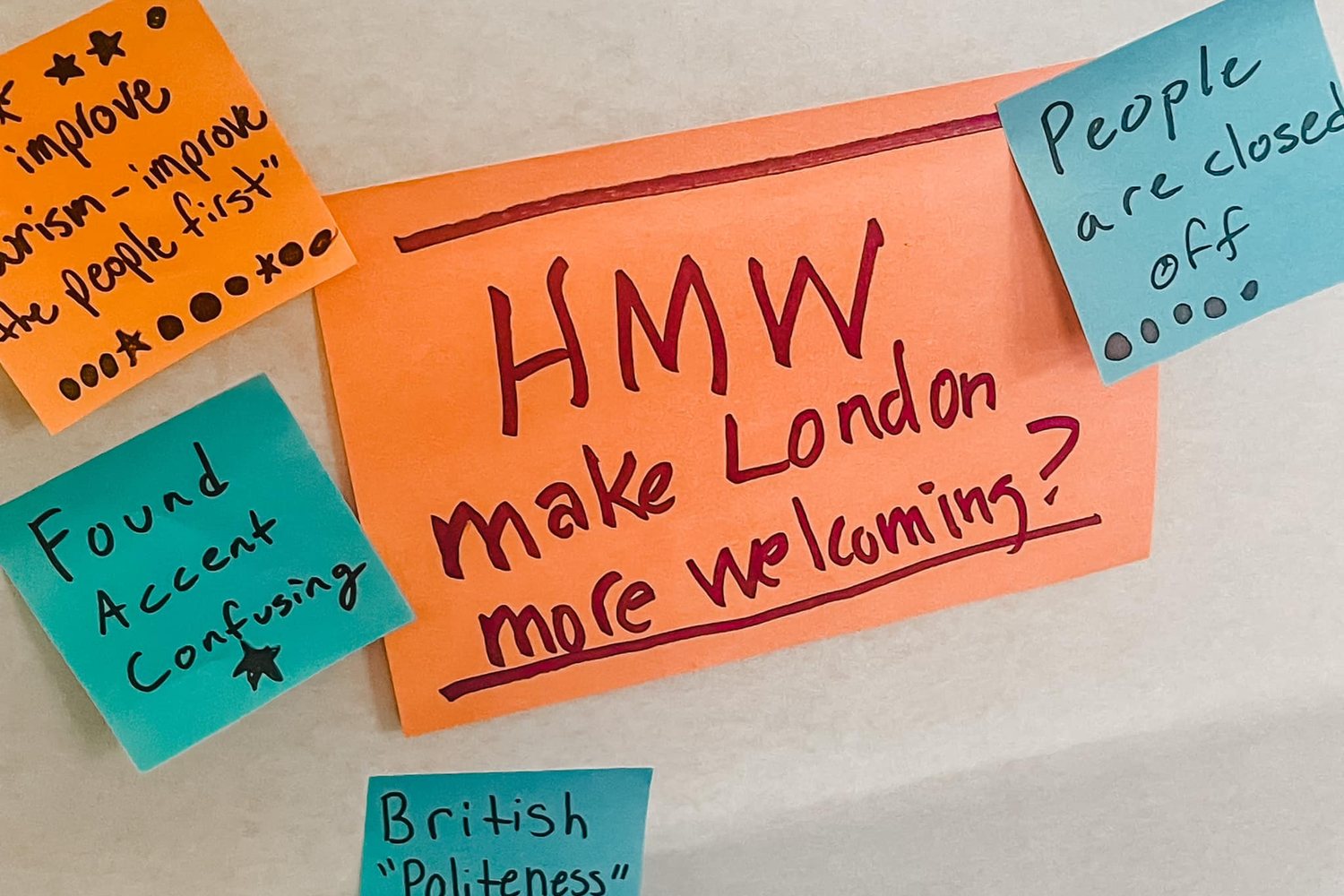
The big idea: A How Might We question turns your point of view into an invitation to brainstorm, and its scope decides how good your ideas can be: broad enough for many answers, narrow enough to know where to start.
In 60 seconds
- A How Might We question turns your point of view into an invitation to brainstorm.
- Scope matters: too broad gives no place to start, too narrow hides a solution inside.
- Write five to ten HMWs from different angles, then test each by naming three different solutions.
Do this: write and scope-check a set of HMWs, then pick the one that opens your Ideate phase.
How HMW questions work
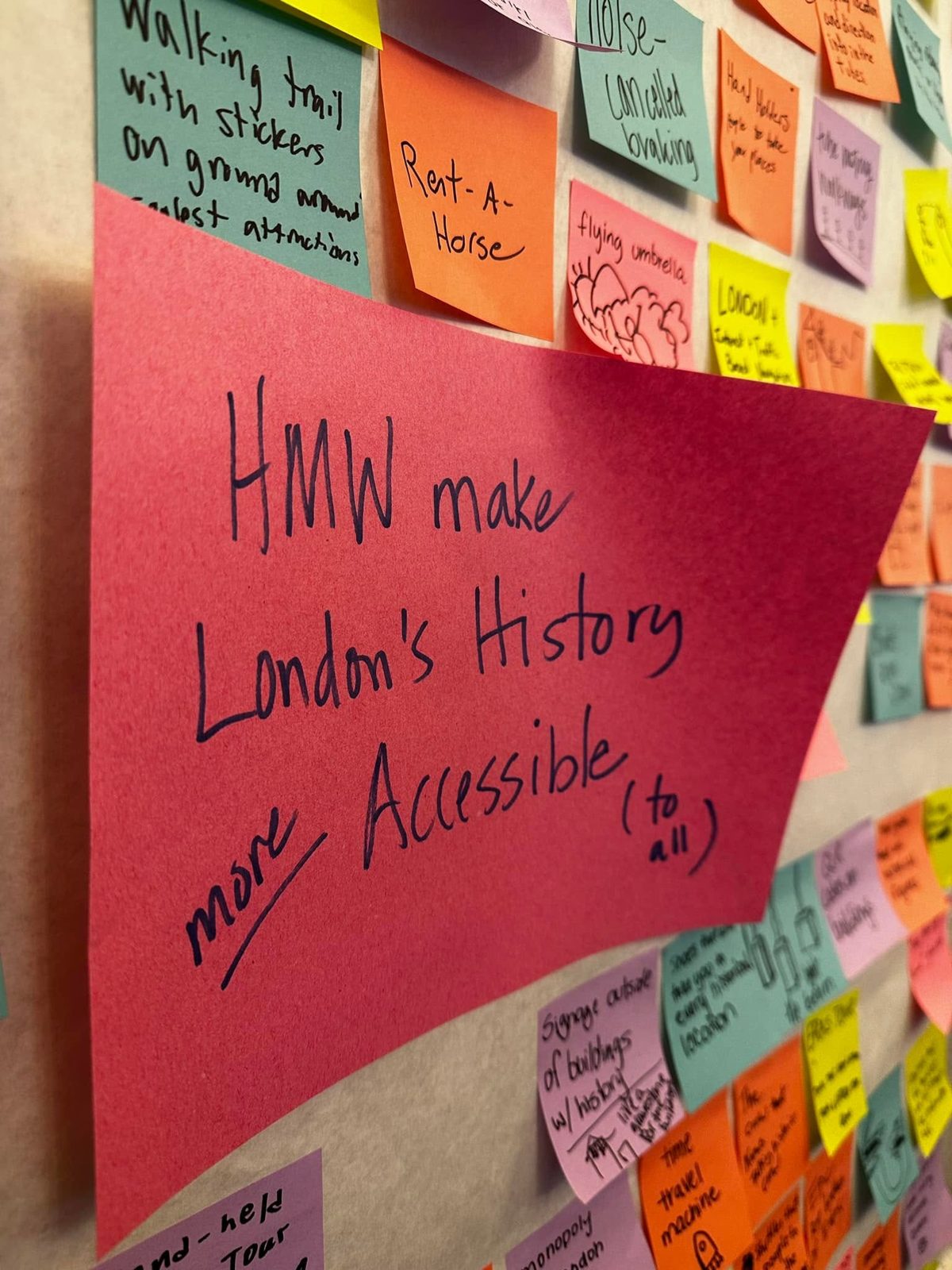
A How Might We (HMW) question turns your point of view into an invitation to brainstorm. Each word does a job.
How
Admits you do not have the answer yet. It keeps you from jumping to the solution you walked in with.
Might
Says any answer is one possibility, not the only one. It gives the team permission to explore.
We
Makes it a team effort. The answer will come from building on each other’s ideas.
Adapted from the How Might We handouts in your course materials (Interaction Design Foundation and the Stanford d.school).
Find the right scope
Too broad
No person, no moment. The team does not know where to start.
Example: “How might we improve health care?”
Too narrow
The solution is already inside. Only one answer fits.
Example: “How might we build an app that texts patients a pill schedule?”
Just right
A person, a moment and a change, with room for wild ideas.
Example: “How might we take the guesswork out of her first week of pills at home?”
Signs it is too broad
Fewer than five words after “How might we.” Big verbs like improve, fix or transform. A whole system as the object (tourism, health care, education). No user in sight.
Signs it is too narrow
It names a product (app, sign, kiosk, checklist). It says how (“by adding,” “using a”). It stacks so many conditions that only one idea fits.
Your design challenge is broad on purpose
A class challenge like “How might we delight London tourists?” is a starting frame, not your brainstorm question. Fieldwork and your point of view narrow it. Then you write many smaller HMWs from that point of view. The right scope also shifts as your project moves forward.
Angles for writing more HMWsWays to come at the same point of view
The d.school’s How Might We method card suggests angles like these. Each one opens a different set of ideas. Examples use the hospital discharge point of view.
| Angle | Example HMW |
|---|---|
| Amp up the good | How might we build on the daughter’s habit of photographing everything so the family shares one clear plan? |
| Remove the bad | How might we take the guesswork out of her first week of pills at home? |
| Explore the opposite | How might we make going home feel as supported as the hospital bed? |
| Question an assumption | How might we explain medications when she is rested instead of on the way out the door? |
| Go after an adjective | How might we make the last hour in the hospital calm instead of rushed? |
| Find unexpected resources | How might we use the time a roommate’s visitors spend waiting? |
| Borrow an analogy | How might we make discharge feel like a pilot’s preflight checklist? |
| Break it into pieces | How might we help a tired patient remember what a nurse told her? |
Tweak the questionQuestions to ask when an HMW feels off
- What is the job, opportunity or problem we are really trying to solve?
- What is the ultimate impact we want to have on this person?
- Can we list several possible solutions? Do they vary?
- What context and constraints are we facing (time, cost, rules, culture)?
- Does the question need adjusting? Rewrite it and test again.
A good HMW can lead to many kinds of answers: experiences, spaces, activities, services or products. If every idea is the same kind, widen the question.
Try it: HMW Scope Checker
Tool · IB 407
HMW Scope Checker
Wide enough for wild ideas, narrow enough to know where to start.
- 1Write
- 2Check
- 3Shortlist
Point of view
Your question
All checks
Put it to work: HMWs that launch your Ideate phase
HMW questions close your Interpret/Define phase and open Ideate. The Ideate rubric asks for a spectrum of ideas from your HMW, so a well-scoped question decides how good your brainstorm can be. At the very least, you should be able to get 20 ideas from a single HMW.
Launch your brainstorm in five steps
Restate your point of view
User + need (a verb) + insight, from your need-finding work.
Your deliverable: one point of view statement at the top of your Define board.
Write five to ten HMWs
Use at least four different angles. Do not brainstorm solutions yet.
Your deliverable: a list of HMWs on Post-its or in your notebook.
Scope-check every one
Run each through the HMW Scope Checker. Fix the too broad and too narrow ones.
Your deliverable: your HMW set, each marked just right, for the Interpret/Define submission.
Run the three-solution test
For each HMW, try to name three very different solutions in one minute. Drop the ones that stall.
Your deliverable: a short list of two or three HMWs that passed.
Pick one and brainstorm
Vote on the HMW the team is most excited about. Then go for quantity: 20 ideas or more, practical to wild.
Your deliverable: the HMW that opens your Ideate phase.
A worked exampleOne point of view, three rounds of rewriting
For example, a team studying campus dining at lunch has this point of view: a commuter student with 15 minutes between back-to-back classes needs to know whether she can eat and still make it to class, because she cannot see the menu or the wait from the door.
- First try (too broad): How might we fix campus dining?
- Second try (too narrow): How might we add a second menu board above the salad bar?
- Third try (just right): How might we help a student decide in ten seconds whether to eat now or later?
The third version names a person and a moment, and it allows many answers: a view of the line from the door, a grab-and-go shelf, a pre-order, a different layout.
Do this, not thatHabits that make a brainstorm take off
Do this
- Write HMWs from your point of view, not from the original challenge.
- Write many, then choose.
- Keep the user and the moment in the question.
- Test each HMW by naming three different solutions.
- Rewrite as you learn more.
Not that
- Hiding your favorite solution inside the question.
- “How might we improve the experience?”
- Brainstorming before you have HMWs.
- Stacking so many conditions that only one idea fits.
- Keeping a question no one on the team is excited about.
Before you submitCheck your HMW set
- [ ] Our point of view names a user, a need as a verb, and an insight.
- [ ] We wrote at least five HMWs from at least four angles.
- [ ] Every HMW starts with “How might we” and contains no product or method.
- [ ] Each HMW names a person or a moment.
- [ ] We can name three different solutions for our chosen HMW.
- [ ] The team voted on the HMW that opens Ideate.
Go deeper
Back to all IB 407 topics · Next: Ideation That Goes Somewhere
In-class team activity · 25 min
HMW Swap and Stress Test
By the end: A point of view, a scope-checked set of How Might We questions, and one HMW that another team proved can spark ideas. Your instructor will give you the password in class.
Part of the Smith GLS human-centered leadership sequence: IB 407, BUAD 317 and BUAD 497, toward the Human Centered Consulting Certificate.
Frequently asked questions
What is a How Might We question?
A How Might We (HMW) question turns your point of view into an invitation to brainstorm. "How" admits you do not have the answer yet, "might" says any answer is one possibility, and "we" makes it a team effort. HMW questions close the Interpret/Define phase of human-centered design and open Ideate.
How do you write a How Might We question?
Start from your point of view: user, need as a verb, and insight. Break it into pieces and write five to ten HMWs from at least four angles before brainstorming. Check each one for scope, then pick one or two the team is most excited about. A single good HMW should produce at least 20 ideas.
How do you know if a How Might We question is too broad or too narrow?
A question is too broad if it has no person or moment, uses big verbs like improve or transform, or targets a whole system such as health care. It is too narrow if it names a product like an app or kiosk, or says how. A just-right HMW has a person, a moment and a change, with room for wild ideas.
What is the three-solution test for How Might We questions?
The three-solution test checks whether an HMW leaves room for many answers. For each question, try to name three very different solutions in one minute, and drop the ones that stall. A good HMW can lead to experiences, spaces, activities, services or products. If every idea is the same kind, widen the question.
What is an example of rewriting a How Might We question?
A team studying campus dining first wrote "How might we fix campus dining?" which was too broad. Next, "How might we add a second menu board above the salad bar?" was too narrow. The final version, "How might we help a student decide in ten seconds whether to eat now or later?" names a person and a moment and allows many answers.