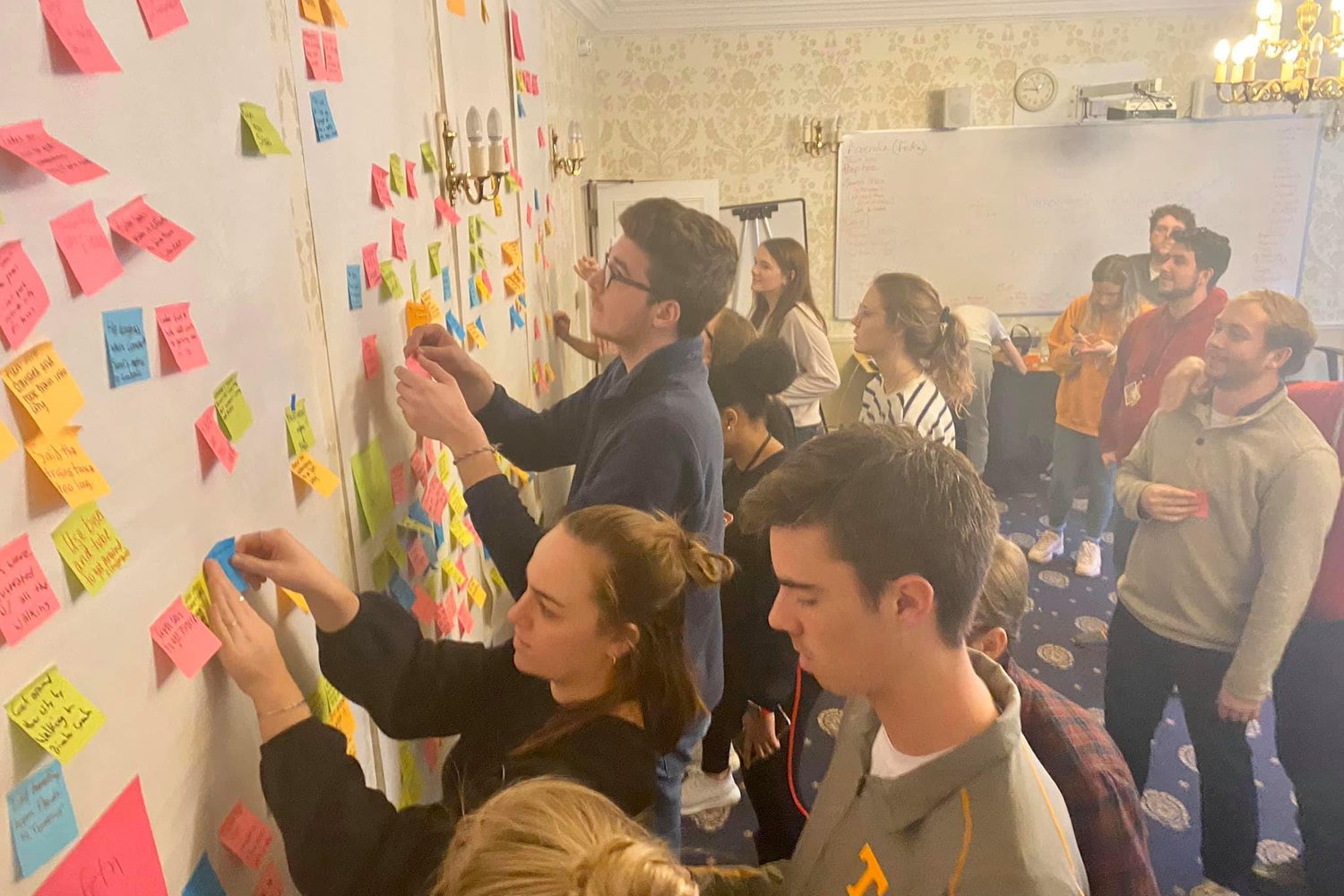
The big idea: Human-centered design solves problems by starting with the people who live with them, and it works best when the people doing it bring the mindsets along with the steps. Day 1 is about your own starting point.
In 60 seconds
- Human-centered design starts with the people who live with a problem, then loops through empathize, define, ideate, prototype and test.
- Every idea must pass three tests: desirable to people, feasible to build and run, and viable for the organization to pay for and keep going.
- Mindsets matter as much as steps. Creative confidence is learned, and HCD fits adaptive challenges that have no single right answer.
Do this: find your starting point: take the Mindset Self-Check, back up your strongest and growing mindsets with moments from your own life, and practice calling a London problem technical or adaptive.
How human-centered design works
Human-centered design (HCD) solves problems by starting with the people who live with them. It works in a hospital, a finance team, a warehouse or a city office, because every one of those has people trying to get something done.
Why a leadership course starts with design
Jules and Lane define leadership as inspiring and mobilizing people to tackle tough challenges and do things that matter. HCD is a practical way to do that: you start with the people who live the challenge, and you bring them along as you find the answer.
Empathize
Watch and talk to the people you are designing for, in their own setting.
You leave with: stories, quotes and surprises.
Define
Make sense of what you heard. Turn it into needs and a sharp question.
You leave with: a point of view and How Might We questions.
Ideate
Generate lots of ideas, from practical to wild, then pick a few.
You leave with: a short list worth building.
Prototype
Build rough, cheap versions people can see, hold or act out.
You leave with: something users can react to.
Test
Put the prototype in front of real users. Learn, change it, test again.
You leave with: evidence and a story to pitch.
In class: three phases that open and close
In London the same work is grouped into the three phases from the IDEO.org Field Guide, the same three spaces Tim Brown of IDEO describes. Inspiration: frame the challenge, do your research and fieldwork. Ideation: make sense of what you learned, brainstorm, prototype and test. Implementation: keep iterating, run a live prototype, then a pilot. Each phase opens up to more options (diverge) and then narrows to choices (converge).
The phases look like a straight line on paper. In practice you circle back: a test sends you back to empathy, an idea shows you asked the wrong question. Expect the mess. It is part of the method.
The three tests every idea must pass
Brown describes design thinking as matching what people need with what is technically feasible and what a viable business strategy can support. Each business major is good at spotting one of these, which is one reason design teams mix majors.
Desirable
Do people actually want this? Does it meet a real need you saw in the field?
Proof comes from: empathy, interviews and testing. Everyone owns this one, whatever the major.
Feasible
Can it be built and run with the people, tools and processes available?
Proof comes from: operations, supply chain and analytics majors asking “how would this work on a Tuesday?”
Viable
Can the organization pay for it and keep it going?
Proof comes from: finance, accounting and economics majors running the numbers.
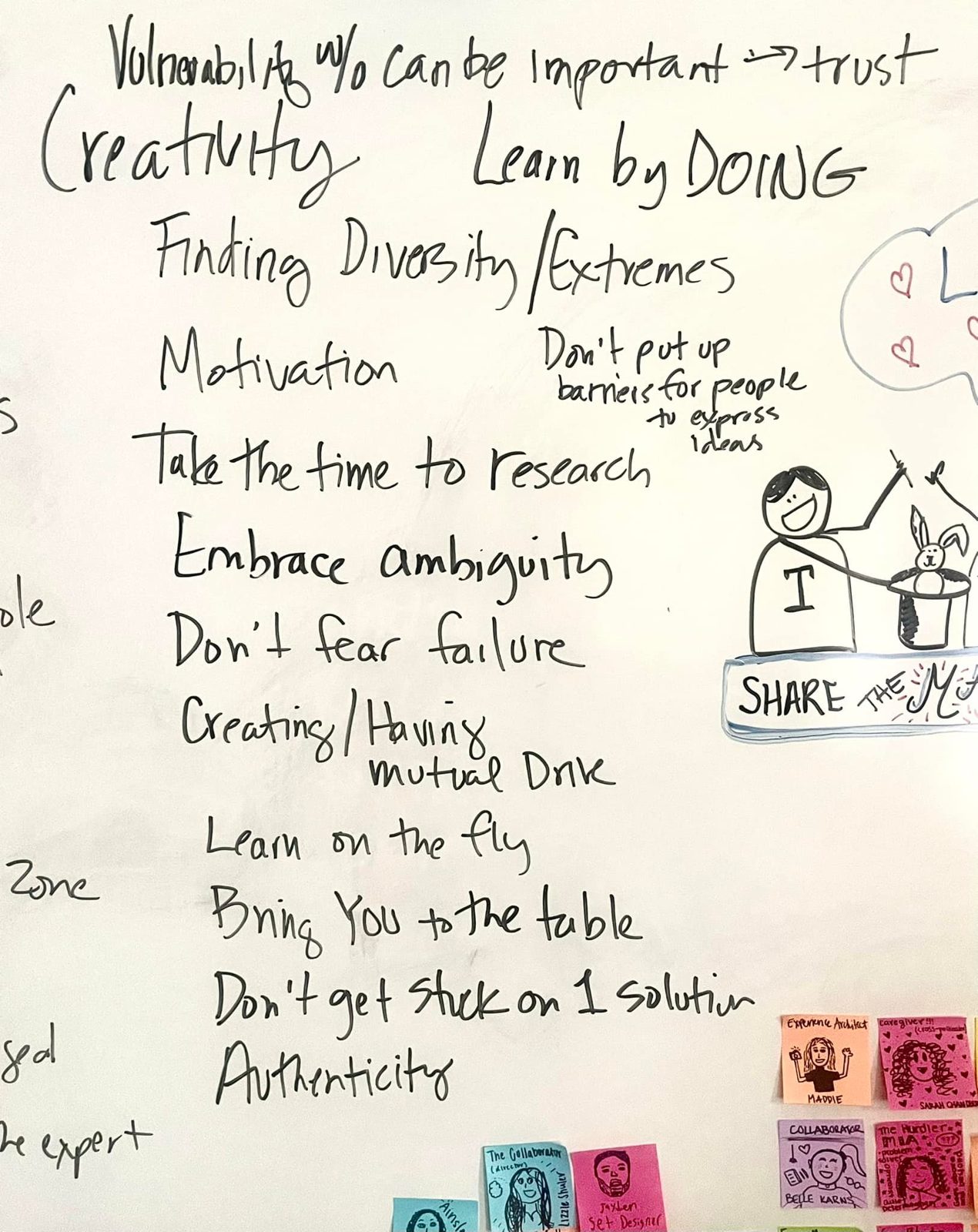
Mindsets: how designers think, not just what they do
Seven mindsets from the IDEO.org Field Guide
- Empathy. See the problem through the eyes of the people who live it.
- Creative confidence. Believe you can come up with ideas and act on them.
- Make it. Build to think. A rough model teaches more than a long memo.
- Learn from failure. Treat a failed test as data, not a verdict on you.
- Embrace ambiguity. Keep going before the answer is clear.
- Optimism. Work from the belief that a better solution exists.
- Iterate, iterate, iterate. Small changes, real feedback, repeat.
What this course adds
- Collaboration. People from different majors see more together than any one person sees alone.
- Curiosity. Ask the next question, then the one after that.
- Vulnerability. Share half-formed ideas. It builds trust and connection.
- Abundance over scarcity. There is no shortage of ideas. Go look for more.
- Reflection. Step off the dance floor and onto the balcony to see the bigger picture.
- Purpose. Effort and courage need a direction. Know who you are designing for.
Technical problem or adaptive challenge?
A technical problem has a known fix that an expert can apply. An adaptive challenge has no clear answer and asks people to learn and change. Ronald Heifetz, who drew this line, calls treating an adaptive challenge like a technical one the most common leadership mistake. HCD is built for adaptive challenges, which is why the London design challenge you get on Day 2 has no single right answer. Start practicing the call on problems you run into this week.
A real example: nurses redesign the shift changeHow HCD worked inside a large hospital system
In his 2008 Harvard Business Review article “Design Thinking,” Tim Brown describes a project at Kaiser Permanente, a large U.S. health care provider. Kaiser taught design thinking to nurses, doctors and administrators in workshops with IDEO, and those workshops produced a portfolio of new ideas.
One team looked at nursing shift changes at four hospitals. The core team mixed a former nurse, an organizational development specialist, a technology expert, a process designer, a union representative and designers.
- What they changed: nurses passed information to the next shift in front of the patient, not at the nurses’ station.
- How fast they built it: a working prototype in about a week, with new procedures and simple software for shift notes.
- What happened: Brown reports that the average time between a nurse arriving and first seeing a patient was more than cut in half.
Notice the mix of disciplines, the quick rough prototype, and the fact that the “product” was a process. Most of your projects will be processes and services too.
The four fears that block creative confidenceName the fear, then take the next small step
In “Reclaim Your Creative Confidence” (Harvard Business Review, 2012), Tom and David Kelley name four fears. They borrow from psychologist Albert Bandura, who helped people overcome a fear of snakes through small, guided steps he called “guided mastery.”
Fear of the messy unknown
Staying at your desk feels safer than going out to talk to strangers.
Next step: go out early and often, even for ten minutes.
Fear of being judged
You hold back ideas because someone might think they are dumb.
Next step: label it a wild idea and invite others to build on it.
Fear of the first step
The project feels so big you never start.
Next step: shrink the first move until it is easy, like one interview today.
Fear of losing control
Letting others shape the idea feels risky.
Next step: share early and let the best idea win, even if it is not yours.
A heuristic: the Ten Faces of InnovationTom Kelley’s ten roles, used lightly
Tom Kelley of IDEO names ten roles people play in innovation work, from the Anthropologist who watches people closely to the Storyteller who wins support for an idea.
A heuristic, not a personality test. Use it to notice roles you lean toward, then try a different one.
HCD in every business majorThe same method, pointed at different problems
| Major | A human-centered question |
|---|---|
| Finance | Why do department managers keep missing the budget deadline, and what are they doing instead? |
| Accounting | What makes expense reports so painful that people put them off for weeks? |
| Supply chain | How do warehouse pickers work around the handheld scanner, and why? |
| Management and HR | What does a new hire’s first week feel like on the night shift? |
| Business analytics | Why does a dashboard the team asked for go unused after a month? |
| Economics | How do people actually choose between options when they are tired and rushed? |
| International business | How does a first-time visitor experience a new city in their first 24 hours? |
Try it: HCD Mindset Self-Check
Tool · IB 407
HCD Mindset Self-Check
Seven moments from one design project. Pick what you would most likely do, not what sounds best.
- 1Answer
- 2See profile
- 3Practice
Practice next in London
Your mindset profile
Put it to work: get ready for the London design challenge
In London your class works like a consulting firm with a real client challenge. Teams form on Day 2, and each team is graded on five HCD phases (40 points each: Empathy, Interpret/Define, Ideate, Prototype, and Testing/Final Presentation/Storytelling), plus Individual Participation and your Peer Contributions & Self-Assessment with a Final Reflection Letter. Day 1 is about you: the mindsets, creative confidence and judgment you bring to whatever team you join.
Get ready in five steps
Run the Mindset Self-Check
Answer for real, not for the option that sounds best. Note which mindsets come up Strong and which come up Growing.
Your deliverable: your profile, copied into your individual notebook.
Name your starting point
Pick your strongest mindset and the one you most want to grow. For each, write down a moment from your own life that shows it: a job, a sport, a class project, a trip. If the tool and your life disagree, trust your life.
Your deliverable: your first daily a-ha insight and discussion question in the Facebook Group daily doc.
Practice the technical or adaptive call
Pick a problem you have run into in London so far, like finding the right exit from a busy Tube station. List what you would have to learn from people before you could solve it. A long list points to adaptive. A known fix an expert could apply points to technical.
Your deliverable: one line in your individual notebook: “This is adaptive (or technical) because…”
Face one fear
Read the four fears that block creative confidence. Name the one you feel most, then shrink it to one small step you will take this week, like sharing a wild idea out loud on Day 2.
Your deliverable: one sentence in your notebook: the fear and your first small step.
Know the check you bring
Desirable, feasible and viable are how every final idea will be judged. Decide which test your major helps you check best, so you can offer it when teams form.
Your deliverable: a short note you can say out loud on Day 2: “I can help us check…”
What the graders look for in each phaseThe top level of each 40-point rubric, in plain words
Empathy
A full spectrum of human-centered insights, with rich descriptions, surprising insights and deep needs.
Interpret/Define
Multiple complex problem statements, a compelling reframe, and needs stated as verbs, not nouns.
Ideate
Many techniques, an overwhelming number of ideas, from very practical to nearly impossible.
Prototype
Multiple representations and iterations, tested thoroughly from more than one perspective.
Testing/Presentation/Storytelling
A captivating user-focused story that ties empathy, point of view, prototype and real-world testing together. What worked? What did not?
Peer contributions
Useful ideas, roles done well, respect for others, focus on the goal, and leadership within the group.
Smith GLS is an honors program. “Exceeds expectations” is the assumed norm.
Do this, not thatHabits that help in an intensive week
Do this
- Get out of the classroom early. Start noticing how real people move through London on day one.
- Share rough ideas fast and invite people to build on them.
- Once teams form, use every major: someone checks feasible, someone checks viable.
- Treat a failed test as the most useful thing that happened that day.
- Use AI to brainstorm or practice interviews, then check it against what people told you, and note how you used it.
Not that
- Starting with a solution and looking for users to agree.
- Waiting until the plan is perfect before you build anything.
- One person doing all the talking in interviews or presentations.
- Defending your prototype when a user struggles with it.
- Treating the phases as a checklist you finish once.
Before teams formA quick checklist for the end of Day 1
- [ ] I can explain the five phases and why they loop.
- [ ] I can name the seven Field Guide mindsets, my strongest one and the one I will practice.
- [ ] I can tell a technical problem from an adaptive challenge and give a London example of each.
- [ ] I can name the fear that most often holds me back and one small step against it.
- [ ] I posted my a-ha insight and discussion question in the daily doc.
- [ ] I have my individual notebook ready for fieldwork.
Go deeper
Back to all IB 407 topics · Next: Frame the Challenge: Problems, Questions and Secondary Research
In-class activity · 25 min
Seven Mindsets, Your Starting Point
By the end: your strongest and growing mindsets backed by moments from your own life, a technical or adaptive call on a London challenge made with a partner from a different major, and one thing you want to practice when teams form on Day 2. Your instructor will give you the password in class.
Part of the Smith GLS human-centered leadership sequence: IB 407, BUAD 317 and BUAD 497, toward the Human Centered Consulting Certificate.
Frequently asked questions
What is human-centered design?
Human-centered design (HCD) solves problems by starting with the people who live with them. It moves through five phases: empathize, define, ideate, prototype and test, and in practice it loops back as teams learn. It works in a hospital, a finance team, a warehouse or a city office, because each has people trying to get something done.
What does desirable, feasible and viable mean in design thinking?
These are the three tests every idea must pass. Desirable asks whether people actually want it, proven through empathy, interviews and testing. Feasible asks whether it can be built and run with the available people, tools and processes. Viable asks whether the organization can pay for it and keep it going. Each business major tends to be strongest at one of these checks.
What are the mindsets of human-centered design?
The IDEO.org Field Guide lists seven mindsets: empathy, creative confidence, make it, learn from failure, embrace ambiguity, optimism, and iterate, iterate, iterate. The IB 407 course adds collaboration, curiosity, vulnerability, abundance over scarcity, reflection and purpose. HCD works best when each person brings these mindsets along with the steps.
What fears block creative confidence?
Tom and David Kelley name four fears: fear of the messy unknown, fear of being judged, fear of the first step and fear of losing control. Their answer borrows from Albert Bandura's guided mastery: take small steps. Go out early, label a wild idea and invite others to build on it, shrink the first move, and share early.
What is an example of human-centered design in a hospital?
Tim Brown's 2008 Harvard Business Review article describes Kaiser Permanente nurses redesigning shift changes with IDEO. A mixed team built a working prototype in about a week, and nurses began passing information to the next shift in front of the patient. Brown reports the average time before a nurse first saw a patient was more than cut in half.