Case study · Marketing 475 · Brand Strategy: Who Is Your Brand?
Stanley’s Quencher was a slow seller until the company stopped asking who had always bought Stanley and started serving the women who were already asking for the cup.

Brand
Stanley (Pacific Market International)
Year(s)
2019 to 2024
Channel(s)
Influencer and affiliate partners, TikTok and Instagram, limited color drops, retail and brand collaborations
Goal
Grow a century-old drinkware brand by reaching a new customer
Topic
Brand strategy
$73M
Stanley sales in 2019, before the Quencher boom (CNBC, 2023)
$750M+
Projected Stanley sales for 2023 (CNBC, 2023)
5,000
Cups in The Buy Guide’s 2019 wholesale order that sold out within days (CNBC, 2023)
100+
Quencher colors released by late 2023 (CNBC, 2023)
The situation
Stanley was founded in 1913 by William Stanley, who built an all-steel vacuum bottle. For most of its history, TODAY reported in 2024, Stanley’s thermoses appealed to outdoorsy people and blue-collar workers. The classic green bottle was its best-known product.
In 2016, Stanley launched the Quencher, a 40-ounce insulated cup with a handle and straw. According to CNBC, it sold poorly, and by 2019 Stanley had stopped restocking and marketing it. Total company sales in 2019 were about $73 million.
The challenge
The people who loved the Quencher did not look like Stanley’s traditional customer. Ashlee LeSueur, a cofounder of The Buy Guide, a Utah-based shopping blog run by a group of women, had bought one in 2017. In 2019 she asked Stanley to keep making it. Sales data did not support that, so Stanley offered a wholesale deal instead.
The Buy Guide ordered 5,000 cups. “I felt like I was signing a mortgage,” LeSueur told CNBC. The order sold out within days. Stanley now had evidence of demand from a customer group it had not targeted much in its first century: women.
What they did
In 2020 Stanley hired Terence Reilly as president. He had spent seven years at Crocs, where he led the strategy that made the clogs popular again. Reilly told TODAY that with “new colors, materials and finishes,” the product “could be something that catches the eye of a new customer.”
The core product stayed the same 40-ounce Quencher. What changed was who Stanley designed the marketing for and how it reached them.
- Influencer partners: Stanley treated The Buy Guide as a partner to launch new colors, and Reilly credited them with helping create “the Quencher phenomenon” (CNBC, 2023)
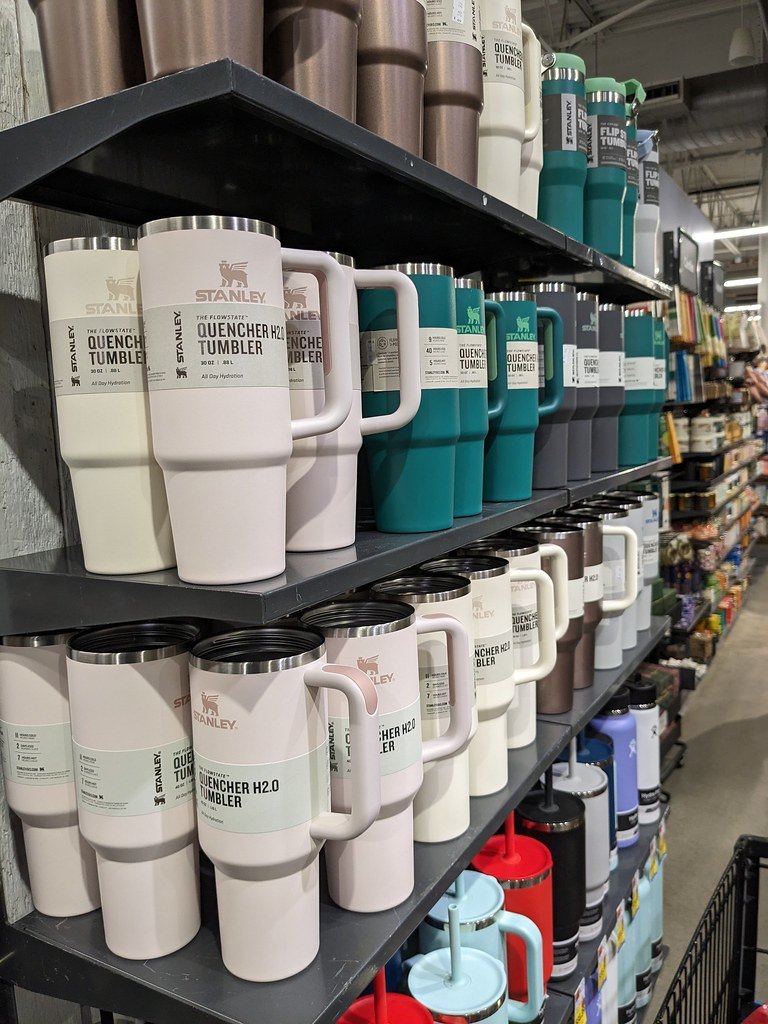
- Color as fashion: more than 100 colors released, many in pastel, photo-friendly shades (CNBC, 2023)
- Scarcity: limited-edition color drops that sell out, with production increased each time but some scarcity kept on purpose (CNBC, 2023)
- Collaborations: for example, a Starbucks red Quencher in late 2023 and a Starbucks pink cup sold at Target in early 2024
- Fast, human response: in November 2023, after a TikTok video showed a Quencher surviving a car fire with ice still inside, Reilly replied on Stanley’s TikTok and offered to replace the woman’s car (ABC7, 2023)
What happened
The Quencher became Stanley’s top seller in 2020, replacing the classic green bottle, and more than 10 million had sold by late 2023, according to CNBC. Company sales grew quickly.
- 2019: $73 million in sales (CNBC, 2023)
- 2020: $94 million (CNBC, 2023)
- 2021: $194 million (CNBC, 2023)
- 2022: $402 million (CNBC, 2023)
- 2023: projected to top $750 million (CNBC, 2023)
Why it worked
Stanley listened to evidence instead of history. A small, passionate group of women was already buying and talking about the cup. Rather than ignore them because they did not match the old customer profile, Stanley built its strategy around them.
It also changed what the product meant. The same cup was positioned as a daily accessory and a collectible, not only a tool for a job site. Colors and drops gave people reasons to buy a second and third cup. Influencers who already had the trust of this audience did the explaining.
Where it gets complicated
Success brought problems. At the start of 2024, a Starbucks-branded pink Quencher sold at Target led to shoppers camping in parking lots and reselling cups for hundreds of dollars. Critics asked why anyone needed many versions of a reusable product, and some children were reportedly teased for not owning a real Stanley (TODAY, 2024).
In early 2024, Stanley also confirmed that the sealing material at the base of its cups “includes some lead,” while saying no lead contacts the user or the drink. Proposed class actions followed in California and Washington state (Scripps News, 2024).
A brand built on trend and scarcity has to keep the trend alive. That is a different and riskier business than selling durable gear to loyal workers.
The marketing principle
Product-market fit is not fixed. Stanley did not need a new product. It needed a new answer to the strategy question “who is this for?” Once it chose a new customer, everything else followed: colors, partners, channels and launch style. The lesson is to watch who is already choosing your product, even when they are not who you expected.
Sources
- How a 40-ounce cup turned Stanley into a $750 million a year business, CNBC (2023)
- The Stanley cup craze: How a 110-year-old company went mega-viral, TODAY via NBC10 Philadelphia (2024)
- Woman’s Stanley tumbler survived a car fire. Now the company is giving her free cups and a new ride, ABC7 (2023)
- Viral Stanley cup maker facing multiple lawsuits over lead, Scripps News via WTVR (2024)
Group activity for this case
Who’s Already Buying?
An unexpected customer for your brand and the colors, partners and drops that would serve them. A 22-minute group activity. Dr. Morris gives the password in class.
Back to Brand Strategy: Who Is Your Brand? · All case studies
Brand names, images and trademarks belong to their owners and appear here for educational purposes only.