Case study · Marketing 465 · Social Media and Short-Form Video
Duolingo turned its mascot into an unpredictable TikTok character, and the chaos worked because it was built on daily listening to the audience, not on random jokes.
Brand
Duolingo
Year(s)
2021 to 2025
Channel(s)
TikTok, later YouTube Shorts and other social platforms
Goal
Grow awareness and sign-ups through organic, entertaining content instead of paid acquisition
Topic
Social Media and Short-Form Video
16M+
Duolingo TikTok followers, up from about 50,000 (The Drum, 2025)
10B+
impressions on Duolingo’s official social accounts to date (Duolingo 2024 annual report)
40M+
daily active users at the end of 2024, up 51% (Duolingo, 2025)
The situation
Duolingo is a language-learning app with a green owl mascot named Duo. In its 2024 annual report, the company said it grows “primarily relying on word-of-mouth and brand buzz rather than paid user acquisition.” Social media is a big part of that buzz.
Duolingo started posting on TikTok in early 2021. In October 2021, Duo became a regular character on the account, and the content started to take off.
The challenge
An education app is not naturally entertaining. Most brand accounts on TikTok look like ads, and viewers scroll past ads. Duolingo needed a reason for people to watch, share and follow, without paying for every view.
What they did
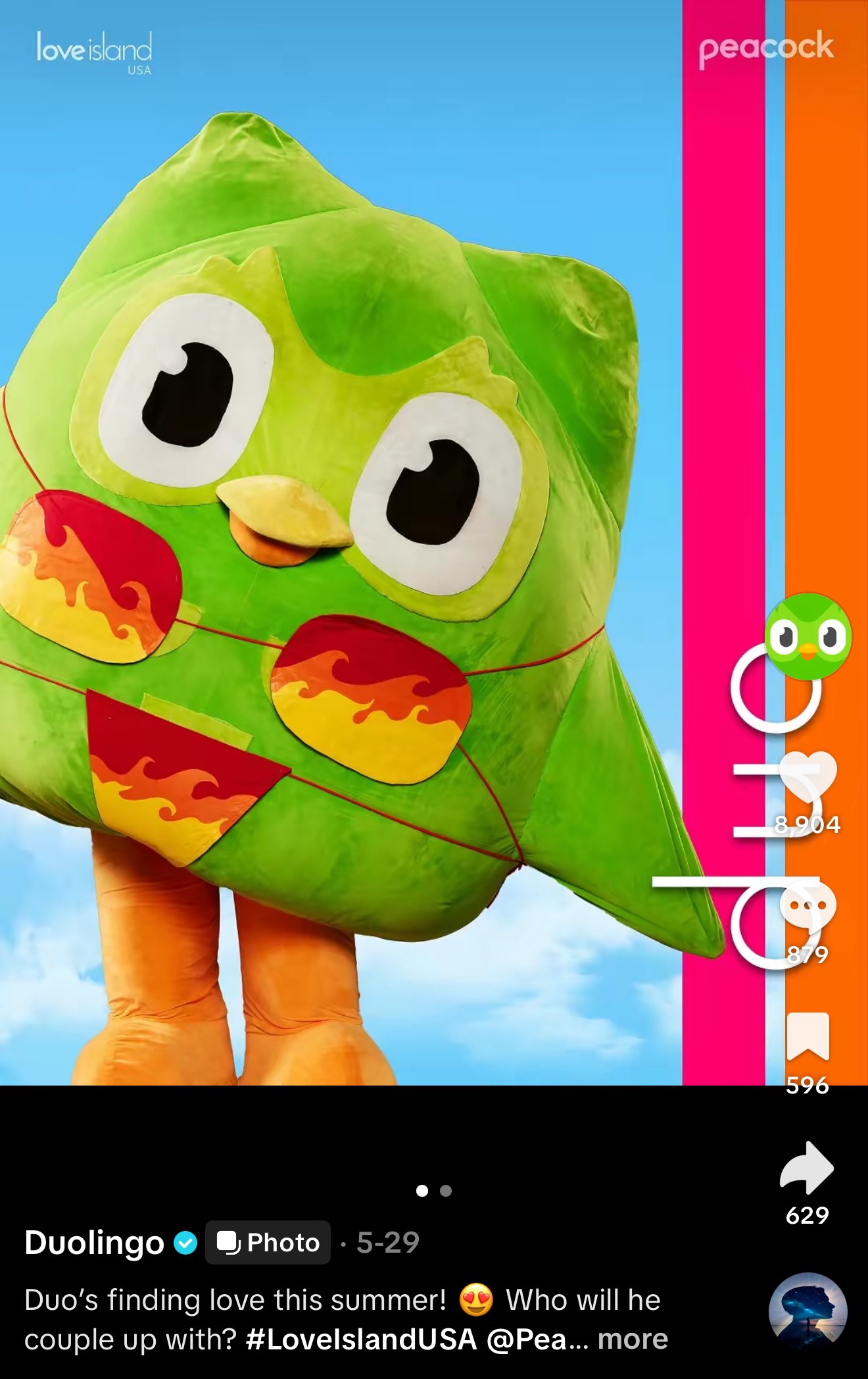
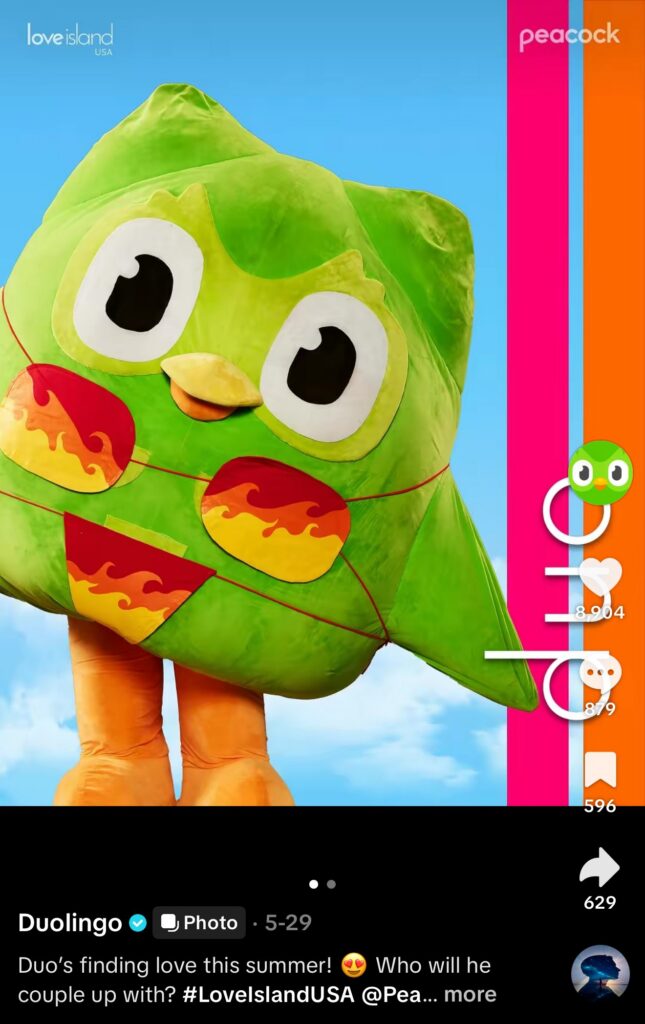
Duolingo made Duo act like a character, not a company. The owl twerked on office tables, chased trends, joked about pop stars and commented under other brands’ posts. The tone became known as “unhinged.”
The chaos had a method behind it. Zaria Parvez, who joined in 2020 as the company’s only social media coordinator, told Digiday in 2021 that she spent one to two hours a day scrolling TikTok to see what the audience was talking about. Those notes shaped the team’s content pitches. In 2025 she told The Drum, “A lot of our social is just what our community wants us to do.”
- Daily social listening on the platform itself.
- Content made in-house, with about a one-week turnaround and light approvals.
- Entertainment first: trending sounds, memes and replies in comment sections.
- Results tracked with an in-app “How did you hear about us?” survey, not only views.
What happened
The account grew from about 50,000 followers to more than 16 million in a little over four years, according to The Drum. In February 2025 the team staged the “death” of Duo, starting with an app icon that showed X’s over the owl’s eyes. Parvez said the idea went from concept to launch in six days.
- 16M+ TikTok followers, up from about 50,000 (The Drum, February 2025).
- More than 10 billion impressions on its official social accounts to date (Duolingo 2024 annual report).
- More than 40 million daily active users at the end of 2024, up 51% for the year (Duolingo, February 2025). The company credits its product-led strategy, not social media alone.
- Sales and marketing expense of $90.5 million in 2024 (Duolingo 2024 annual report).
Why it worked
Duo was already the face of the app, so the character did not need an introduction. The team used it to join conversations the audience was already having on TikTok, from trending sounds to pop music jokes, instead of interrupting them.
The team also earned attention instead of buying it. A funny video gets shared because people want to share it. That reach costs time and creativity, not media spend. And because Duolingo measured sign-ups through its survey, the team could show that the attention turned into users.
Where it gets complicated
A character with a strong personality can make a brand feel human. That also means people react to the brand like a person. In April 2025, CEO Luis von Ahn posted a memo describing Duolingo as “AI-first,” including plans to reduce contractors for work AI could handle. Many users were angry. In May 2025 the brand removed its posts from TikTok and Instagram for a period, and YPulse, citing Ad Age, reported a loss of more than 400,000 TikTok followers. Von Ahn later said, “I did not give enough context.”
The lesson is that personality cannot cover for decisions the audience dislikes. The same closeness that made Duo shareable also made the backlash personal.
There is also a copycat risk. A brand that borrows the “unhinged” tone without the daily listening, the fast turnaround and a mascot people already know can come across as forced.
The marketing principle
On short-form platforms, people choose what to watch. A brand earns attention by acting like a creator who knows the audience, not like an advertiser. The personality has to come from real listening, and it has to match how the company actually behaves.
Sources
- Duolingo’s TikTok mastermind on its unhinged social strategy and killing its mascot, The Drum (2025)
- How Duolingo is using its ‘unhinged content’ with Duo the Owl to make people laugh on TikTok, Digiday (2021)
- Duolingo, Inc. Form 10-K for fiscal year 2024, U.S. Securities and Exchange Commission (2025)
- Duolingo Finishes 2024 with 51% DAUs growth, more than 40 Million DAUs, and Record Revenue in the Fourth Quarter, Duolingo Investor Relations (2025)
- Duolingo deleted their Instagram and TikTok posts after getting backlash over AI, YPulse (2025)
- Duolingo CEO admits controversial AI memo did not give enough context, insists company never laid off full-time employees, Fortune (2025)
Group activity for this case
Chaos With a Plan
Listening notes on what your brand’s audience is talking about and one post idea that joins that conversation. A 20-minute group activity. Dr. Morris gives the password in class.
Back to Social Media and Short-Form Video · All case studies
Brand names, images and trademarks belong to their owners and appear here for educational purposes only.