Case study · Marketing 465 · Presenting Like Pros
Steve Jobs launched the iPhone with a one-sentence headline, three simple ideas and slides with almost nothing on them, then backed it up with a demo rehearsed for days to hide how unfinished the product was.

Brand
Apple
Year(s)
2007
Channel(s)
Live keynote at Macworld San Francisco, press release, news coverage
Goal
Launch a new product category and make a room of press and fans understand it in minutes
Topic
Presenting Like Pros
74 days
Time from iPhone launch to one million units sold (Apple Newsroom, 2007)
$499
Announced U.S. price of the 4GB iPhone (Apple Newsroom, January 2007)
3
Products Jobs said he was introducing: iPod, phone, internet device. They were one device (Macworld, 2007)
5 days
Rehearsal time for the keynote, per Fred Vogelstein’s reporting (New York Times Magazine, 2013)
The situation
On January 9, 2007, Steve Jobs took the stage at Macworld San Francisco. Apple was known for Macs and the iPod. It had never sold a phone.
The first part of the keynote covered iTunes sales and Apple TV. Then Jobs changed gears. “This is a day I’ve been looking forward to for two and a half years,” he said, according to Macworld’s live coverage. “Every once in a while a revolutionary product comes along that changes everything.”
The challenge
Jobs had to explain a device with no keyboard, a touch screen, a music player, a web browser and a phone, to an audience that had never seen anything like it. Apple’s own press release that day listed a long set of features: multi-touch, Visual Voicemail, Safari, Google Maps, a widescreen iPod, three kinds of sensors.
That is a feature list. It is not a message. If Jobs had walked through it slide by slide, the audience would have left remembering pieces. He needed people to leave with one idea they could repeat.
What they did
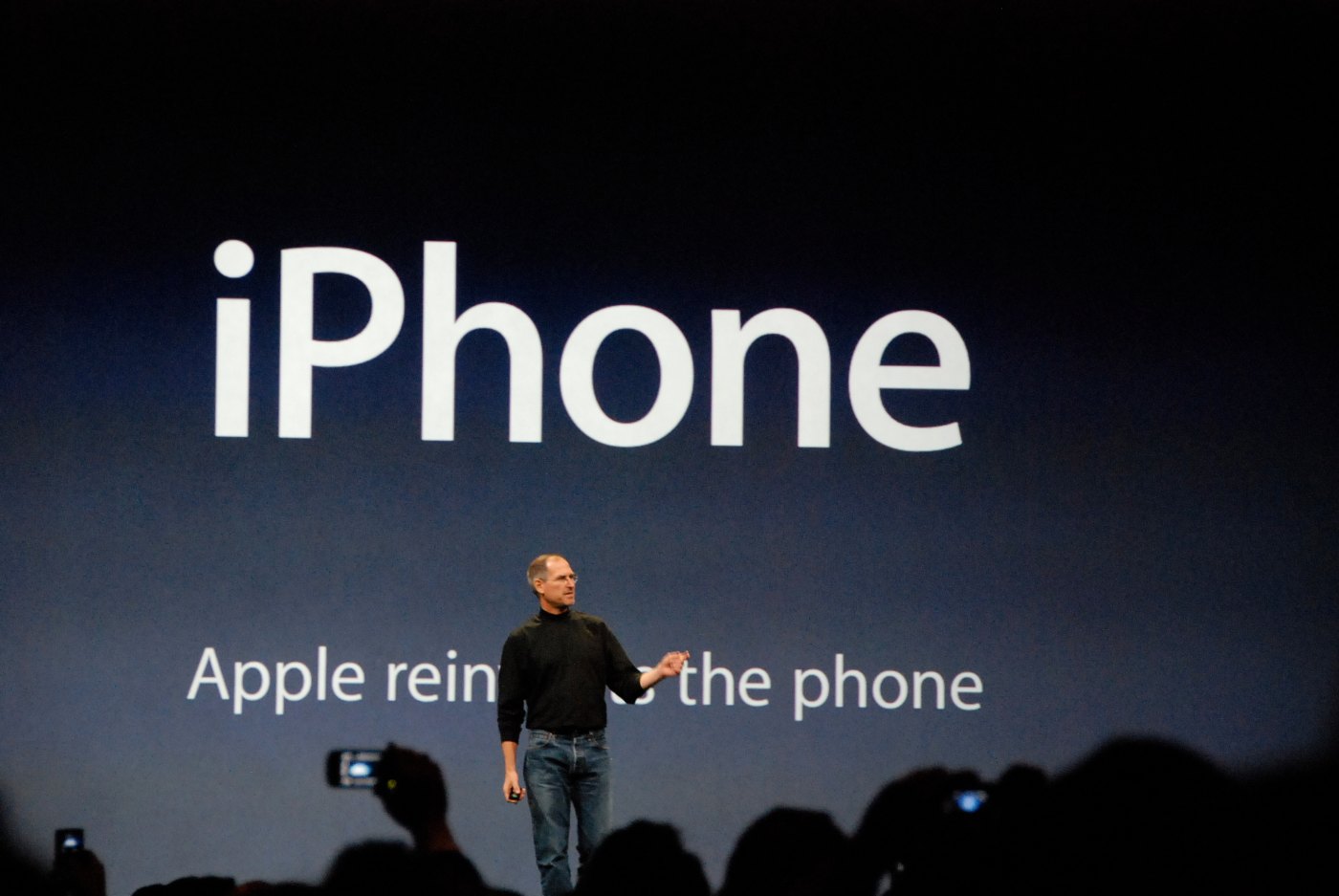
He gave the audience the headline before the details. Jobs said Apple was introducing three revolutionary products: a widescreen iPod with touch controls, a revolutionary mobile phone and a breakthrough internet communications device. He repeated the three names until the room caught on, then delivered the reveal. Communication coach Carmine Gallo quotes the line: “These are not three separate devices. They are one device and we are calling it, iPhone.” Then came the takeaway in a single sentence: “Today Apple is going to reinvent the phone.”
Only after that did the evidence arrive, in the form of live demos.
- One message: the iPhone reinvents the phone. Everything else supported that claim.
- Three parts: iPod, phone, internet device. Gallo argues Jobs divided presentations into threes because people absorb information in chunks.
- Sparse slides: Gallo describes Jobs’s slides as “stunningly visual and minimalistic” and says Jobs was “not afraid of empty space.”
- Rehearsal: Gallo says Jobs often practiced on stage for hours at a stretch in the days before a keynote. Fred Vogelstein’s 2013 New York Times Magazine reporting, summarized by Gizmodo and others, describes five days of rehearsals for this one.
What happened
The phrase Jobs chose became the headline. Apple’s own press release that day was titled “Apple Reinvents the Phone with iPhone,” and it carried the same three-in-one framing. It announced prices of $499 (4GB) and $599 (8GB) and a U.S. launch in June 2007.
The iPhone went on sale June 29, 2007. On September 10, 2007, Apple announced it had sold its one millionth iPhone, 74 days after launch.
- January 9, 2007: iPhone announced at Macworld San Francisco (Apple Newsroom).
- June 29, 2007: U.S. sales begin (Apple Newsroom).
- September 9, 2007: one millionth iPhone sold, 74 days after launch (Apple Newsroom, September 10, 2007).
Why it worked
Jobs did the audience’s thinking for them. He did not show a feature list and hope people would draw a conclusion. He stated the conclusion, gave it a simple structure, and then proved it. Reporters walked out with a sentence they could print.
The slides served the speaker instead of competing with him. Gallo contrasts Jobs’s approach with the roughly 40 words he says sit on an average PowerPoint slide. When a slide holds one image or a few words, the audience listens to the person talking.
The rehearsal made the delivery look easy. That ease was planned.
Where it gets complicated
The product was not ready. According to Vogelstein’s reporting, the prototype often ran out of memory and needed a restart if asked to do more than a few tasks. The team built a “golden path,” a set of tasks done in a specific order that made the phone look like it worked. Jobs had several demo units on stage and switched between them. Engineers set the display to always show five bars of signal. The polish of the presentation covered real flaws, which raises fair questions about how far a presenter should go.
Jobs also built suspense before he gave the answer. That works in a keynote where the audience came to be entertained. In a client meeting, a busy executive may not wait for the reveal. Lead with the answer there.
And slides are not the only option. In his 2017 letter to shareholders, published in April 2018, Jeff Bezos wrote that Amazon does not do PowerPoint presentations and instead uses narratively structured six-page memos. Some decisions need more detail than a minimal slide can hold.
The marketing principle
A strong presentation tells the audience what to think in one sentence, then proves it. Jobs’s headline was the takeaway, not the topic: “Today Apple is going to reinvent the phone,” not “iPhone Features.” Clear structure, sparse slides and serious rehearsal made that one message stick. The lesson for a client pitch is the same, with less theater: put the recommendation first and make every slide earn its place.
Sources
- Apple Reinvents the Phone with iPhone, Apple Newsroom (2007)
- Apple Sells One Millionth iPhone, Apple Newsroom (2007)
- Macworld Expo Keynote Live Update: Introducing the iPhone, Macworld (2007)
- Q&A with Author of ‘The Presentation Secrets of Steve Jobs’, CIO (2009)
- The iPhone’s First Demo Was Buggy as Hell (summarizing Fred Vogelstein, New York Times Magazine), Gizmodo (2013)
- 2017 Letter to Shareholders, About Amazon (2018)
Group activity for this case
Reinvent Your Pitch
Your group will have a one-sentence takeaway for your brand’s recommendation and three supporting ideas, ready to open a presentation. A 20-minute group activity. Dr. Morris gives the password in class.
Back to Presenting Like Pros · All case studies
Brand names, images and trademarks belong to their owners and appear here for educational purposes only.