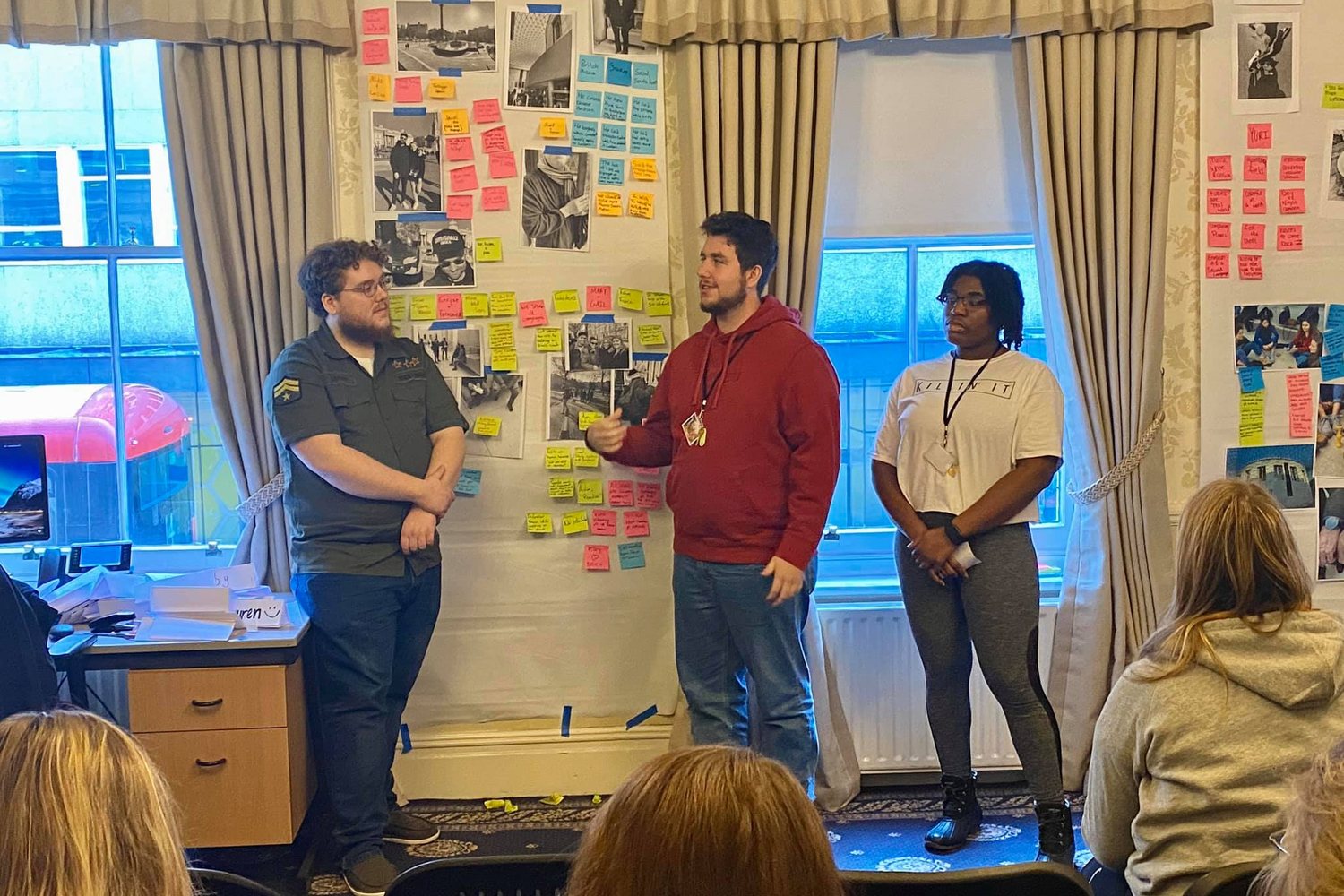
The big idea: Generative research is open-ended, early research that discovers what people need, do and care about before you have a solution, so the solution you build later is aimed at the right problem.
In 60 seconds
- Generative research discovers what people need, do and care about before you have a solution.
- Say, do and make methods reach explicit, observable, and tacit or latent knowledge.
- Generative work comes first in BUAD 317, and prototype feedback is the evaluative part later.
Do this: plan your fieldwork with an open research question, a mix of mainstream, extreme and insider voices, say, do and make methods, and your solution questions parked.
How generative research works
Generative research is the research engine of human-centered design. Before you have a solution, you go to the people who live with a problem, listen to their stories and watch what they do. You come back knowing what they need, how they behave and what drives them. The solution comes later, and it is better because it is aimed at the right problem.
Why a leadership course starts here
Class 1 opens with a working definition of leadership adapted from Ronald Heifetz’s adaptive leadership work: inspiring and mobilizing people to tackle tough challenges and do things that matter. Generative research is how a leader learns what those challenges look like from the inside.
Research makes you a strategist
Gjoko Muratovski (2022) argues that research is what moves design beyond an artistic service. Human-centered designers and leaders act as researchers, social scientists and business strategists. Research builds understanding (empathy) and compassion (empathy in action) for the people you serve.
What a human-centered designer believes
Problems are solvable
Embracing HCD means believing that even messy, stubborn problems can be moved.
People hold the keys
The people who face a problem every day know things no outsider knows. They hold the keys to the answer.
Stay grounded, co-create
If you stay grounded in what you learn from people, you can create new solutions with them, not just for them. Research is what unlocks this.
Three kinds of research
Traditional research explains, predicts or controls something. It manipulates variables, tests a hypothesis with experimental and control groups, and checks for statistical significance. Business consulting usually needs a different mix.
Quantitative
Collects and analyzes numbers to describe, explain, predict or control. Tests hypotheses in controlled ways.
Example: average wait time at a clinic, by day of the week.
Qualitative
Uses narrative, descriptive data to understand how things are and what they mean from the participants’ point of view.
Example: patients’ stories about the last time they waited.
Mixed methods
Combines quantitative and qualitative data collection in a single study.
Example: wait-time data plus interviews that explain the slowest days.
| Question | Traditional research | Generative research |
|---|---|---|
| Who does it? | Professors, scholars and graduate students | Leaders and scholar-practitioners, like your consulting team |
| Where? | Settings where variables can be controlled | The field, where people actually live and work |
| How does it unfold? | A fixed design, planned in advance | An emerging inquiry that follows an unfolding story in the data |
| Main methods | Quantitative, to measure statistical significance | Mostly qualitative, to describe what is happening and why |
| The end point | Report and publish conclusions | A bias toward action: positive change for the people with the challenge |
Generative first, evaluative later
Generative (formative): in process
- When. Early, before you have an idea to test.
- Asks. What do people need, and why do they do what they do?
- Its words. Understanding words: discover, explore, why.
- Methods. Interviews, casual learning conversations, observation, immersion, diary studies, card sorts, secondary research.
- You end with. Needs, insights and a reframed problem worth solving.
Evaluative (summative): in conclusion
- When. After you build something, even a rough prototype.
- Asks. Does our solution meet the needs of the people it is for?
- Its words. Action words: test, measure, compare.
- Methods. Prototype feedback interviews, usability tests, A/B comparisons, rating surveys.
- You end with. Evidence to keep, change or drop a design.
Human-centered design combines both. In BUAD 317, Classes 1 through 10 are mostly generative. Your rapid prototype and its feedback interviews (Classes 11 to 13) are the evaluative part.
Humans, not users
Nikki Anderson-Stanier, founder of User Research Academy and author of the dscout guide on your reading list, describes generative research as understanding people “as humans, not as users.” You are not asking for surface suggestions about a product. You are learning the feelings and triggers behind behavior, so you start from the problem space instead of the solution space. Open-ended conversation gets people to tell stories about their everyday lives, and from those stories you learn their motivations, goals, needs and pain points, inside and outside the thing you might design.
Say, do, make: three routes to what people know
Design researcher Elizabeth Sanders points out that each kind of method reaches a different level of knowledge. The deeper you go, the less people can simply tell you, so the more you need to watch and invite them to make things.
Say: explicit knowledge
What people can put into words when you ask. Interviews, conversations and surveys reach it.
Limit: people tell you what they think, which is not always what they do.
Do: observable knowledge
What people actually do and use. Observation, immersion and diary studies reach it.
Look for: workarounds and gaps between what people say and do.
Make: tacit and latent knowledge
What people know but cannot easily explain (tacit), and needs they have not yet recognized (latent). Card sorts, collages, drawings and co-design sessions reach it.
Why it matters: latent needs are where new ideas come from.
Who does what in co-design
Traditional research treats people as subjects to study. Co-design treats them as partners. Your Class 1 slides name three roles (U, R, D):
User
The expert of their own experience. Nobody knows their day better than they do.
Researcher
The translator and facilitator. Sets up conversations and activities that help people express what they know.
Designer
The expert prototyper. Turns what the team learned into things people can react to.
On a GLS consulting team you play all three roles at different moments, and your client contacts and the people you interview step into the user role.
Where research happens in the design process
| HCD phase | Development stage | What happens |
|---|---|---|
| Inspiration | Predesign | Generative research, problem definition and the highest opportunity for innovation |
| Interpretation | Discovery | Spotting opportunities and translating research into design direction |
| Ideate | Design | Continued exploration, design and development |
| Ideate | Making | Production, building or manufacturing |
| Implement | Marketing, sales or distribution | Rollout and sales |
| Implement | After sales | People use the product or experience the service |
The earlier the stage, the more a research finding can change. That is why BUAD 317 spends most of the semester in Inspiration and Interpretation.
Need the basics again? See What Is Human-Centered Design? from IB 407. This page adds the research side.
Creativity and where generative research came from
Research feeds creativity. Class 1 pairs generative research with a short look at how creative ideas happen, then shows where this kind of research came from. Use these panels when you need the background.
Wallas’s four stages of the creative process (1926)
Preparation
Learn the problem deeply. In BUAD 317, this is your secondary research and interviews.
Incubation
Step away and let the mind work on it below the surface.
Illumination
The “aha” moment, when an insight or idea arrives.
Verification
Test whether the idea holds up. In HCD, that is prototyping and feedback.
Notice that the creative process starts with preparation. Teams that skip generative research ask incubation and illumination to work with nothing in the tank.
What is creativity?Amabile’s definition, levels of creativity and Noller’s formula
Teresa Amabile (Harvard Business School) defines creativity as producing ideas that are both novel and appropriate: new, and useful for the problem at hand. Her work names three ingredients in a person: expertise, creative-thinking skills and intrinsic motivation (doing the work because it matters to you). A new idea that does not fit the need is not creative in this sense. Generative research is how you learn what “appropriate” means for the people you serve.
Levels of creativity. The Class 1 slides show creativity at four levels, from the everyday creativity of a person learning something new up to work that changes a whole field. A well-known version is Kaufman and Beghetto’s “Four C” model: mini-c (personal insight while learning), little-c (everyday problem solving), Pro-c (professional expertise) and Big-C (field-changing work). Most consulting creativity lives at little-c and Pro-c, and that is plenty.
Ruth Noller’s creative formula is often written as C = fa(K, I, E): creativity is a function of knowledge, imagination and evaluation, all shaped by your attitude. Research supplies the knowledge. Your team supplies the imagination. Feedback interviews supply the evaluation. A closed attitude shuts all three down.
Where it came from: Lewin, Susman and the research cycleBackground only. Supplemental, not required
Generative research grows out of a family of applied research that studies real problems in real settings with the people who live with them. Psychologist Kurt Lewin coined the term action research and described it as cycles of planning, acting and fact-finding that help ordinary people work through problems together. Later models drew the same idea as a loop:
- Susman’s model (Susman and Evered, 1978) runs five phases: diagnosing the problem, planning action, taking action, evaluating the results and specifying what was learned. Then the cycle starts again.
- Cal Swann (2002) showed that the design process follows the same pattern: identify and analyze the problem, design and synthesize possible solutions, test a design, produce it, then implement, evaluate and revise.
- Stringer (2004) drew it as a spiral of look, think and act that repeats as you learn more.
Your syllabus labels sometimes say “generative action research” (GAR). In this course it means the same thing as generative research: discovering needs in repeated passes before you commit to a solution. If you want the full tradition, the optional supplemental books are Coghlan and Shani, Conducting Action Research for Business and Management Students, and Mills, Action Research: A Guide for the Teacher Researcher.
Co-creation and stories as dataCo-creation as mindset, method or tool, and participative narrative inquiry
Co-creation can be three things. As a mindset, it is the belief that the people you serve are partners. As a method, it is a planned session where people design with you. As a tool, it is a specific kit, such as a card sort or a collage, that helps people express what they know. Sanders and Stappers describe this shift from designing for people to designing with them.
Generative research is narrative research. Narrative research relies on people’s spoken, written or visual accounts of their own experiences. People make meaning of their lives by telling stories, so stories are the data. You listen for the experience story and the epiphany, the moment something changed for the person.
Participative narrative inquiry goes one step further: the people who share stories also help make sense of them, for example by sorting their own stories into themes or reacting to patterns your team found. It keeps interpretation honest because the storytellers can say “that is not what I meant.”
Try it: Generative Research Planner
Tool · BUAD 317
Generative Research Planner
Sort generative from evaluative research, then plan who you will learn from and how you will reach what they say, do and make.
- 1Sort
- 2Plan
- 3Share
Research question
All checks
Put it to work: plan and run your BUAD 317 fieldwork
Most of BUAD 317 is generative research. Secondary research and street interviews come first, then interpretation. Only after that do you build and test a rapid prototype, which is the evaluative part. Here is how each step lines up with your five deliverables, in class order.
Show up ready to think out loud
From Class 1 on, bring the readings into the room: Field Guide pages 9 to 26 and the dscout guide for Class 1. Say what surprised you and push on each other’s ideas.
Your deliverable: Deliverable #1, class engagement, earned every week you are prepared, on time and engaged.
Plan who you will learn from and how
Write one open research question about a need, not your idea. List mainstream people, extremes and at least one insider. Pick say, do and make methods, and park your solution questions. Build it in the planner above.
Your deliverable: the research plan your interview team uses. Interview teams are formed by the end of Class 3.
Start from what is already known, with AI as a partner
Run secondary research with AI, check every source yourself, and turn the gaps into interview questions. Make sure each question is open, neutral and about the person’s own life.
Your deliverable: Deliverable #2, your own set of AI-generated interview questions, brought to Class 4 to discuss. See Framing the Challenge and Secondary Research with AI.
Get your feet on the street
Gather ten or more solid interviews over several weeks, not one afternoon. Mix casual learning conversations with observation, and include extremes as well as typical people. Ask for stories about the last time something happened. Capture exact quotes and photos, with permission.
Your deliverable: Deliverable #3, Part A: 10+ interviews downloaded onto sticky notes with photos, ready to share at the start of Class 8. It is judged on empathy (how deep and surprising your insights are) and interpretation (needs stated as verbs, a reframed challenge).
Interpret before you ideate
Look for patterns, surprises and contradictions. Write needs as verbs, reframe the challenge around a real person, then brainstorm from a How Might We question.
Your deliverable: Deliverable #3, Part B, your brainstorm in Class 9, where your final prototype teams also form.
Switch to evaluative research
Build a rapid prototype, then take it to 7 to 10 people who would use it or be affected by it. Ask for honest, even negative, feedback. Keep listening generatively too: new needs often show up during testing.
Your deliverable: Deliverable #3, Part C (rapid prototype, Class 11) and Part D (feedback interviews with 7 to 10 people, Class 12).
Tell the research story
Show how you got from people’s needs to your idea: who you learned from, the methods you used, what surprised you and how testing changed the prototype. Then say what evidence you still need and how you will get it.
Your deliverable: Deliverable #4, your 15 to 20 minute Capstone presentation in Class 14, followed by Deliverable #5, your confidential team evaluation.
Example: a bus route riders avoidA made-up project, from generative to evaluative
This project is invented to show the flow. It is not a real client.
Research question. Why do people who live near one city bus route choose to drive or walk instead, and what would make the trip work for them?
Who. Regular riders (mainstream), people who stopped riding and a rider who uses a wheelchair (extremes), and two drivers plus a route planner (insiders).
Methods. Public ridership reports first (read). Then intercept conversations at three stops (say), riding the route at rush hour (do) and a card sort where riders ranked what matters most on a trip (make).
What they found. Riders did not mainly complain about speed. They talked about not knowing whether the bus had already passed. Several had a workaround: texting a neighbor who could see the stop. Need, stated as a verb: riders need to know, before leaving home, when the bus will really arrive.
Then evaluative. The team prototyped a paper “next bus” sign updated by a driver’s radio call and tested it with eight riders. Feedback changed the design twice.
What your senior technical report will ask forStart collecting it now
The BUAD 497 technical report has a section on your generative research approach. Keep a simple research log this semester so you can fill it in later. It asks for:
- An overview of your project plan and the methods you used (qualitative and quantitative)
- Your stakeholder engagement plan and how you recruited people
- A persona or user profile, and the extremes and mainstreams you included
- The secondary research and analogous inspiration you consulted
- What you learned from individuals, groups and subject matter experts
- Your conversation starters and questions, photographs and notes, and an empathy map
See the HCD Technical Report topic for the full outline.
Do this, not thatHabits that keep generative research open
Do this
- Start from a question about people’s needs.
- Talk to extremes and mainstream people, plus an insider.
- Use say, do and make methods, not interviews alone.
- Ask for specific stories: “the last time you…”
- Write needs as verbs, without a solution inside.
- Read what is already known before the field.
Not that
- Picking the solution in week one, then “researching” to prove it.
- Interviewing only roommates and classmates.
- Asking “Would you use our app?” in a discovery interview.
- Collecting opinions about the future instead of stories about the past.
- Writing needs as nouns, like “a shuttle” or “an app.”
- Running a rating survey before you know what matters to people.
Before you submitA quick check for your research plan and interviews
- [ ] Our research question is open and about a need, not a solution we already picked.
- [ ] Our interview questions are different from our research question and ask for stories.
- [ ] We included mainstream people, extremes and at least one insider or expert.
- [ ] We planned at least one say, one do and one make method, plus secondary research.
- [ ] We parked solution questions for prototype feedback later.
- [ ] We captured exact quotes and photos, with permission, and kept participants’ identities private.
- [ ] Our needs are written as verbs, and we can point to the evidence behind each one.
Go deeper
Class 1 readings
Related topics
Back to all BUAD 317 topics · Next: Framing the Challenge and Secondary Research with AI
In-class team activity · 25 min
Needs Before Ideas
By the end: One generative research plan for your team's challenge: an open research question, a mix of mainstream, extreme and insider voices, a say, do and make method mix, and interview starters tested on real people in the room. Your instructor will give you the password in class.
Part of BUAD 317, taught by Lane Morris, PhD and Jules Morris, PhD, in the Smith GLS human-centered leadership program, toward the Human Centered Consulting Certificate.
Frequently asked questions
What is generative research?
Generative research is open-ended, early research that discovers what people need, how they behave and what motivates them before you have a solution. You interview people, observe them in their own settings, invite them to make things and read what is already known. It is also called discovery or exploratory research. The goal is to find the right problem, so the solution you build later fits real needs.
What is the difference between generative and evaluative research?
Generative (formative) research happens early, before you have a solution, and asks what people need and why they act as they do. Evaluative (summative) research happens after you build something and asks whether that solution works. Generative research uses interviews, observation and card sorts. Evaluative research uses prototype feedback, usability tests and comparisons. Human-centered design uses both, generative first.
What do say, do and make mean in design research?
Design researcher Elizabeth Sanders sorts methods by what they reach. Say methods, like interviews, reach explicit knowledge people can put into words. Do methods, like observation, reach observable knowledge about what people actually do. Make methods, like card sorts, collages and co-design sessions, reach tacit and latent knowledge: what people know or need but cannot easily say. Strong plans use all three.
How is generative research different from traditional research?
Traditional research is usually run by scholars in controlled settings. It manipulates variables, tests a hypothesis and measures statistical significance, then publishes conclusions. Generative research is run by leaders and practitioners in the field. It follows an unfolding story in the data, uses mostly qualitative methods to describe what is happening and why, and has a bias toward action for the people with the challenge.
Why does human-centered design say humans, not users?
Calling people users ties them to your product. Generative research tries to understand them as whole humans: their identity, everyday life, goals, needs and pain points, inside and outside the thing you might design. Researcher Nikki Anderson-Stanier describes this as working from the problem space instead of the solution space. It helps you find needs that a product-focused question would miss.